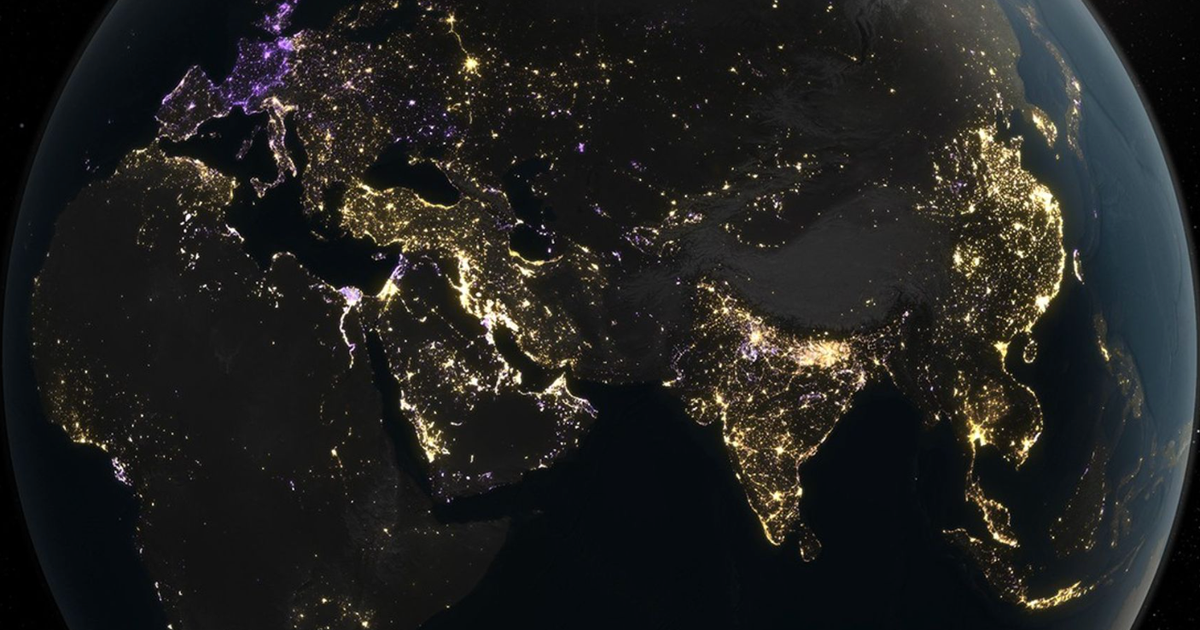
SouthernWorldwide.com – New maps released by NASA, utilizing nearly a decade of collected data, illustrate the evolving patterns of artificial light across Earth during nighttime hours.
The creation of these maps involved NASA researchers meticulously analyzing data gathered by their “Black Marble” program. This program employs a specialized sensor designed to capture low-light imagery of our planet from space at night.
Data for this comprehensive study was acquired by three distinct satellites over an eight-year period, spanning from 2014 to 2022. This extensive timeframe allowed for a detailed observation of changes.
Scientists initially anticipated observing a steady increase in artificial light emissions globally over the years. However, NASA’s findings, as detailed in a recent news release, revealed “much more nuanced patterns” in light radiance than previously expected.
“The analysis portrays a world flickering with industrial booms and busts, construction, and blackouts, as well as more gradual shifts, such as policy-driven retrofits,” NASA stated, highlighting the complex dynamics captured by the data.
The research indicated that each specific location observed by the sensors experienced several notable shifts throughout the nine years of data collection. During this period, the overall radiance of artificial light increased by 34%, while a dimming effect counteracted this by 18%.
Both the intensification and reduction of light “markedly intensified over the past decade,” according to the researchers’ findings published in the esteemed academic journal Nature. This suggests a period of significant change in human activity at night.
“This evidence of increasing volatility in human night-time activity provides an important dynamic dimension for understanding urban evolution, energy transitions, policy impacts and ecological consequences of rapidly changing illuminated nights,” the researchers elaborated in their study.
Within the United States, cities along the West Coast experienced a general brightening, which the researchers linked to population growth. Conversely, the East Coast exhibited more instances of dimming.
This dimming on the East Coast was attributed by the researchers to the widespread adoption of more energy-efficient lightbulbs and broader economic restructuring occurring in the region.
On a global scale, nights became noticeably brighter in China and northern India, correlating with significant urban development and expansion in these areas.
Across Europe, a consistent pattern of dimming was observed, largely attributed to energy conservation measures implemented in various countries.
A particularly sharp drop in nighttime light was recorded in 2022. This was a direct consequence of the energy crisis that emerged in the region following the outbreak of the war in Ukraine.
“This global, high-resolution analysis… refines and expands our understanding of how humanity is altering the night environment,” the researchers stated in their published paper.
Read more : Rob Stone on Gio Reyna's World Cup Selection: 'I'm Okay If He Isn't Included
“Our findings show that the human light footprint is not a universally expanding entity but a dynamic system, characterized by the pervasive coexistence of brightening and dimming,” they concluded, emphasizing the complex and multifaceted nature of global nighttime illumination.