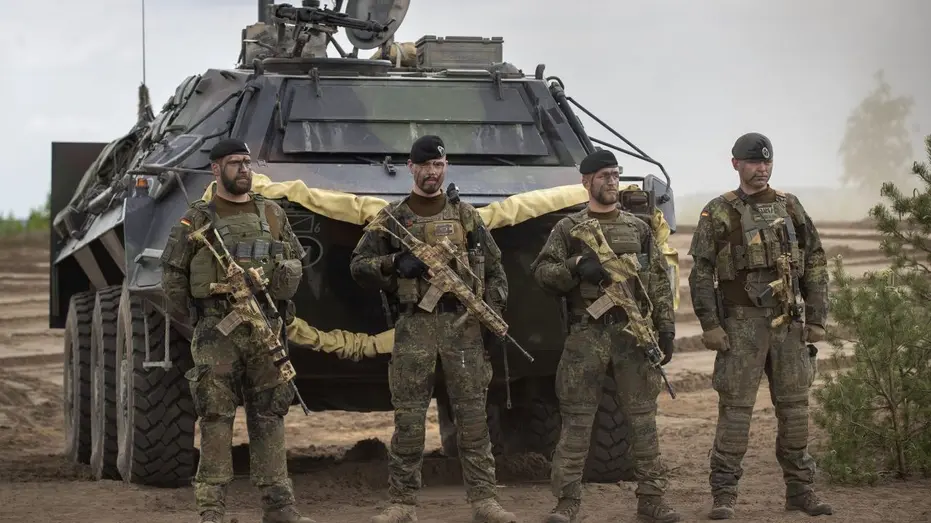
SouthernWorldwide.com – As President Donald Trump continues to urge NATO allies to increase their contributions to European defense, nations situated closest to Russia are accelerating their rearmament efforts. Meanwhile, some of Western Europe’s largest economies are facing mounting pressure to enhance their own defense capabilities.
Retired Rear Adm. Mark Montgomery, a senior director at the Foundation for Defense of Democracies and former deputy director for strategy, policy, and plans at U.S. European Command, observed that this shift is already evident across the alliance.
“If you ask me who’s doing the most, the Eastern Europeans are clearly,” Montgomery stated.
Montgomery highlighted the Baltic states, Poland, Romania, and Bulgaria as countries actively working to bolster their deterrence against Russia.
His assessment comes as NATO allies are striving to meet a new defense spending benchmark agreed upon at the 2025 summit in The Hague. This benchmark mandates members to invest 5% of their GDP in defense and security-related expenditures by 2035, with 3.5% allocated to core defense requirements and 1.5% for defense-related infrastructure and security investments.
John Deni, a research professor at the U.S. Army War College, commented that this trend is not surprising.
Deni noted that many eastern allies are swiftly acquiring readily available equipment on the market, rather than waiting years for domestic defense programs to reach maturity.
This transformation is apparent across NATO’s eastern and northern flanks. Poland has emerged as one of the alliance’s most significant military spenders, Romania is increasing its defense investments, and Finland and Sweden have significantly bolstered NATO’s advanced military capabilities following their accession.
Secretary of State Marco Rubio lauded Finland and Sweden on Thursday during a Senate Foreign Relations Committee hearing, citing them as examples of allies strengthening the alliance.
“Sweden and Finland have actually contributed because they brought their own defense industry, their own advanced technology,” Rubio remarked. “They have been great partners.”
“We do agree with President Trump on the need to increase budgets,” stated Ţoiu.
Ţoiu mentioned that Romania increased its defense spending to 2% of GDP during Trump’s previous term and plans to allocate “an average of 3.4 percent” in the upcoming year through military procurement and strategic infrastructure investments.
“We have launched initiatives that are directed at the eastern flank because it is increasingly more clear that that needs to be protected,” she explained.
She argued that Romania’s role extends beyond national defense.
“We need better deterrence, better defense capabilities there in order to ensure our responsibility in protecting not just the Romanian border, which is the longest border to the war, but also it is in the same time a European border and the border of the Allied territory,” Ţoiu asserted.
For frontline states, the urgency is driven as much by geography as by politics. Romania shares a border with Ukraine and has repeatedly experienced Russian drones entering its airspace. Poland has become one of NATO’s top military spenders, while the Baltic states are rapidly approaching defense expenditures of 5% of GDP.
Montgomery emphasized that the urgency felt on the eastern flank stands in stark contrast to the pace observed in much of Western Europe.
Among the continent’s five largest economies, and despite a slight decrease in military spending in 2025, the U.K. remains the largest investor relative to GDP at 2.4%. It is followed by Germany (2.3%), Spain (2.1%), France (2%), and Italy (1.9%), according to data from the Stockholm International Peace Research Institute (SIPRI).
“The Germans are the one country, I think, with a large economy that is starting to make the right kind of investments.”
Montgomery suggested that Germany could become the backbone of Europe’s future defense industrial base.
“Germany developing a large, impressive defense industrial base is good for NATO, it’s good for Western security, and it’s even good for our primes,” Montgomery stated.
German Chancellor Friedrich Merz has embraced increased defense spending and supported NATO’s new spending goals, positioning Berlin as a potential hub for Europe’s future defense industrial base as allies seek to reduce their long-term dependence on the United States.
However, despite rising defense budgets, experts caution that Europe remains heavily reliant on American military capabilities.
Barak Seener, a senior fellow at the Henry Jackson Society, indicated that Europe continues to depend on the United States for many of the systems necessary to engage in modern warfare.
“Europe is heavily dependent on NATO for its strategic airlift and sea lift, its air-to-air refueling, its cyber capabilities, its space assets, its intelligence, surveillance and reconnaissance,” Seener explained.
He warned that without these capabilities, European forces would struggle to maintain situational awareness during a major conflict.
Montgomery outlined three primary challenges facing Europe: expanding military capacity, rebuilding its defense industrial base, and developing high-end support capabilities that have long been provided by the United States.
“When you are freeloading for 30 years, you create enormous deficits in terms of people, equipment, technology and know-how,” he commented.
“The primary forces to defend Europe should be European,” he asserted. “The United States should provide additional forces that allow maneuver and offensive operations.”
Montgomery also expressed criticism regarding reported Pentagon discussions about delaying long-range strike deployments to Germany and reconsidering future Tomahawk missile sales, arguing that these systems are crucial for deterring Russia.
“The goal here is not to fight Russia in the Baltics or in Poland. The idea here is we want to deter Russia from even trying to attack.”
Looking ahead, Montgomery remains optimistic about NATO’s future.
Montgomery predicted that Europe will continue to increase defense spending and expand its defense industrial base, while the alliance benefits from more stable transatlantic relations.
“I think you’ll have a U.S. president that probably doesn’t provoke the Europeans as much. You’ll have Europe that’s investing more,” he suggested.
He also predicted that NATO Secretary-General Mark Rutte would be remembered for his role in holding the alliance together during a period of significant change.
“I think five years from now, NATO will be stronger,” he concluded. “And I hope we have Ukraine in there.”