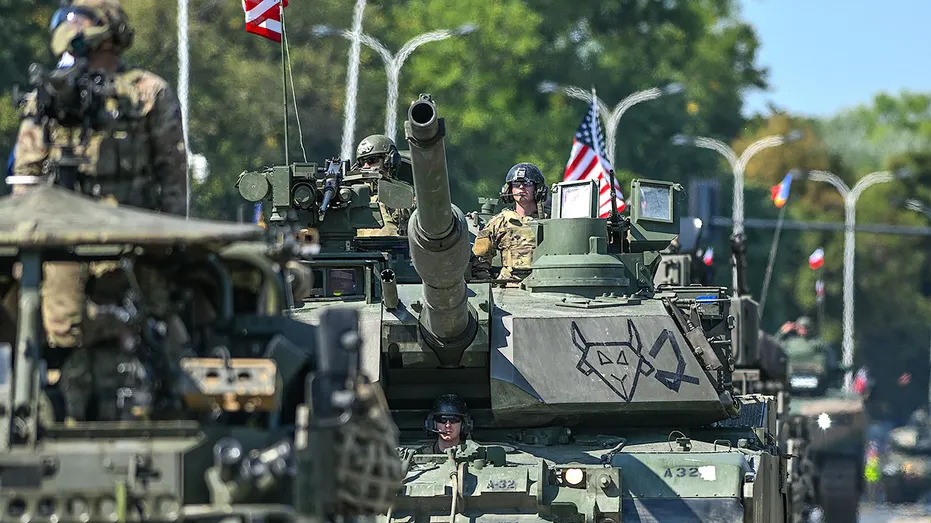
SouthernWorldwide.com – NATO, by its traditional metrics, appears to have undergone a significant transformation. Following years of pressure from President Donald Trump and growing alarm over Russia’s war in Ukraine, NATO allies are now investing more in defense than at any point since the Cold War. The alliance has agreed to move towards a new framework, aiming for defense spending to approach 5% of GDP by 2035.
For years, Trump consistently accused NATO allies of over-relying on U.S. military protection while inadequately investing in their own defense. His repeated threats to reconsider U.S. commitments to allies failing to meet spending targets elevated what was once an obscure alliance benchmark into a central political metric for NATO.
TRUMP PRAISED FOR GETTING NATO ALLIES TO BOLSTER DEFENSE SPENDING: ‘REALLY STAGGERING’
Countries geographically closest to Russia were among the quickest to respond. Poland now dedicates a larger portion of its economy to defense than any other NATO member. Estonia, Latvia, and Lithuania have all significantly increased their military budgets since 2022.
Germany, long seen as a symbol of Europe’s post-Cold War military decline, has initiated a substantial rearmament effort. This includes the creation of a 100-billion-euro special fund specifically for rebuilding the Bundeswehr, Germany’s armed forces.
On paper, these figures represent a historic turnaround. According to NATO’s latest annual report, European allies and Canada collectively increased defense spending by 20% in 2025 compared to the previous year. The alliance also notes that European members and Canada have added hundreds of billions of dollars in defense spending since 2014.
UK, GERMAN DEFENSE OFFICIALS DEFEND MILITARY BUILDUP UNDER RUSSIAN THREATS
Across Europe, governments are actively purchasing tanks, air defense systems, fighter jets, and artillery. They are also racing to replenish stockpiles that were depleted by the ongoing war in Ukraine.
However, this surge in spending also brings to light certain limitations. As Townsend noted, “You have to start off with spending more, and you’re not going to see the capability results for a while.”
EXAMINING NATO: INSIDE THE ‘COMMITMENT GAP’ AS US CARRIES ALLIANCE DETERRENCE
The conflict in Ukraine demonstrated how rapidly a major war can deplete ammunition stockpiles, strain production lines, and overwhelm peacetime defense industries. A defense budget can signify political commitment, but it does not necessarily indicate the number of deployable brigades, the quantity of ammunition on hand, the speed of weapon production, or a country’s capacity to sustain combat operations once a war begins.
This is the challenge that NATO is now confronting. For many years, the alliance primarily measured burden-sharing through the 2% of GDP benchmark. This metric was straightforward, public, and easily comparable. Countries that met it could claim they were fulfilling their obligations, while those that fell short often faced criticism from the United States.
However, the events in Ukraine have underscored that a higher defense budget is merely the initial step. A nation can meet the spending benchmark yet still lack sufficient deployable forces. Another might announce significant weapons purchases that will not be delivered for several years. A third could invest heavily in personnel, pensions, or infrastructure without a corresponding immediate increase in battlefield power.
Read more : South Korean Starbucks Head Apologizes for Massacre-Evoking Ad
Even NATO leaders are increasingly acknowledging this distinction. NATO Secretary-General Mark Rutte stated earlier in 2026 that the focus must be on “smarter investment in the right capabilities,” not just increased spending. Rutte has also cautioned that rising defense budgets must be accompanied by expanded production capacity as the alliance strives to replenish its stockpiles and prepare for a prolonged period of competition with Russia.
Townsend explained that both Europe’s and America’s defense industries have contracted after decades of reduced military spending following the Cold War. “The defense industrial capability in Europe and the United States has atrophied,” he said. “They lost the scale to be able to surge a lot more production.”
He further elaborated that governments are now encountering the reality that factories cannot instantly produce the volume of weapons NATO requires. “While the money is there and the orders are coming in, the producers are struggling to meet the requirements,” Townsend observed.
The war in Ukraine highlighted how quickly modern industrial warfare can overwhelm systems designed for peacetime production. European governments that announced major procurement plans after 2022 have frequently faced lengthy delivery timelines, strained supply chains, and shortages in critical sectors, ranging from artillery ammunition to air defense interceptors.
A recent analysis by McKinsey warned that “structural constraints could slow the path from spending to military capabilities,” citing fragmented procurement systems, industrial bottlenecks, and extended production timelines across Europe’s defense sector.
These delays have also underscored Europe’s continued reliance on American military technology and production capacity. Townsend stated, “Europe right now is dependent on the United States and U.S. industry to provide a lot of the capabilities they know they need.”
NATO CHIEF WARNS EUROPE CAN’T DEFEND ITSELF WITHOUT US AS TENSIONS RISE OVER GREENLAND
Among the most challenging capabilities for Europe to rebuild quickly, he identified air defense systems, long-range strike weapons, logistics networks, intelligence capabilities, and substantial ammunition stockpiles. “Air defense is what they need and they need long-range fires,” Townsend emphasized, pointing to systems like Patriot missiles and High Mobility Artillery Rocket System launchers, which European governments are urgently trying to acquire.
However, as demand for these systems surged following Russia’s invasion of Ukraine, production timelines have extended considerably. This has already prompted some NATO countries to seek alternative suppliers. Poland, for instance, turned to South Korea for significant weapons purchases, as governments searched for providers with faster delivery times.
Concurrently, European governments are working to expand their domestic production capacity to reduce dependence on U.S. suppliers. Germany has increased its ammunition production, and some civilian industrial firms have begun reallocating portions of their operations towards defense manufacturing.
Despite these efforts, Townsend believes that rebuilding Europe’s military capacity will take years. The more pressing question, he suggested, is whether NATO can bridge the capability gap swiftly enough. “Will the Russians take advantage of this gap?” Townsend posited.