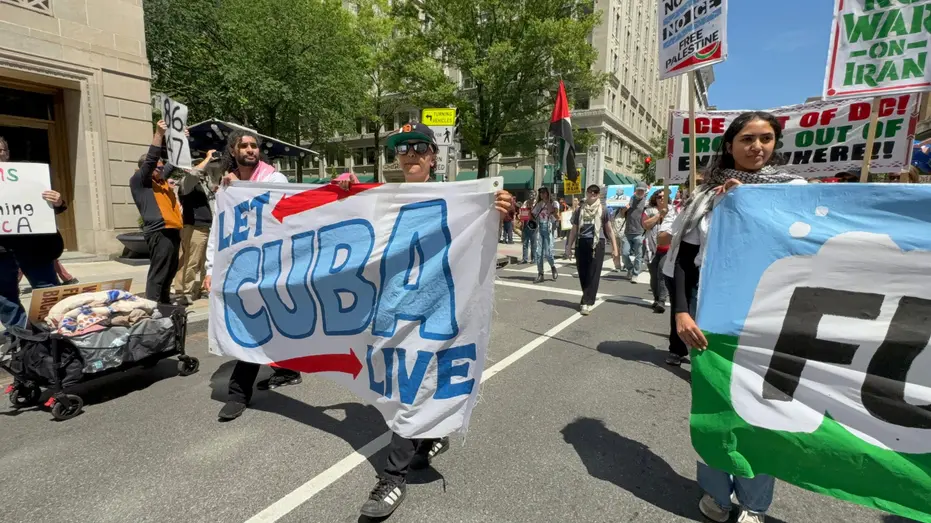
SouthernWorldwide.com – This article delves into the intricate network of alleged foreign influence campaigns orchestrated by the Communist Party of Cuba within the United States. It traces this influence from the Venceremos Brigade in the 1960s to recent gatherings in union halls, highlighting how American citizens are allegedly utilized to bolster the Cuban communist regime.
The U.S. operation is described as part of a global, transnational pro-Cuba network. One individual, Hasan Piker, was brought to Cuba in March as part of the Nuestra América Convoy, also known as the “Our America” Convoy. Piker reportedly stated on a podcast that he was contacted by an individual from the Cuban embassy who promised him consistent internet access in exchange for his trip to Cuba.
On the evening of May 9, the Machinists Hall became the venue for a gathering of pro-communism activists. The hall was adorned with imagery of communist leader Che Guevara, copies of Karl Marx’s “Communist Manifesto,” and “The Militant” newspaper. Approximately 50 individuals filled the room for what was described as a strategy session.
A banner at the front of the room declared Cuba’s foreign policy and national security priorities: “U.S. HANDS OFF CUBA! Remove Cuba from state sponsors terrorism list! END THE BLOCKADE, TRADE, TRAVEL BANS & SANCTIONS!” The event was sponsored by the U.S. Hands Off Cuba Committee, an alliance of 23 organizations, including CodePink. Notably, Medea Benjamin, a co-founder of CodePink, had reportedly also received a subpoena from the Treasury Department regarding her March trip to Cuba.
A spokesperson for the Embassy of Cuba in Washington, D.C., denied any wrongdoing. The embassy stated that Cuban diplomats strictly adhere to the Vienna Convention on Diplomatic Relations and that their diplomatic work in the United States is aligned with its principles. The Vienna Convention requires diplomats to respect the laws of the receiving state and refrain from interfering in its internal affairs.
The network in question is reportedly led by several organizations, including the People’s Forum, CodePink, BreakThrough News, Tricontinental Ltd., ANSWER Coalition, Party for Socialism and Liberation, and the Inter Religious Foundation For Community Organization Inc. These groups are allegedly funded and supported by Neville Roy Singham, an American expatriate tech tycoon residing in Shanghai, who is said to support the Chinese Communist Party and its alliance with the Communist Party of Cuba.
Investigators are examining how Cuban officials, including Ramírez Álvarez, build relationships between U.S.-based activists and the Cuban Institute of Friendship with the Peoples (ICAP). Founded by Fidel Castro in 1960, ICAP was established to manage foreign delegations and solidarity campaigns following the communist revolution in 1959. Fernando González Llort, one of the “Cuban Five” former intelligence officers, currently leads ICAP. U.S. officials have identified ICAP as a potential proxy for Cuban intelligence services, though the organization denies wrongdoing and identifies itself as a civil society organization.
Representatives from various groups, including CodePink, Service Employees International Union, United Union of Roofers, Waterproofers and Allied Workers Local 36, International Association of Machinists Local 1484, Jewish Voice for Peace, National Lawyers Guild, Venceremos Brigade, and Democratic Socialists of America, were present at the meeting. The Cuban Embassy spokesperson highlighted that engaging with civil society organizations is a standard diplomatic practice aimed at promoting friendly relations, as outlined in the Vienna Convention.
The federal investigation into Cuba-linked activist and nonprofit networks is reportedly mirroring the framework established by National Security Presidential Memorandum 7 (NSPM-7). Issued by President Donald Trump in September 2025, NSPM-7 called for a comprehensive strategy to investigate and disrupt entities and individuals engaged in political violence and intimidation. It directed authorities to examine organized structures, networks, entities, funding sources, and predicate actions behind such activities.
NSPM-7 also instructed the Treasury Department to identify and disrupt financial networks funding domestic terrorism and political violence, deploy investigative tools, examine financial flows, and trace illicit funding streams. The IRS was directed to ensure that tax-exempt entities do not finance political violence or domestic terrorism. These directives align with the current probe into Cuba-related activities, involving the Justice, Treasury, and State departments, which are scrutinizing activist organizations, nonprofit funding, foreign coordination, travel logistics, communications, and potential sanctions violations related to Cuba’s communist regime.
Investigators are examining whether these organizations and influencers function as part of broader ideological or financial networks connected to foreign state interests, consistent with the objectives of NSPM-7. Ramírez Álvarez, the senior Cuban Embassy official, greeted attendees by name, expressing happiness to see “friends” who have supported Cuba over the years. His image was broadcast into the room via a large screen.
During the hour-long briefing, Ramírez Álvarez provided activists with an update on congressional legislation, lobbying strategies, political allies in Washington, and nationwide organizing efforts aimed at pressuring lawmakers to lift sanctions and alter U.S. policy toward Cuba. Investigators are assessing whether the recurring coordination between Ramírez Álvarez and activist organizations constitutes political activity directed by a foreign government, crossing the line from constitutionally protected advocacy.
When asked about specific demands for legislators, Ramírez Álvarez detailed current congressional actions. He highlighted the “United States-Cuba Trade Act of 2025” (S. 136) introduced by Senator Ron Wyden, which seeks to repeal significant portions of the U.S. embargo. He also mentioned the House companion bill (H.R. 7521) by Representative James McGovern, and Representative Nydia Velázquez’s “New Good Neighbor Act” (H.R. 1056), which calls for annulling the Monroe Doctrine. Ramírez Álvarez also referenced a War Powers resolution introduced by Senator Tim Kaine, opposing potential military escalation involving Cuba.
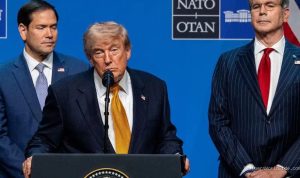
Read more : Trump Pushed NATO to Spend More: Can Europe Fight?
Ramírez Álvarez escalated his rhetoric by describing the U.S. embargo as an “act of war,” “collective punishment,” and a “genocidal action.” Speakers at the event repeatedly discussed expanding organizing efforts, building activist infrastructure, increasing labor coordination, and broadening outreach campaigns across the U.S. on behalf of the Communist Party of Cuba.
Mark Friedman, a representative from the International Association of Machinists and a leader in the Los Angeles Hands Off Cuba Committee, emphasized the importance of U.S. delegations traveling to Cuba and stated that the current objective is to “defend Cuba in whatever way we can.” The Cuban Embassy spokesperson reiterated that engaging with pro-Cuba groups is within the established functions of diplomatic work and does not involve encouraging any action against the U.S. constitutional order.
The current activations are part of a long-standing historical relationship between far-left groups and the Cuban government, including its intelligence apparatus. For over six decades, since Fidel Castro’s communist takeover, the Cuban government has cultivated an American solidarity infrastructure that has evolved from Cold War-era movements into a modern network of nonprofits, labor groups, and activist collectives. Intelligence reports and defectors have alleged that Cuba’s intelligence apparatus cultivated relationships with American radicals through ICAP, and investigators suggest that many of these pathways remain active today through various forms of exchange and outreach.
The roots of this network can be traced back to the late 1960s with the formation of the Venceremos Brigade by members of Students for a Democratic Society (SDS). The Venceremos Brigade, organized with the Cuban government, brought American activists to Cuba for political solidarity and labor work. Factions of the SDS later splintered into groups like the Weather Underground.
Ramírez Álvarez has been a central figure in recent organizing efforts, appearing at events with labor unions, Democratic Socialists of America, Green Party activists, National Lawyers Guild chapters, church groups, anti-war coalitions, and various activist nonprofits. Public records place him at events across the U.S. where he has advocated for lifting the embargo, removing Cuba from the State Sponsors of Terrorism list, and expanding solidarity campaigns.
At a meeting in Wilmington, local organizer Destiny Rivera-Gome urged attendees to engage organizers within schools, churches, unions, and community organizations. She stated that Cuban President Miguel Díaz-Canel has emphasized the need for permanent, massive campaigns and a network to counter anti-Cuban propaganda. Federal investigators are examining whether these activities constitute coordinated foreign political activity requiring registration under the Foreign Agents Registration Act.
Organizations involved in the Cuba solidarity movement publicly describe their work as activism opposing sanctions and supporting humanitarian engagement, denying they are acting as foreign agents. However, investigators are examining the extent of coordination between activists and Cuban diplomatic officials. The Venceremos Brigade is currently a fiscally sponsored project of the People’s Forum, a nonprofit funded by Singham. The People’s Forum and its affiliates have supported campaigns for communist Cuba, Venezuela, Palestine activism, and anti-police organizing.
Donation pages tied to Cuba aid efforts raise further questions for investigators, as they sometimes instruct donors to conceal the destination of funds. For example, a People’s Forum fundraising page for solar panel donations for Cuba advised donors to write “Urgent Aid” instead of “Cuba” in donation comments or check memos. The People’s Forum also sponsors the Hatuey Project. Several organizations at the Wilmington event openly discussed material support campaigns for Cuba’s energy and medical sectors.
Rachel, an organizer affiliated with CodePink, proposed agricultural delegations and aid campaigns to support Cuban food production. The Wilmington gathering was described as one node in a broader network. Anna Capati, a leader from the National Lawyers Guild, discussed revitalizing a Cuba subcommittee within the organization and coordinating resolutions opposing U.S. sanctions. The ideological messaging at the event extended beyond Cuba, with one activist group, Anti-Racist Action, describing itself as having over 35 years of experience in antifa activism.
Speakers praised the Soviet Union’s communism, denounced capitalism, defended the Palestinian cause, condemned U.S. imperialism, and advocated for what they termed “working-class revolution.” Estee Chandler, a member of Jewish Voice for Peace, delivered a video message highlighting Cuba’s historical support for Palestinian causes and its participation in international legal actions against Israel. Throughout the evening, speakers framed Cuba not just as a foreign policy issue but as part of a larger ideological struggle against capitalism and American power.
Groups involved in the Cuba solidarity movement deny acting as foreign agents and characterize their work as constitutionally protected activism. The Southern California meeting offers a rare public glimpse into a network that has spent decades building relationships between American activist groups and the Cuban state. As one organizer stated, “Please put us in front of a group, and we got you.”