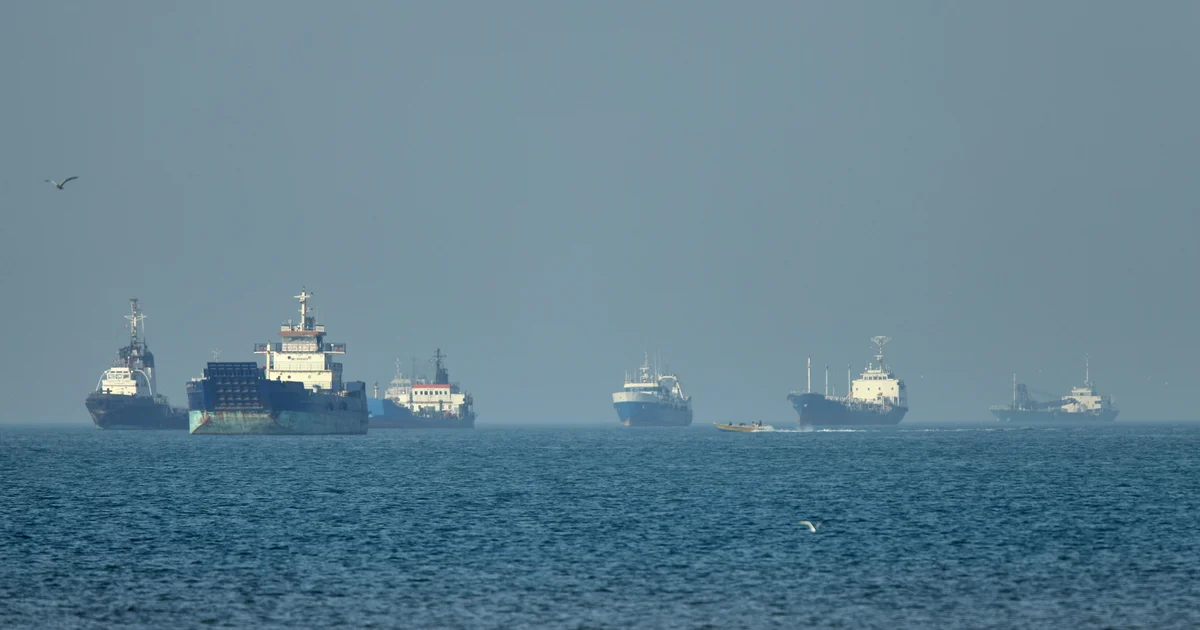
SouthernWorldwide.com – The U.S. Navy has rerouted commercial vessels through a safer passage in the Strait of Hormuz, steering them away from Iranian waters due to the significant risk posed by mines. This directive comes as the Navy intensifies efforts to clear the waterway, a critical global shipping lane.
A notice to mariners, issued on the same day that the U.S. launched “Project Freedom,” a major operation to reopen parts of the Strait of Hormuz, warned of the dangers. Under this initiative, forces from U.S. Central Command will collaborate with commercial ships, guiding them through a meticulously cleared route.
During a briefing on Tuesday, the Pentagon presented evidence indicating that Iran had planted new mines in the Strait of Hormuz on April 23. This followed a CBS News report in March detailing approximately a dozen Iranian mines in the same area. In response, the Pentagon had previously tasked MQ-9 Reaper drones with providing mine-sweeping support within the vital strait.
The National Geospatial-Intelligence Agency, a division of the Defense Department specializing in satellite imagery and geospatial data analysis, has also been enlisted for mine-hunting operations. This information was shared by two U.S. officials who spoke on the condition of anonymity, citing national security sensitivities.
Read more: Shooter accused of assaulting federal officer
“It is already well reported that Iran has laid mines in the Strait of Hormuz, though not extensively,” stated Capt. Tim Hawkins, a spokesperson for U.S. Central Command. He was responding to inquiries about the number of mines present in the strait.
“We’ve been addressing this matter in past weeks, including by clearing an effective pathway ships can use to safely transit. We will continue to take steps to ensure opportunities remain for ships to complete their journeys safely,” Hawkins added in his statement.
When reports of Iran laying mines first surfaced in March, then-President Trump publicly denied any U.S. knowledge of such actions, stating, “we have no reports of them doing so.” At that time, the Pentagon also indicated there was “no clear evidence” of mines being deployed in the strait. However, recent statements from the administration have now acknowledged the presence of some mines.
“I don’t know if people appreciate how outrageous this is,” remarked Secretary of State Marco Rubio during a White House briefing on Tuesday. “That any country would try to fire at, to sink commercial vessels or put mines in the water — both of these things are illegal.”
On April 24, Defense Secretary Pete Hegseth issued a stern warning to Iran, stating that any further mining activities would be considered a violation of the ceasefire. “If there’s attempts to lay – recklessly and irresponsibly – lay more mines, we’re going to deal with that. It’s a violation of the ceasefire,” Hegseth declared.
When questioned about the mine threat on Tuesday, Hegseth elaborated, “If there are mines identified, it would be something that our — some of our units could undertake or the world could undertake. But right now, we know we have a lane of safe passage that commercial shipping can flow through.”
Since the commencement of Project Freedom, two U.S. commercial ships have successfully departed the Persian Gulf. This represents a small fraction of the 1,550 commercial vessels that Joint Chiefs Chairman Gen. Dan Caine reported were detained in the Gulf.
Hegseth noted that “hundreds more ships from nations around the world are lining up to transit.” However, neither Hegseth nor Caine provided specific projections for the number of vessels expected to pass through in the immediate future.
Both officials characterized Project Freedom as a “defensive operation” with a “temporary duration.” This operation is distinct from the bombing campaign, Operation Epic Fury, which Rubio confirmed on Tuesday has concluded.
Iran has stated that its actions in the strait are a direct response to the bombing campaign and will persist until the U.S. military lifts its blockade on Iranian ports.