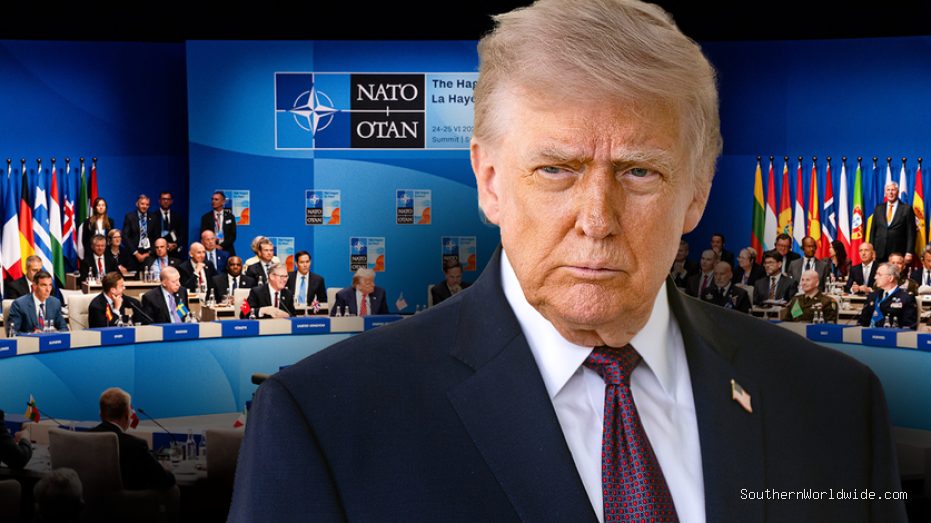
SouthernWorldwide.com – Despite years of criticism from former President Donald Trump regarding its effectiveness and burden-sharing, a significant majority of Americans, including a substantial portion of Republicans and self-identified MAGA Republicans, believe it is important for the United States to remain a member of the North Atlantic Treaty Organization (NATO) for the nation’s security and prosperity.
This finding comes from a new poll that also indicates a bipartisan consensus on the core principle of NATO’s collective defense. When informed that NATO members are bound to defend each other if attacked, a strong majority across the political spectrum expressed support for U.S. military intervention.
Specifically, 76% of Democrats, 71% of Republicans, and 69% of MAGA Republicans stated they would back a U.S. military response if a NATO ally were to come under attack. This highlights a deep-seated belief in the alliance’s mutual security guarantees among the American populace.
These poll results emerge at a time when President Donald Trump continues to advocate for NATO allies to increase their contributions to the alliance’s collective defense. During a recent meeting at the White House with NATO Secretary-General Mark Rutte, Trump voiced his dissatisfaction with several European nations, citing their perceived lack of support during the recent U.S. operation against Iran.
Conversely, Rutte acknowledged Trump’s leadership role in encouraging NATO members to enhance their defense spending. This exchange underscores the ongoing tension between Trump’s demands for greater burden-sharing and the alliance’s existing structures and commitments.
The survey in question is the Reagan Institute Summer Survey, which was conducted from May 26 to June 3, encompassing 1,555 respondents nationwide. It has a margin of error of plus or minus 2.5 percentage points, indicating a high degree of statistical reliability.
The methodology employed a mixed-mode approach, incorporating live telephone interviews, an online panel, and text-to-web responses. This comprehensive approach aims to capture a diverse range of participants and ensure the representativeness of the data.
To ensure the results accurately reflect the broader U.S. population, the data was weighted using demographic benchmarks derived from the U.S. Census Bureau’s 2023 American Community Survey. These benchmarks include crucial factors such as age, gender, race, region, and education levels.
Furthermore, the poll included an oversample of 331 MAGA Republicans under the age of 30. This specific demographic group has a slightly larger margin of error, calculated at plus or minus 5 percentage points, allowing for a more granular analysis of this important segment of the electorate.
The Reagan Institute, the organization behind the survey, is a Washington-based policy think tank. Its advocacy is rooted in the Reagan foreign policy tradition, which emphasizes “peace through strength” and a sustained U.S. leadership role on the global stage.
During the White House meeting on Wednesday, Secretary-General Rutte expressed strong praise for President Trump. Rutte specifically highlighted the importance of Trump’s actions concerning Iran, particularly in preventing Iran from acquiring nuclear capabilities.
“I really want to make clear how important it is what you are doing on Iran,” Rutte stated to Trump. “This is first of all about the nuclear capability Iran was very near to getting its hands on.”
In contrast, Trump articulated his disappointment with several European allies. He pointed to what he perceived as insufficient backing from countries like Italy, the UK, Germany, and France during the U.S. operation against Iran. He also described Spain’s stance as a “horror show.”
“We don’t need their money, we don’t need anything. We have the most powerful military in the world by far, but I just want loyalty,” Trump remarked, emphasizing his desire for unwavering commitment from allies.
The principle of collective defense within NATO, enshrined in Article 5 of the Washington Treaty, has been invoked only once in the alliance’s 77-year history. This historic invocation occurred after the September 11, 2001, terrorist attacks, when all NATO members unanimously declared the attacks on the United States as an attack on the entire alliance.
Trump has consistently voiced criticism regarding NATO members’ failure to meet their defense spending commitments. At times, he has even suggested the possibility of withdrawing the U.S. from the alliance, arguing that the United States has shouldered an inequitable share of the collective security burden.