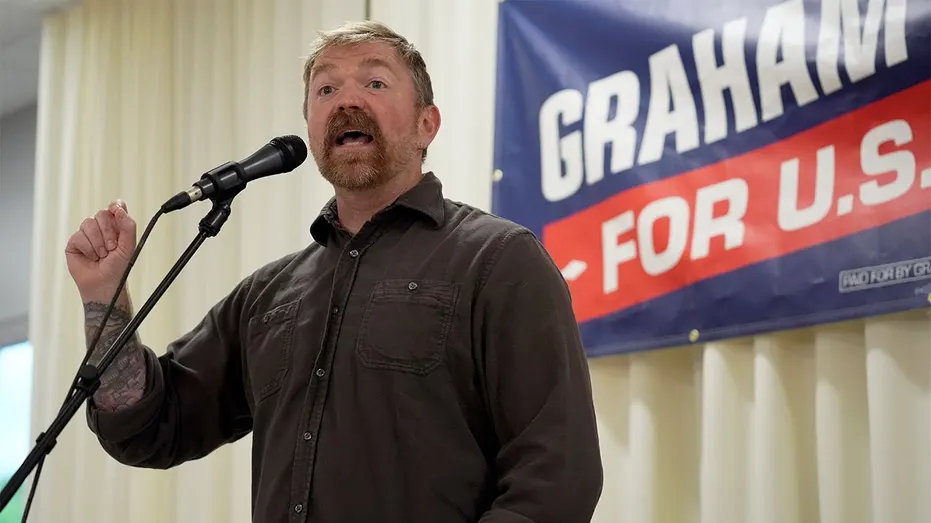
SouthernWorldwide.com – Democratic Senate candidate Graham Platner’s assertion of “making a living on the sea” since leaving the armed forces has been met with scrutiny, as his financial disclosures appear to present a different narrative.
Platner, who is campaigning for a Senate seat in Maine against incumbent GOP Sen. Susan Collins, has cultivated an image of a blue-collar candidate, identifying himself as an oyster farmer and harbor master. This persona is intended to resonate with his left-wing campaign platform.
However, his financial disclosures indicate that his income from oyster farming is relatively modest. Reports suggest that the majority of his earnings stem from veteran’s disability payments.
“My healthcare gave me freedom,” Platner stated at a rally on June 5. “It gave me the freedom to take risks, to start a business and to sink my intellect and my physicality into mastering the skills necessary to make a living on the sea.”
These remarks have sparked criticism on social media, with many questioning the Senate hopeful’s claim to a working-class identity.
According to Platner’s 2025 financial disclosures, his annual income from oyster farming is listed as “other $5,001.” The total valuation of his oyster farming business, which includes his boat, equipment, and supplies, is estimated to be between $50,000 and $100,000.
He also earned an additional $3,000 annually as the harbor master for Sullivan, Maine. The Washington Free Beacon reported that this role was largely administrative, involving the oversight of 17 boat moorings along the town’s coast, and that he held the position for 18 months before resigning to focus on his campaign.
These combined earnings are significantly less than the $4,800 Platner reportedly receives monthly in disability payments. This sum is legally owed to him due to injuries sustained during his service in the armed forces.
“I’ve got a couple herniated discs. My shoulder’s a wreck. My knees bother me,” Platner, who served in combat in Iraq and Afghanistan, told News Center Maine in an interview in October 2025.
Despite his reliance on disability benefits, Platner has consistently presented himself as an “oyster farmer” throughout his Senate campaign.
For instance, in a September 2025 interview with The New Yorker, he described himself as a “small-town oyster farmer.”
While Platner attributes his ability to start a business to federally funded healthcare, other factors have also played a role in his ventures.
His financial disclosures list a restaurant owned by his mother as his sole customer for oysters. Furthermore, Platner’s oyster farm is situated on a private island owned by his business partner’s family. The Washington Free Beacon also reported that Platner received a $200,000 loan from his father to purchase his home.
“Platner lies in this clip,” freelance journalist Magdi Jacobs commented on Platner’s recent statement. “He says he ‘makes a living off the sea.’ He objectively does not.”
Others have pointed out that the reality of Platner’s oyster farming may differ from the common perception of making a living from the ocean.
“Buddy, I love oyster farmers you’re not trawling Georges Bank, you’re pulling up traps in a protected 25-foot deep bay,” wrote D.C.-based lawyer Patrick Brennan on social media.
The Maine Democrat has been open about receiving substantial financial support from the federal government as compensation for disabilities incurred during his service as an infantryman. He informed News Center Maine that, in addition to the estimated $4,800 in monthly cash benefits, a portion of which he allocates to his mortgage, he also benefits from subsidized healthcare.
“I put $954 of it toward my mortgage,” he stated.
He did not disclose the loan from his father during that particular interview.
Platner’s rise within the Democratic Party followed the 2024 election, where Democrats were perceived to have struggled partly due to their inability to connect with male voters.
“I definitely don’t think I’m uniquely qualified for it,” Platner previously said when asked about his perceived appeal to younger men. “I do understand that because of my journey, I think my voice on the issue can be more accessible, just because I’ve been angry on the internet as a younger man, I get it. I also get that it wasn’t anger on the internet that got me out of it. It was quite literally, community. It was building healthy, normal relationships with people.”
While some argue that Platner’s combat experience and blue-collar background offer qualities that the Democratic Party has been lacking, others contend that his public image does not entirely align with public records.
Some observers suggest that the apparent disconnect between Platner’s blue-collar public image and the information emerging in media reports does not seem to be negatively impacting his standing with voters.
Platner has faced significant public backlash in recent weeks concerning his deleted social media posts, allegations of mistreatment of women, and a Nazi tattoo he acquired during his military service. Despite these controversies, he has resisted calls to withdraw from the race.
“This is the political establishment doing its best to make sure that people like me, who have lived lives that are sometimes flawed, sometimes complicated, they’re going to try to send the message that if you ever attempt to get into power, if you ever attempt to advocate for yourself, we will crush you,” Platner recently stated regarding the controversies surrounding his candidacy. “This is the political establishment trying to fight back. And they are going to fail.”
Platner has been the presumptive nominee since Democratic Gov. Janet Mills withdrew from the Senate race in April. However, he faces a key test on Tuesday as Mainers participate in the state’s primary elections.