SouthernWorldwide.com – A leading shipping company has declared that the heightened risk and regulatory uncertainty surrounding the Strait of Hormuz have become the “new normal,” as military actions escalate and conflicting navigation directives create significant operational disruption.
Hapag-Lloyd, a major German shipping firm, issued this warning on Sunday. The company’s statement coincided with reports from maritime intelligence firm Windward AI indicating that Tehran has begun moving millions of barrels of crude oil from Kharg Island. This marks the first such movement in several days.
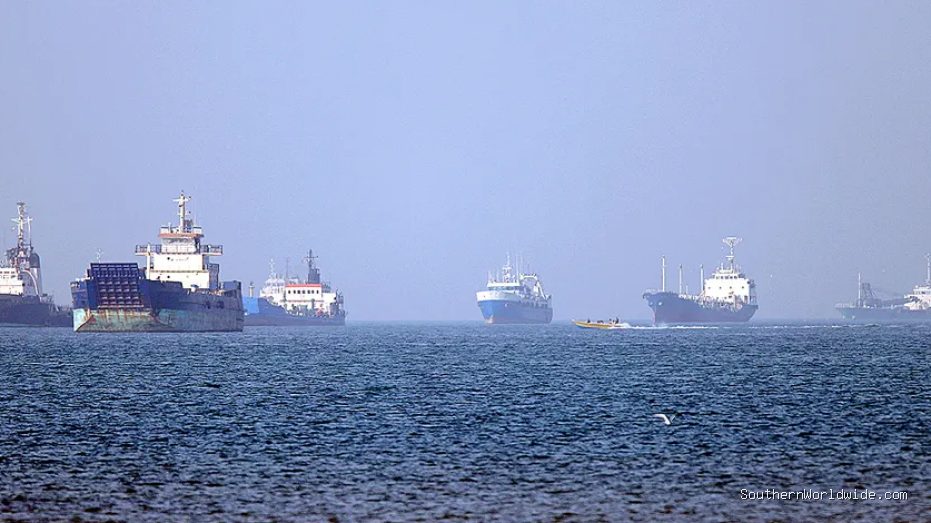
Windward AI noted on the platform X that the T-Jetty and Western Terminal at Kharg were simultaneously loaded for the first time in days. The East Waiting Area currently holds 28 tankers, with 27 of them operating “dark,” suggesting a restart of Iran’s crude oil export cycle.
Analytics firm Vortexa reported that the outbound cargo is estimated to comprise 4.12 million barrels of liquid cargo, including crude oil and other liquid hydrocarbons. Of this total, approximately 3.91 million barrels are crude oil.
The situation in the Gulf has been described as fluid since the conflict began. Constant vigilance has become an essential element for operating in the region.
Hapag-Lloyd stated that they are continuously conducting risk and situation assessments with their security partners, all relevant authorities, and their personnel both on shore and aboard vessels.
Given that the region is experiencing conflict, every ship transiting through it is considered with this context. The risks for each vessel and its crew are assessed individually.
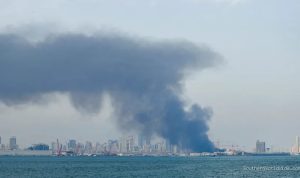
These remarks from Hapag-Lloyd’s representative came shortly after U.S. Central Command (CENTCOM) launched airstrikes against Iranian targets on June 26. This action followed an incident where a vessel was struck in the Strait of Hormuz, with Qeshm Island being among the targeted locations.
In response to the U.S. airstrikes, Iran’s Islamic Revolutionary Guard Corps (IRGC) reportedly retaliated by targeting U.S. military sites located in Kuwait and Bahrain.
Further complicating the situation is a struggle for control over the transit lanes within the strait.
Lloyd’s List has characterized the current state of the waterway as a “confused, two-tier system.” The strait is reportedly divided, with the northern route controlled by Iran and a southern “highway” that is protected by the U.S. The pre-war routes are said to be unusable due to the risk of mines.
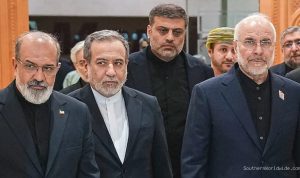
According to Iran International, Iranian Foreign Minister Abbas Araghchi stated on Sunday that Iran is responsible for managing and fully reopening maritime traffic through the Strait of Hormuz, citing recent understandings.
Iranian state television has indicated that passage through the Strait of Hormuz requires coordination with the IRGC.
Hapag-Lloyd has voiced opposition to any future attempts to leverage or monetize passage through this critical global chokepoint.
The company’s representative stated that it would be fundamentally incorrect to impose fees for passage through international waters. This is distinct from fees for infrastructure like the Suez Canal or Panama Canal, which reflect significant investment in infrastructure, a situation not applicable to the Strait of Hormuz.
While thousands of crew members have been affected by the conflicting naval directives, Hapag-Lloyd confirmed that it has successfully navigated the initial bottleneck.
The company reported that all Hapag-Lloyd vessels affected by the temporary closure of the Strait of Hormuz and those waiting in the Persian Gulf have safely departed the Gulf. The safety of their crews remains the highest priority.