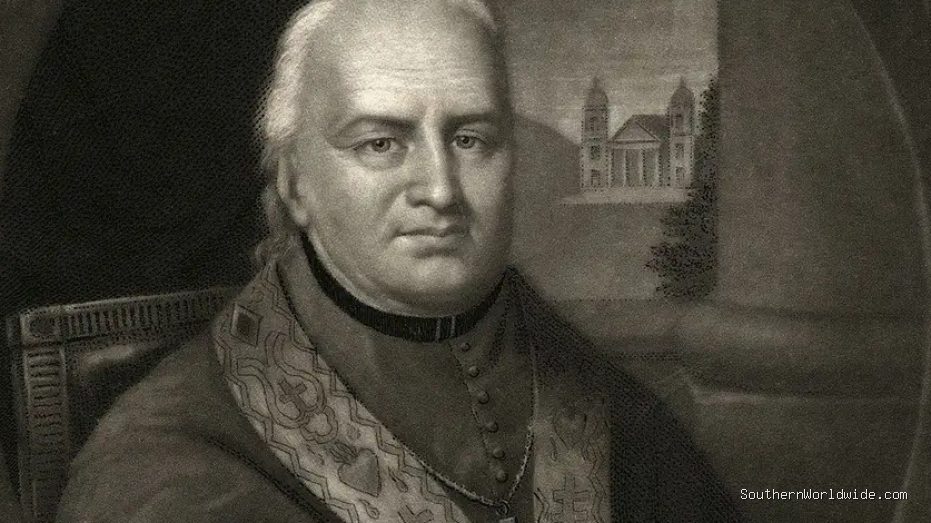
SouthernWorldwide.com – As the United States approaches its 250th anniversary, a significant historical exchange between President George Washington and Bishop John Carroll in 1790 is gaining renewed relevance, shedding light on the nation’s foundational ideals of inclusion and religious liberty.
This little-known correspondence, preserved at the Library of Congress, addresses a crucial question for the nascent republic: could Catholics, historically viewed with suspicion, truly be considered equal citizens in the new America?
The original letter from Bishop Carroll to President Washington is housed within the George Washington Papers at the Library of Congress, a mere fifty feet from the office of Dr. Kevin Butterfield, acting chief of the Library’s Manuscript Division.
Butterfield explains that Washington, in his first year as president, actively engaged with the nation, believing it vital for the public to interact with and witness the new government in action. This outreach led to numerous letters from various groups seeking assurance about their place in the evolving federal structure.
Among these was an address from John Carroll, who had recently become the first Catholic bishop in the United States following the Vatican’s establishment of the first American diocese in Baltimore in 1789. Carroll, along with other Catholic leaders, sought clarity on whether Catholics, long subject to suspicion under British rule, would be fully integrated into the new republic.
Michael Breidenbach, dean of the Honors College at Ave Maria University, emphasizes that this exchange highlights the integral role Catholics played in shaping the nation, not just benefiting from its founding. He notes that contemporary debates about the nation’s roots often overlook these significant Catholic contributions.
Carroll’s letter, according to Butterfield, was particularly notable for its direct plea for Catholic inclusion. The correspondence articulated their views on religious liberty and the importance of being recognized as full citizens.
While Catholic priests had served in the American colonies for generations, the establishment of the Diocese of Baltimore in 1789 marked the first time a Catholic bishop was officially present in the United States. Carroll’s consecration the following year solidified this.
Butterfield, reading from the original manuscript, highlighted a passage that powerfully conveyed the Catholics’ appeal for recognition and rights.
“Whilst our country preserves her freedom and independence, we shall have a well-founded title to claim from her justice equal rights of citizenship as the price of our blood spilt under your eyes and of our common exertions for her defense,” the letter stated.
These words served as a reminder to Washington of the significant contributions Catholics made during the Revolutionary War. Butterfield points out that Carroll’s reference to Washington’s eight years of service and the shared struggle for independence underscored the early participation of Catholics in the fight for American liberty.
For centuries prior to the American Revolution, Catholics in England and its colonies faced considerable restrictions. Catherine O’Donnell, a historian at Arizona State University, explains that many English colonists harbored mistrust towards Catholics, perceiving them as more loyal to Rome than to their own countrymen and lacking independent thought.
These restrictions included prohibitions against holding office, limitations on voting rights, requirements to swear oaths against papal authority, and in some colonies, outright bans on the open practice of their faith.
Carroll himself experienced such discrimination, being sent to Europe for his education due to the lack of Catholic schooling options in Maryland. He later joined the Jesuits, a Catholic order known for its educational and missionary work, but his formation had to occur abroad due to the limited Catholic institutions in the colonies.
Despite these challenges, Carroll did not advocate for a return to an established Catholic state. Instead, he recognized the unique potential of the new American republic.
“He thought the separation of church and state was a good thing,” O’Donnell stated.
O’Donnell describes Carroll’s letter as both sincere and strategically crafted. She notes Carroll’s admiration for Washington and his desire for a public affirmation of Catholics’ welcomed position within the new nation.
She believes Carroll was confident that Washington would respond favorably to his appeal.
The address to Washington was co-signed by several prominent Catholic figures of the era. These included Charles Carroll of Carrollton, the sole Catholic signatory of the Declaration of Independence, his relative Daniel Carroll, a signer of the U.S. Constitution, and Congressman Thomas FitzSimons of Pennsylvania. Together, they argued that American Catholics had earned equal citizenship rights through their sacrifices and contributions to the Revolutionary War and the nation’s establishment.
“American Catholics’ remarkable transformation — from being suspected subjects of a king to being trusted citizens of a new republic — is wonderfully illustrated in Bishop John Carroll’s 1790 letter to George Washington,” remarked Breidenbach, also the author of “Our Dear-Bought Liberty: Catholics and Religious Toleration in Early America.”
Washington’s reply left no ambiguity regarding his stance.
He expressed gratitude for the “patriotic part” Catholics played in the Revolution and affirmed that they were already “realizing, instead of anticipating, the benefits of the general Government.”
Butterfield interprets Washington’s response as reflective of his broader vision for the country.
“As long as you demean yourself as a good citizen and follow the laws, it doesn’t matter what your religious beliefs are,” Butterfield summarized Washington’s message, emphasizing that such individuals were fully integrated members of the nation.
Washington understood the weight of his public statements in defining the new republic. He was acutely aware that his words carried significant consequences and helped shape national identity.
This principle of inclusivity was also evident in Washington’s correspondence with other minority religious groups, such as the Hebrew Congregation in Newport, Rhode Island.
Washington’s stance was not one of mere “toleration,” which might imply a conditional allowance for existence and worship. Instead, he conveyed that all good citizens possessed the same rights irrespective of their religious affiliations.
While some states maintained religious restrictions for many more decades, the federal government, from its inception, adopted a different path.
Even before the ratification of the First Amendment, Article VI of the Constitution explicitly prohibited religious tests for federal office. Washington, who had presided over the Constitutional Convention, consistently upheld this principle throughout his presidency.
“At the national level from day one, this was an experiment in religious freedom,” Butterfield stated.
The preservation of this correspondence is attributed to Washington’s foresight, recognizing the importance of his papers for future generations.
Washington bequeathed his papers to his nephew, Supreme Court Justice Bushrod Washington. Congress acquired the collection in 1834, and it was subsequently transferred from the State Department to the Library of Congress, where it resides today.
The Carroll letter is now one of approximately 77,000 items within the George Washington Papers. While digitized versions are accessible globally, the original manuscript is rarely displayed to ensure its preservation.
O’Donnell believes the lessons from this exchange extend beyond the history of Catholics in America.
“I think that it’s valuable for Americans to understand that the history of the founding period contains just about everything: ideals such as religious liberty and prejudices, such as those against Catholics,” she remarked.
She also highlights the correspondence as a testament to the significance of public leadership.
O’Donnell finds Washington’s conviction that good citizenship is independent of specific religious views to be particularly relevant today. Similarly, Carroll’s belief that public dialogue on important issues can help embed ideals into the community’s consciousness, rather than remaining mere theoretical rights, is also seen as timely.
More than two centuries later, this exchange remains a powerful artifact. It encapsulates a pivotal early moment when one of America’s smallest religious minorities sought to understand if the Revolution’s promises extended to them, and when the nation’s first president affirmed that they did.