SouthernWorldwide.com – Recent discoveries in archaeology, DNA analysis, and archival research have significantly enhanced our understanding of America’s Founding Fathers, shedding new light on their lives and legacies.
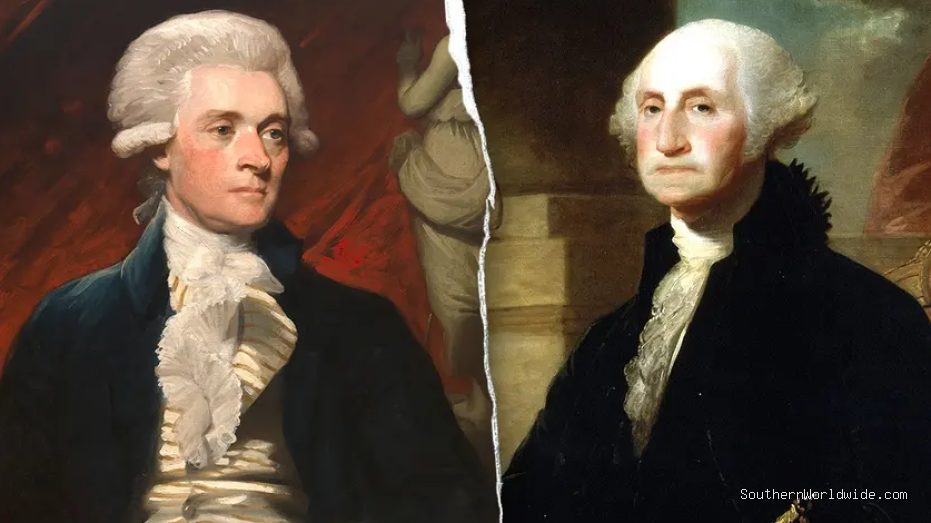
These advancements have unearthed forgotten documents, artifacts, and other crucial evidence from the nation’s formative years. This ongoing process continues to reshape historical perspectives on influential figures like Thomas Jefferson and George Washington.
The exploration into the past has provided fresh insights, offering a more nuanced view of the individuals who shaped the United States.
One of the most significant revelations concerns Thomas Jefferson and Sally Hemings. The Thomas Jefferson Foundation (TJF) states that Jefferson, the principal author of the Declaration of Independence, fathered at least six children with Sally Hemings, an enslaved woman at Monticello.
While rumors of Jefferson’s paternity circulated during his lifetime, it was a landmark DNA study in 1998 that provided scientific evidence supporting this claim. This finding has been widely accepted by mainstream historians.
Sally Hemings accompanied Jefferson’s family to Paris from 1787 to 1789, where she worked as a servant. During their time in Paris, where enslaved individuals had the right to petition for freedom, Hemings reportedly negotiated with Jefferson to return to Monticello under enslavement.
In exchange for this return, she was promised “extraordinary privileges” for herself and freedom for her future children. This agreement highlights the complex dynamics and negotiations that occurred within the institution of slavery.
Jefferson eventually freed all of Sally Hemings’s children, a distinction noted by the TJF, as he did not extend this freedom to any other enslaved family unit at Monticello.
The TJF’s conclusion, based on a comprehensive review of documentary, scientific, statistical, and oral history evidence, asserts that Jefferson most likely fathered Hemings’ children. This assessment is now a cornerstone of historical understanding regarding their relationship.
However, not all historians share this view. The Thomas Jefferson Heritage Society, after reviewing historical evidence, concluded that Hemings was a minor figure in Jefferson’s life and that it is highly improbable he fathered any of her children.
This alternative perspective suggests that Jefferson’s younger brother, Randolph, might have been the father of at least some of Sally Hemings’s children. This conclusion was presented in a report issued in April 2001 and revised in 2011.
Another significant discovery relates to George Washington’s distillery. In 1999, archaeologists at Mount Vernon unearthed the remnants of his long-lost whiskey distillery.
The excavation revealed that by the time of his death in 1799, Washington operated what had become the largest commercial distillery in the United States. This discovery expanded upon existing knowledge from surviving records.
While historians knew Washington had a distillery, the archaeological findings showcased the immense scale and sophisticated operation of the enterprise. Mount Vernon’s website notes that the facility was among the largest and highest-producing operations in the region.
The evidence uncovered indicates the distillery was operating on an industrial scale, a significant contrast to the typical one or two still farmer-distillers common in the 18th and early 19th centuries.
Archaeologists found stone foundations, teacups, drinking glasses, and evidence of copper stills and boilers. These artifacts provided crucial details for reconstructing how this massive operation functioned.
Mount Vernon’s website highlights Washington’s reputation as an innovative and enterprising farmer. The distillery, along with other exhibits like the 16-sided treading barn and gristmill, exemplifies his entrepreneurial spirit.
In the realm of archival discoveries, historian Julian P. Boyd found a previously unknown draft of the Declaration of Independence among Thomas Jefferson’s papers in 1947.
This draft, described by the Library of Congress as “brief, but critically important,” predates the well-known “Rough Draught” that Jefferson later produced. Its discovery offered valuable insights into the drafting process.
By comparing the early fragment with the “Rough Draught,” historians noted that Jefferson made more extensive revisions to his language than previously documented. This provided a clearer picture of his meticulous editing process.
The fragment also allowed historians to trace Jefferson’s edits alongside revisions made by other key figures, including John Adams and Benjamin Franklin, as well as changes made by Congress before the Declaration’s final adoption.
The Library of Congress website emphasizes that the fragment confirmed the view of historians who argued that a heavily edited draft must have preceded the copy Jefferson endorsed as the original rough draft. The existence of this document was a key component in understanding the writing of the Declaration.