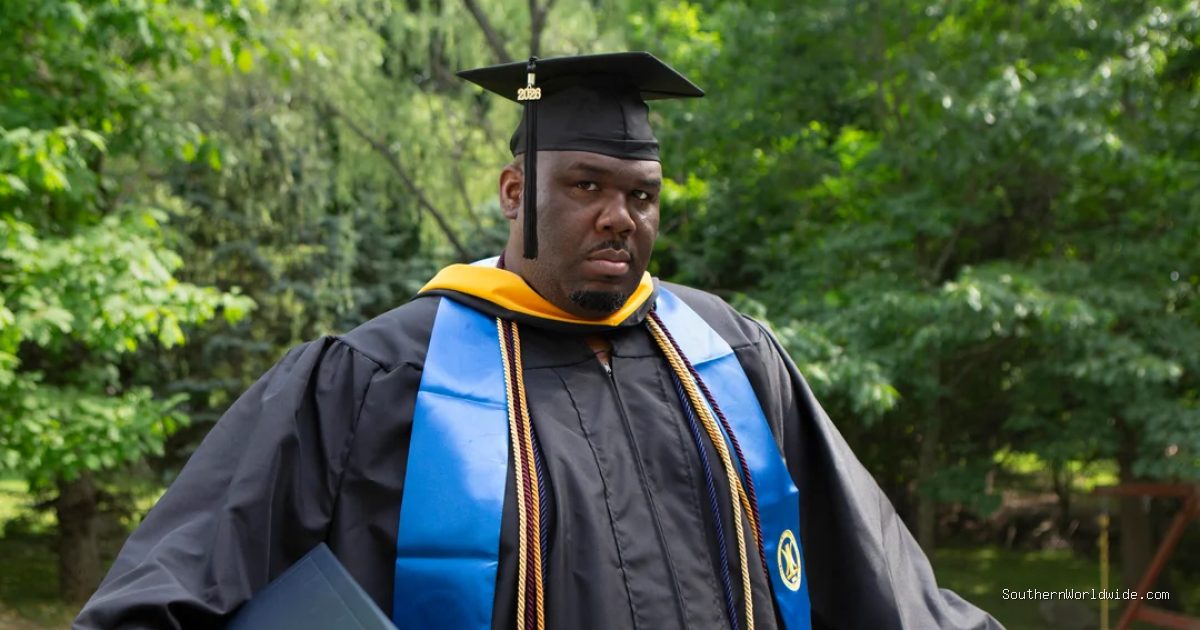
SouthernWorldwide.com – Benjamin Pinckney, 46, has harbored a lifelong ambition to become a physician assistant, a dream ignited shortly after his 20th birthday.
A drive-by shooting in Jacksonville, Florida, left him hospitalized with two gunshot wounds. During his weeklong stay, a physician assistant profoundly impacted his life. This medical professional visited him daily, warning him of the grim prognosis often faced by Black men with similar injuries – paralysis or worse.
“I used to run the streets, you know, on the wrong sides of the track,” Pinckney recounted. “He made me promise that I would never come into his ER that way again. That was the last conversation we had, right before I was discharged.”
Since that pivotal moment, his sole objective has been to enter the physician assistant profession. Pinckney, who dedicated a significant portion of his career to New York City’s Department of Sanitation and served as an Army Reserve medic, recently took a crucial step towards this goal. In May, he graduated with departmental honors from Lehman College, earning a Bachelor of Science degree.
Relocating from New York to Prince George’s County, Maryland, he had intended to apply to physician assistant programs this year. However, he now fears that new student loan regulations may jeopardize his aspirations.
Effective July 1, the amount graduate students can borrow from federal funds will be subject to new limitations. These revised student loan caps are a component of the GOP’s tax-and-spending legislation, the One Big Beautiful Bill Act, which President Donald Trump enacted into law last year.
The stated intention behind these caps, according to the Trump administration, is to mitigate the escalating costs of higher education and the burden of student loan debt.
However, a consensus among critics suggests that the new borrowing limits are excessively restrictive. This is particularly true for students who can now only borrow $20,500 annually in federal loans, a consequence of the law’s contentious definition of a “professional degree.” While a federal judge temporarily halted the Department of Education’s enforcement of this definition on June 24, the new caps remain insufficient for numerous students to cover combined expenses for tuition, housing, and daily living.
This situation could compel hundreds of thousands of students who rely on loans for graduate studies each year to seek funding from private lenders. These private loans typically come with higher interest rates and fewer repayment options.
Furthermore, some experts and students express concern that these limits could undermine efforts to diversify the healthcare sector. They argue that the restrictions may deter minority students and those from low-income backgrounds from pursuing graduate programs. A decline in enrollment could potentially exacerbate existing shortages in rural healthcare and primary care services.
Many lawmakers and loan specialists acknowledge the necessity of addressing the high cost of higher education. However, Todd Pickard, president of the American Academy of Physician Associates, which is among several organizations that have filed lawsuits against the Department of Education over these rules, stated that the new federal loan limits “just not going to achieve that goal.”
“It’d be like if you had a hangnail and I cut your whole arm off instead of just taking care of your hangnail,” Pickard elaborated. “The treatment doesn’t match the problem.”
Students pursuing degrees classified as “professional degrees” under the new law—including aspiring doctors, dentists, pharmacists, and chiropractors—will be permitted to borrow a maximum of $200,000 in total, with an annual cap of $50,000.
In contrast, the median cost for a four-year education at a public medical school is close to $300,000, while a private medical school education can exceed $400,000, according to data from the Association of American Medical Colleges.
The loan caps are set even lower for students pursuing other “graduate” degrees. These students face a federal loan limit of $100,000 over the entire duration of their program, with an annual limit of just $20,500. Initially, students in programs like physical therapy, physician assistant, and nursing were categorized under this group. However, recent guidance from the Department of Education indicates that some of these students may, at least temporarily, be eligible for the higher borrowing limit, as reported by The Associated Press.
Under the original wording of the law, a physician assistant student completing their degree within the typical two to three years would not have been able to borrow the full $100,000. Physician assistants commonly begin their careers with an average debt of $112,000, potentially forcing some to finance their education through private loans with higher interest rates.
“I feel like I’m between a rock and a hard place,” shared Olivia Trull, 24. She is slated to commence the physician assistant program at Northwest University in Kirkland, Washington, this summer. The 28-month program carries a cost of $137,000, with an estimated $62,000 in tuition and fees for the first year alone, not accounting for living expenses.
Prior to the court order, Trull stated she would have qualified for the maximum annual federal loan allotment of $20,500 during her initial year of graduate school. The remaining balance would have necessitated private lender financing.
She anticipates needing up to $100,000 in private loans to fund her graduate degree. Upon completion, she could face monthly loan payments exceeding $3,000.
“I have to actually sit down and have a conversation with myself,” Trull reflected, contemplating “if I want to be drowning in debt for the next 10 years of my life.” One private bank reportedly offered her a loan with an interest rate close to 14%.
Pinckney, who mentioned he had approximately $10,000 in federal student loan debt from his undergraduate studies, noted that some of his friends who have already secured private student loans have been quoted interest rates as high as 13%. In contrast, federal loan interest rates for graduate students, which are adjusted annually, are currently around 8-9%. Federal loans also typically offer more flexible repayment terms compared to private options.
In May, 25 states and the District of Columbia initiated a federal lawsuit against the Department of Education concerning the new regulations. The lawsuit characterized the law’s definition of a “professional degree” as “arbitrary and capricious.”
In a separate federal lawsuit filed in June, the American Academy of Physician Associates and the PA Education Association asserted that the new rules prevent students from obtaining the necessary loan amounts to attend physician assistant schools. They argue that PA students should have access to the higher loan limits available to students in medical school and other professional degree programs. (While “physician assistant” and “physician associate” generally denote the same role, the AAPA adopted the title “physician associate” in 2021 due to concerns that “assistant” did not fully reflect the significant role PAs play in delivering high-quality patient care.)
Meanwhile, Trump administration officials maintain that the overall cost of graduate school is excessive. Education Secretary Linda McMahon, addressing a House committee in May regarding the new limits, stated, “It is our overall goal to bring down the cost of college and education.”
Indeed, some experts concede that the new limits might contribute to reducing costs. The federal Grad PLUS loan program, established by Congress two decades ago, did not impose a cap on the amount graduate students could borrow through federal loans. This program was eliminated as part of the One Big Beautiful Bill Act.
“There is considerable evidence that people borrowed more than they really needed to go to school,” commented Sandy Baum, a higher education economist and senior fellow at the Urban Institute.
Already, some graduate programs have reduced their tuition fees, Baum noted. For instance, in May, the University of California-Irvine announced a significant reduction in its MBA program tuition, aiming to fall below the new federal lending thresholds.
Despite these instances, Baum does not anticipate widespread adoption of similar price reductions by other institutions.
“I don’t think we’re going to see some dramatic decline in prices,” she remarked. “I think some programs could close down because they can’t manage.”
The new lending limits are expected to disproportionately affect Black students, according to Baum, as they have historically taken on higher loan amounts compared to white and Hispanic students.
For some students who previously borrowed to finance their undergraduate degrees, the new regulations will impose a particularly severe burden. Under the revised rules, they will be subject to a lifetime federal student loan limit of $257,000.
“There will be students who can’t enroll,” Baum predicted.
Andrei Robu, 26, a medical student at the Medical University of South Carolina, who leads the Financial Literacy Interest Group on campus, shared that many of his peers are concerned the lending limits will lead to a less diverse student body.
He also worries that given the already high demand for medical school admissions, institutions might begin to favor applicants from affluent backgrounds to “still fill up their classes.”
“That’s just not what we want in our physician workforce,” stated Robu, who is not directly affected by the new rules as a current student. “We want to represent the population of the country at large.”
Jasmine Vasquez, 26, who has been accepted into the physician assistant program at South College in Atlanta, has decided to postpone her enrollment until 2027. This decision is partly to assess potential changes in her financing options, as she is concerned about accumulating excessive debt from private banks.
“Tears have been shed multiple times,” Vasquez shared, adding, “It’s nothing that’s within my control.” She is expecting to give birth in September.
Betsy Mayotte, president of the Institute for Student Loan Advisors, anticipates that the new regulations will lead some graduates to bankruptcy due to their inability to repay private loans.
However, her immediate expectation is a decrease in enrollment numbers and the closure of some graduate programs that struggle to attract sufficient students. She also foresees a decline in completion rates as students encounter federal loan limits midway through their degree programs.
Furthermore, she predicts that healthcare graduates will gravitate towards high-paying specialties, thereby intensifying shortages in rural and underserved communities.
“They’re going to go where they can make the most money,” Mayotte stated.
Pinckney expressed uncertainty about his future path. He financed the majority of his undergraduate education through work while studying, a scenario often not feasible for full-time physician assistant students.
He has contemplated applying to a biomedical science graduate program instead, estimating its cost at approximately $30,000—an amount he considers “a lot more doable.” Such a program could potentially lead to opportunities in research labs or the pharmaceutical industry. While still aligned with the medical field, it would not fulfill his aspiration of directly working with patients.
“Maybe this thing will blow over,” he remarked, referring to the new federal loan limits. In the interim, he remains hopeful.
“If I can influence one person’s life, that would be my way of paying him forward for what he did,” he said, referencing the physician assistant who inspired him in 1999. “It’s very hard to pivot from that dream.”
KFF Health News is a national newsroom producing in-depth journalism on health issues. It is a core program of KFF, an independent entity focused on health policy research, polling, and journalism.
KFF Health News, formerly known as Kaiser Health News (KHN), is a national newsroom that produces in-depth journalism about health issues and is part of KFF, an independent source for health policy research, polling, and journalism.