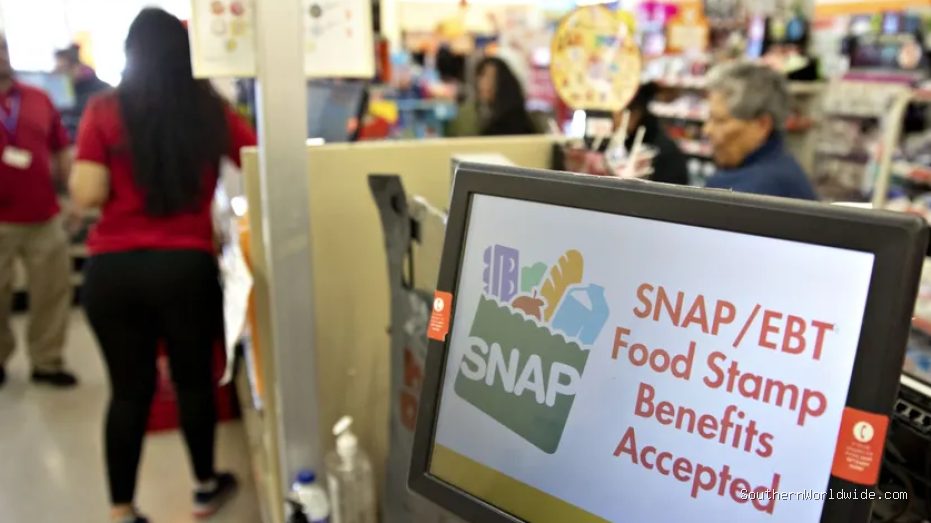
SouthernWorldwide.com – A top official at the Department of Agriculture has warned Congress that fraud within the Supplemental Nutrition Assistance Program (SNAP) has enabled individuals connected to terrorist organizations, foreign adversaries, and international criminal syndicates to exploit food stamp benefits.
This hearing represents the latest effort by the Trump administration and House Republicans to curb financial crimes and address alleged waste, fraud, and abuse within the expansive federal SNAP program.
“SNAP fraud is a reprehensible crime that squanders the compassion of American taxpayers who fund the program and robs from those low-income Americans who qualify for SNAP benefits to feed themselves and their families,” stated USDA Inspector General John Walk before the House Oversight Subcommittee on Delivering on Government Efficiency.
Walk further testified, “Proceeds of SNAP fraud have gone to individuals linked to terrorist groups, foreign adversary nations and transnational criminal organizations.”
Republicans contended that expanded access to state eligibility data could reveal billions more in improper payments and organized criminal activities. Conversely, Democrats expressed concern that such efforts could be used to justify reductions in food assistance for eligible Americans.
During the hearing, Walk appeared to amplify Republican concerns by detailing increasingly sophisticated schemes targeting the approximately $100 billion federal food assistance program. He explained that organized criminals are pilfering benefits from vulnerable Americans through methods such as electronic benefit transfer (EBT) card skimming, trafficking operations, and identity fraud.
The inspector general noted that these crimes leave many legitimate and vulnerable recipients without the funds necessary to purchase food.
He shared a recent conversation with a father of five in New York whose SNAP benefits were stolen after criminals skimmed his EBT card.
“I have heard many stories from victims like these working moms and dads,” Walk said. “They’re why SNAP fraud matters.”
Walk also highlighted an investigation in Southern California where SNAP benefits were allegedly exchanged for cash and crack cocaine.
His testimony indicated that gang members subsequently used the proceeds from this fraud to acquire firearms.
“I’ll just repeat that,” Walk emphasized. “SNAP dollars, federal tax dollars, used to buy drugs and guns.”
Walk’s testimony underscored the central focus of the hearing, where House Republicans argued that deficiencies in oversight and data sharing have led to billions of taxpayer dollars being lost to fraud and abuse within the nation’s food stamp program.
The subcommittee’s chairman, Rep. Tim Burchett, R-Tenn., reported that Department of Agriculture (USDA) officials identified approximately $3 billion in potential fraud and waste based on data submitted by participating states. Examples cited included benefits allegedly being disbursed to 186,000 deceased individuals, 442,000 applicants with fraudulent Social Security numbers, and hundreds of thousands of duplicate recipients within the system.
He also criticized 21 states for refusing to provide requested SNAP data to the USDA, arguing that this lack of participation hinders federal officials’ ability to identify additional instances of fraud.
“If food stamp recipients’ data stays in state-specific databases, individuals may apply for and receive benefits from multiple states,” Burchett stated.
Walk corroborated this challenge, explaining that limited access to state recipient data makes it difficult to detect fraud before taxpayer funds are disbursed.
“We cannot pay and chase our way to stopping SNAP fraud,” he asserted. “We need to guard the front door.”
The inspector general further warned that criminals can install EBT card skimming devices in as little as seven seconds, enabling thieves to clone benefit cards and deplete accounts as soon as monthly benefits are deposited.
While Republicans concentrated on fraud prevention and enhanced oversight, Democrats argued that the hearing risked mischaracterizing administrative errors as intentional fraud and defended SNAP’s crucial role in providing food for vulnerable Americans.
Gina Plata-Nino, Director of SNAP Policy and Advocacy at the Food Research and Action Center, acknowledged that organized theft of EBT benefits is a serious issue but cautioned lawmakers against conflating payment errors with fraudulent activity.
“Program integrity and food access are not competing goals,” Plata-Nino testified.
The hearing takes place as the Trump administration has prioritized the eradication of fraud across federal benefit programs, with Burchett suggesting that increased state cooperation could uncover even more instances of abuse within SNAP.