SouthernWorldwide.com – SpaceX successfully launched a more powerful version of its Super Heavy-Starship rocket on Friday for a crucial test flight. This mission aimed to evaluate numerous upgrades designed to enhance the rocket’s operational efficiency, safety, and reliability.
The upgraded Super Heavy-Starship, developed by Elon Musk’s company, is slated to play a pivotal role in future space endeavors. These include launching larger Starlink satellites, carrying government and commercial payloads, and ultimately enabling missions to the moon and Mars.
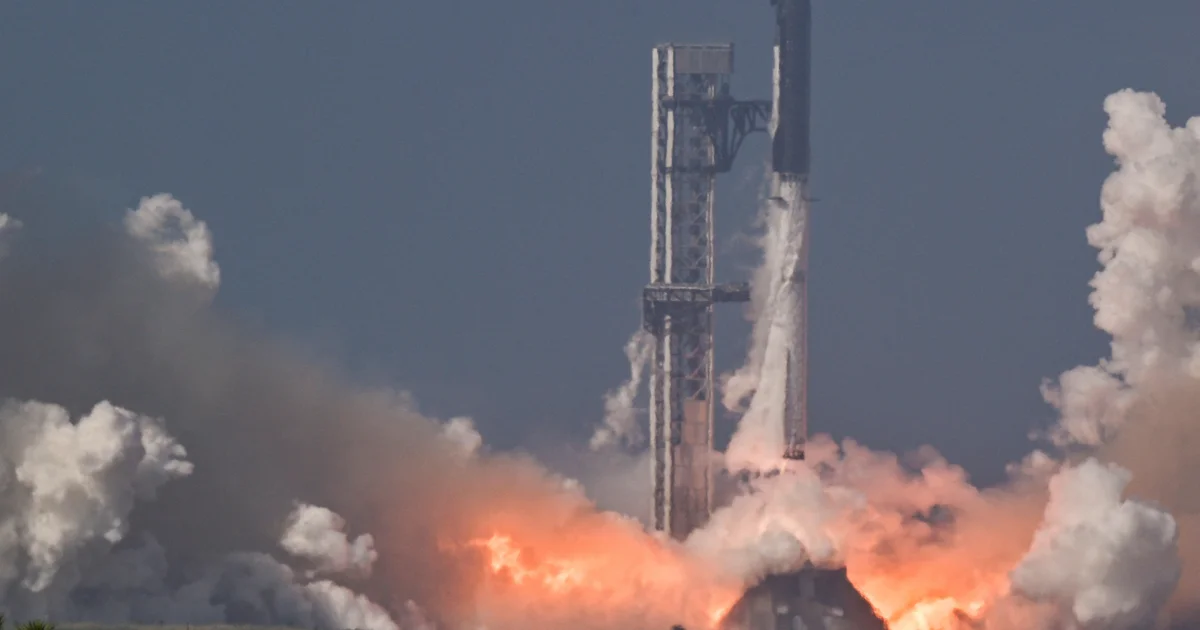
The colossal rocket, standing 407 feet tall, lifted off from SpaceX’s Starbase launch site on the Texas Gulf Coast at approximately 6:30 p.m. EDT. This launch followed a minor glitch with a launch pad system that caused a last-minute scrub on Thursday, and two prior weather-related delays.
The Super Heavy first stage is powered by 33 Raptor engines, which burn methane and oxygen, generating an impressive 18 million pounds of thrust. This is double the liftoff power of NASA’s Space Launch System (SLS) moon rocket. The intense fiery ascent illuminated the sky with a brilliant torrent of blue-white fire.
A SpaceX Super Heavy booster carrying the Starship spacecraft lifts off on a test flight from Starbase, Texas, May 22, 2026. (Steve Nesius / REUTERS)
This launch marked the first flight of a “version 3” Super Heavy-Starship. It also represented the inaugural use of SpaceX’s second Texas launch pad, which has been reinforced to better withstand the extreme forces of launches from the world’s most powerful rocket.
Two minutes and 24 seconds into the flight, after clearing the dense lower atmosphere, the Starship upper stage’s six Raptor engines successfully ignited. This preceded the separation of the Super Heavy first stage.
The Super Heavy booster was programmed to execute a boostback burn and attempt a controlled splashdown in the Gulf of Mexico. However, the rocket encountered some engine issues, preventing it from reaching its intended landing zone.
SpaceX stated on its website that the booster’s primary objective was a successful launch, ascent, stage separation, boostback burn, and landing burn at an offshore point. Given that this was the first flight test of a significantly redesigned vehicle, the booster was not intended to return to the launch site for recovery.
Approximately one minute and 10 seconds after the booster’s splashdown, the 160-foot-tall Starship upper stage’s engines were scheduled to shut down. This would set the spacecraft on a sub-orbital trajectory, targeting a Raptor-assisted splashdown in the Indian Ocean.
During its coast through space, the flight plan included the release of 22 Starlink satellite simulators. Two of these simulators were equipped with cameras to capture imagery of heat shield tiles during re-entry.
The Super Heavy first stage is powered by 36 Raptor engines burning methane and oxygen. The latest version of the rocket features more powerful engines, capable of generating a combined 18 million pounds of thrust. (SpaceX)
The Super Heavy-Starship is outfitted with around 50 cameras that will transmit live imagery to the ground via the Starlink satellite system.
The flight plan also included a test of igniting one of the Raptor engines in space to assess start-up procedures in a vacuum. To measure the thermal and structural effects of re-entry, one heat shield tile was deliberately removed.
“Finally, the ship will perform experimental actions tested on previous flight tests, including a maneuver to intentionally stress the structural limits of the vehicle’s rear flaps and a dynamic banking maneuver to mimic the trajectory that future missions returning to Starbase will fly,” SpaceX announced prior to the launch.
As with earlier test flights, the Starship upper stage is expected to re-enter the atmosphere in a belly-first orientation before flipping vertical for a rocket-powered descent to splashdown in the Indian Ocean. This view shows an earlier Starship seconds before the spacecraft hit the water. (SpaceX)
A milestone on the path to the moon
The version 3 test flights represent significant milestones for SpaceX in its pursuit of a fully reusable rocket for operational use. This rocket is intended for launching government and commercial satellites, science probes, and eventually, crewed missions to Mars.
These flights are also critical for NASA, which has contracted SpaceX to develop a version of the Starship upper stage to serve as a lunar lander. This lander is planned to transport NASA’s Artemis astronauts to the moon’s surface starting in 2028. Following this, NASA intends to conduct multiple missions annually and establish a base near the moon’s south pole.
In the interim, NASA plans to launch its next Artemis mission in 2027. This mission will send four astronauts in an Orion capsule, atop an SLS rocket, to rendezvous in Earth orbit with SpaceX’s lander and an alternative lander being developed by Blue Origin.
An artist’s impression of SpaceX’s Starship moon lander compared to the squat lunar modules that carried Apollo astronauts to the lunar surface more than 55 years ago. (NASA/SpaceX)
NASA plans to conduct tests with both landers during the Artemis III mission. However, the mission will proceed even if only one lander is operational. Both SpaceX and Blue Origin must successfully complete an uncrewed lunar landing mission before NASA attempts to land astronauts in 2028.
Neither company has yet successfully sent a moon lander into space, and both face challenging test schedules. With the version 3 of its flagship rocket now operational, SpaceX is focused on transitioning from sub-orbital test flights to orbital missions. This includes continued development of the systems necessary for lunar missions.
A significant challenge lies in the autonomous refueling of a Starship lander in Earth orbit, a prerequisite for deep space travel. The version 3 Starship now incorporates the necessary attachment points and fuel transfer systems for these operations.
Read more : Four Lessons from the Second Annual Wienie 500
SpaceX has indicated that the first in a series of orbital refueling tests is anticipated before the end of the year.