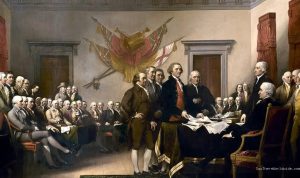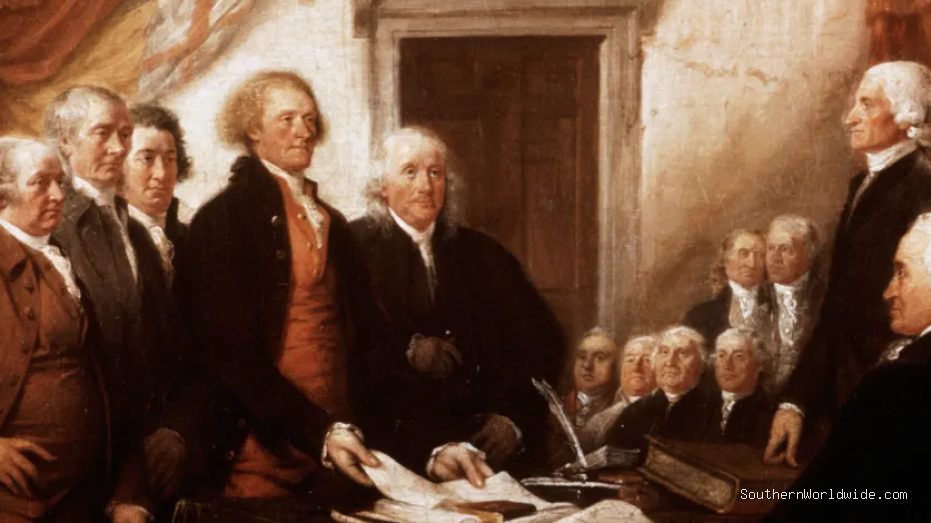
SouthernWorldwide.com – Two hundred and fifty years ago, 56 men gathered in the Pennsylvania State House in Philadelphia. Their purpose was to commit an act of treason against the most powerful empire of their time.
These men, representing the 13 colonies, were a diverse group including landowners, entrepreneurs, and politicians. They had been profoundly influenced by the new ideas emerging from Enlightenment thinkers and Christian teachings.
These deeply held convictions spurred them to initiate a war that, by all rational accounts, they could not possibly win. The world we inhabit today is a direct result of the vision of these 56 men. Even modern dictatorships, like North Korea, now adopt the language of “republic” to legitimize their rule.
In 1776, concepts like freedom, equality, and self-governance were still relatively new. They were primarily discussed by philosophers and only partially implemented in a few small communities. The overwhelming majority of nations globally were ruled by hereditary monarchies and empires, where the idea of equal rights and individual liberty was not even a consideration.
The struggle undertaken by the Founding Fathers seemed utterly incomprehensible to many at the time.
The Second Continental Congress largely entrusted Thomas Jefferson with the critical task of drafting the document that would articulate their vision for humanity and their new nation, thereby reshaping the course of history.
One can only imagine the immense pressure Jefferson must have felt. He secluded himself from June 11 to June 28 in a rented home on Market Street to meticulously craft this document. At the young age of 33, he penned what many consider one of the most beautiful passages in human history.
We hold these truths to be self-evident, that all men are created equal, that they are endowed by their Creator with certain unalienable Rights, that among these are Life, Liberty and the pursuit of Happiness.
Consider the profound impact of these words. Imagine living under Spanish colonial rule in South America or the oppressive grip of the Qing dynasty in China. Picture yourself as a poor tenant farmer under the heavy hand of King George in Virginia, or as an enslaved person in Georgia, whose freedom, under the principles of the Declaration, was still many decades away.
Read these words as if you had grown up in a society that inherently valued some individuals more than others based on their social standing. A system where your future was predetermined by the circumstances of your birth.
The Declaration of Independence was, in essence, a revolutionary statement. It provided the ideological and factual justification for a coup against an empire. However, its spiritual significance was even more profound.
It represented a revolution against the prevailing historical narrative. It challenged the notion that some individuals, whether men or women, were inherently superior to others. It championed the ideals of human dignity, fundamental rights, and equality before the law.
When Jefferson presented his document to Congress, and those 56 men affixed their signatures, dispatching it to King George and other world leaders, they ignited a war in the American colonies. This conflict would evolve into a centuries-long struggle to transform the globe from tyranny to liberty.
War was indeed what they got. Five of the signatories were captured, subjected to torture, and ultimately killed. Nine others succumbed to wounds or the harsh conditions of war. All of them were deeply affected by the conflict; their homes and property were ravaged by violence, and their children were thrust into the very turmoil they had initiated.
They faced starvation and suffered significant defeats. There must have been moments when they questioned whether these ideals, which had plunged their nation into such violence, were truly worth the immense cost.
And then, against all odds, they emerged victorious.
By establishing America, the Founding Fathers fundamentally altered the course of human history. We now live in a world where nearly half of all nations are democracies. The synergy of political freedom, free markets, and the technological innovation unleashed by these systems has lifted billions of people out of poverty, creating a world over 100 times wealthier than it was at the time of the Declaration of Independence.
The dominant global ideology today is the one articulated in the Declaration. The American Revolution has indeed become a revolution in human history.
This weekend, the United States celebrates Independence Day. We honor the 56 men who risked everything for their beliefs. But we also engage in solemn reflection on the charge laid out in the Declaration and its authors.
All individuals are created equal. We are all endowed by our Creator with inherent rights. Each of us deserves life, liberty, and the opportunity to pursue our own unique paths to fulfillment. However, these inalienable rights are not guaranteed.
Like our forebears, we are called upon to embrace and defend them. Abraham Lincoln once observed that great men “thirst and burn for distinction” and will achieve it, “whether at the expense of emancipating slaves, or enslaving free men.”
Across the globe, powers that oppose liberty, dignity, and opportunity ceaselessly strive to dominate others. As we mark America’s 250th Independence Day, let us resolve to fight back. Let us possess the audacity and conviction to stand against the enemies of liberty and to continue the fight for the promise of the Declaration and America’s spiritual foundation.
May we do so out of love – for our neighbors and for the blessings bestowed by the Creator. And may we draw courage from the example of those 56 men, their hundreds of thousands of compatriots, and the seemingly unwinnable war they ultimately won. Happy Independence Day.