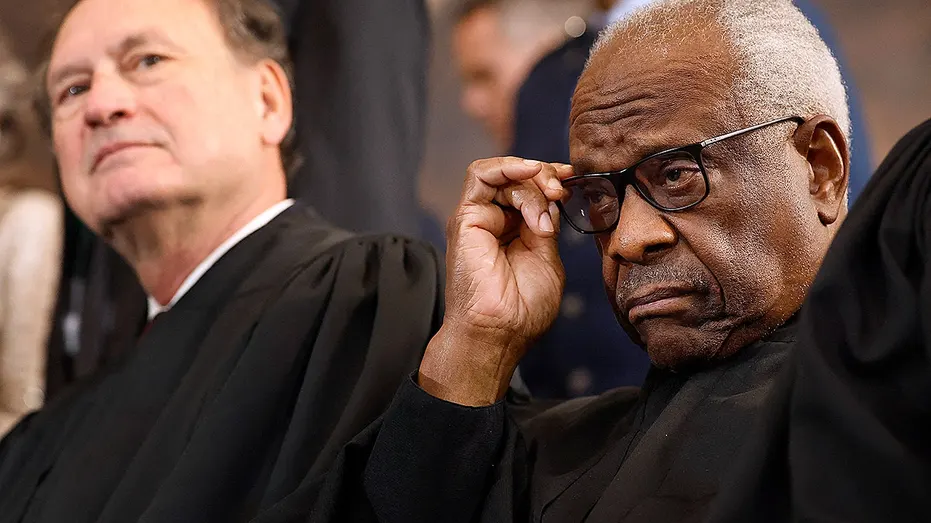
SouthernWorldwide.com – Justice Clarence Thomas, joined by Justice Samuel Alito, has voiced strong criticism regarding the Supreme Court’s case selection, suggesting the justices are prioritizing the wrong matters. This comes after the Court vacated a lower court’s ruling in a Florida murder case concerning what Thomas described as a minor procedural error with no bearing on the ultimate verdict.
Thomas argued that Gary Whitton’s attempt to secure a new trial, based on allegations of false testimony from a prosecution witness, would not have altered the outcome. He emphasized that the evidence against the Florida death row inmate was substantial and conclusive. However, the core of his dissent was a pointed critique of the Court’s apparent priorities. He highlighted several cases involving issues of race, freedom of speech, and military families that the justices chose not to review, believing these disputes were more deserving of the Court’s attention.
“It is unfortunate that the Court chose to intervene at the request of a convicted murderer to correct the Eleventh Circuit’s inconsequential foot fault,” Thomas wrote in his dissent. “What makes it even worse is that the Court does so even while it refuses to correct far more consequential errors for law-abiding citizens.”
In a 7-2 decision, the Supreme Court directed the Eleventh Circuit to re-evaluate whether Gary Whitton should receive a new trial. Crucially, this reconsideration must exclude any consideration of DNA evidence that was discovered after the original trial concluded. This newly found evidence indicated that blood stains on Whitton’s boots matched those of James Maulden, who was discovered deceased with multiple stab wounds in a motel room on October 10, 1990. The preceding evening, Whitton had been seen with Maulden at a bank, where Maulden had withdrawn the entirety of his account balance.
The justices concluded that the DNA evidence, unearthed through advancements in testing in 2002, was not pertinent. This was because the original jury in the 1991 trial had no knowledge of this evidence during their deliberations.
However, Thomas viewed the Eleventh Circuit’s reliance on the DNA testing results in its denial of Whitton’s request as a “technicality” error. He believed it was a misstep in their reasoning.
“If the Eleventh Circuit erred at all in mentioning the DNA test results, it was harmless for at least two reasons. First, the court thoroughly examined the overwhelming evidence against Whitton, which was more than sufficient to justify its decision,” Thomas wrote. “Second, Whitton had not even exhausted his claim in state court, so the Eleventh Circuit could not have ruled for him anyway.”
Whitton’s pursuit of a new trial is primarily anchored in the revelation that Jake Ozio, a witness for the prosecution, allegedly lied during the trial. Ozio had testified that he had no prior criminal record before his arrest. Ozio, who shared a jail cell with Whitton, claimed to have overheard Whitton confessing to “‘stabb[ing] the bastard.’”
Whitton subsequently filed a Giglio claim, asserting that Ozio had misrepresented his criminal history. This claim was initially rejected by the Florida Supreme Court. Years later, during federal habeas proceedings, Whitton argued that Ozio had lied about his lack of a criminal record. Thomas, however, contended that this specific claim should have been addressed and exhausted within the state court system first. This procedural point suggests that Whitton might be barred from obtaining any legal remedy, irrespective of whether the Eleventh Circuit improperly considered the post-trial DNA evidence.
“Whitton does not deny that state-court remedies were available,” Thomas wrote. “Yet, he never sought state remedies for his claim based on Ozio’s characterization of his criminal record.”
In concluding his dissent, Thomas expressed his disappointment with the Court’s decision to bypass cases involving “law-abiding citizens.” He cited several examples that he felt were more compelling and deserving of the Court’s attention. These included a challenge by parents of Boston University students against an affirmative-action policy they argue constitutes unconstitutional racial discrimination. He also mentioned objections to university policies alleged to suppress “free speech” and a lawsuit filed by the widow of an Air Force service member who died in the line of duty.
Read more : Odell Beckham Jr. Returns to Giants
“This Court routinely declines to provide relief to law-abiding Americans when it would actually matter, even after lower courts conspicuously flout this Court’s precedents in ruling against them,” Thomas wrote, underscoring his belief that the Court is not adequately serving the interests of ordinary citizens when significant legal errors occur in lower courts.