SouthernWorldwide.com – A cockroach equipped with a miniature scuba suit might initially evoke a sense of unease rather than hope, but scientists suggest this unconventional setup could revolutionize disaster response by enabling search teams to access areas inaccessible to humans and larger robots.
Researchers from NTU Singapore and Waseda University have successfully developed a flexible diving suit specifically designed for cyborg cockroaches. This innovative suit allows the insects to survive and navigate underwater, as well as in environments with limited oxygen, for extended periods of up to three hours.
The findings of this study were detailed in the prestigious journal Nature Communications. The primary objective behind this research is to enhance the capabilities of cyborg insects in post-disaster scenarios, such as floods, earthquakes, and other catastrophic events where debris, drainage systems, and confined spaces often impede rescue efforts.
A cyborg cockroach is essentially a living insect augmented with miniature electronic components that allow for guided movement. Unlike small artificial robots that rely on motors, these cyborg insects utilize their natural musculature for locomotion, significantly reducing their power consumption and extending operational duration.
However, a critical limitation for cockroaches is their reliance on air, which they absorb through small openings called spiracles. When submerged, they cannot extract oxygen from water, posing a substantial challenge for underwater operations.
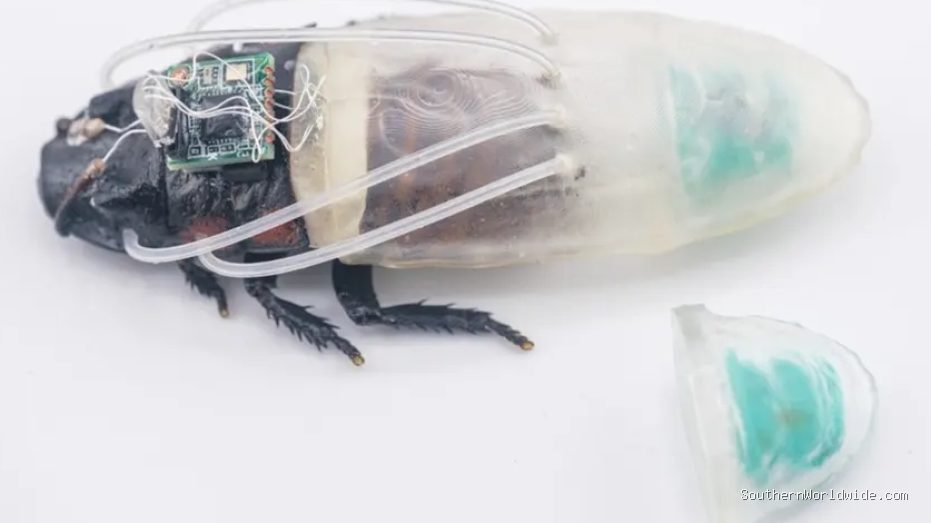
This is precisely where the cyborg cockroach diving suit addresses the critical need. The suit incorporates an oxygen-generation tank, a pliable waterproof casing, and four silicone oxygen tubes. These integrated components effectively prevent water ingress while directly supplying oxygen to the insect’s spiracles.
The oxygen tank itself is a marvel of 3D-printed technology, constructed from a clear, plastic-like resin. Within this tank, researchers have embedded a sponge treated with manganese dioxide. When a small quantity of diluted hydrogen peroxide is introduced, a chemical reaction ensues, slowly releasing oxygen. This oxygen is then channeled through the suit and delivered via tubes connected to the cockroach’s spiracles, effectively creating a self-contained, miniature oxygen supply system for the insect, analogous to the tanks used by human divers.
The research team conducted their tests using the Madagascar hissing cockroach, a species frequently chosen for cyborg insect research due to its substantial size, robust build, and lack of wings. The diving suit effectively transforms these cyborg insects from terrestrial crawlers into amphibious rescue robots capable of traversing both dry and wet terrains.
This unique capability could prove invaluable in disaster zones characterized by collapsed structures, standing water, blocked drains, and narrow crevices – environments where conventional robots often struggle. Small, insect-guided systems could navigate these challenging spaces, with future iterations potentially carrying sophisticated sensors or cameras.
While the concept might seem unsettling, the engineering behind it is undeniably impressive. Researchers are leveraging the cockroach’s innate agility and natural movement, augmented by a life-sustaining underwater breathing mechanism.
During trials, the cyborg cockroaches fitted with the diving suit maintained activity underwater for up to three hours. In stark contrast, a control cockroach without the suit succumbed to suffocation within approximately two minutes when submerged.
Further testing involved simulated rescue conditions within plastic tunnels. One scenario included a section filled with carbon dioxide followed by a water-filled segment. The cyborg cockroaches equipped with the diving suit successfully navigated these challenging environments.
The team also evaluated the insects’ ability to traverse narrow underwater passages. With the implanted electronics discreetly integrated rather than a bulky external backpack, the cyborg cockroach was able to maneuver through a crevice just 2 centimeters high – a space where many small robots would likely become trapped.
The most significant implication of this research is the potential to redefine the appearance of rescue robots. In certain scenarios, these robots may not be entirely mechanical but could incorporate the biological body of a living insect, enhanced with technological advancements. A cyborg cockroach, with its ability to crawl through debris, infiltrate tight spaces, and operate with minimal power, becomes significantly more useful when equipped for underwater movement in flooded disaster zones.
This technology could offer critical assistance following severe weather events, earthquakes, or infrastructure failures. Future applications might include inspecting flooded pipelines, drainage systems, tunnels, or compromised buildings.
While the widespread deployment of cyborg cockroaches in rescue operations is not imminent, as this remains an active area of research rather than an off-the-shelf tool for emergency crews, it clearly indicates the future trajectory of search and rescue technology.
Rescue teams are in constant need of tools that can penetrate environments deemed too hazardous for human entry. If a small, living insect can be equipped with electronics, navigate treacherous debris, and sustain itself underwater, it holds the potential to become an integral component of a comprehensive rescue system.
Ultimately, this could lead to more rapid post-flood inspections, improved access within damaged structures, and a broader range of options during critical rescue operations where every second counts.
The idea of a cyborg cockroach in a diving suit might seem far-fetched, but the underlying motivation is profoundly serious. Disaster zones are often characterized by confined spaces, hazardous air quality, and standing water – conditions that pose significant challenges for humans, drones, and even many small robots. This research offers scientists a novel perspective on developing rescue technology.
Instead of solely relying on the construction of entirely artificial machines, researchers are harnessing the cockroach’s natural capabilities and augmenting them with the essential missing element: the ability to breathe underwater. The most compelling aspect of this innovation lies in its future potential. When integrated with advanced sensors, cameras, and improved navigation systems, these once-creepy crawlers could transform into invaluable tools capable of saving lives.
Would you be comfortable with the use of cyborg insects in search-and-rescue missions if they could expedite the process of finding people? Share your thoughts with us by writing to us at Cyberguy.com.