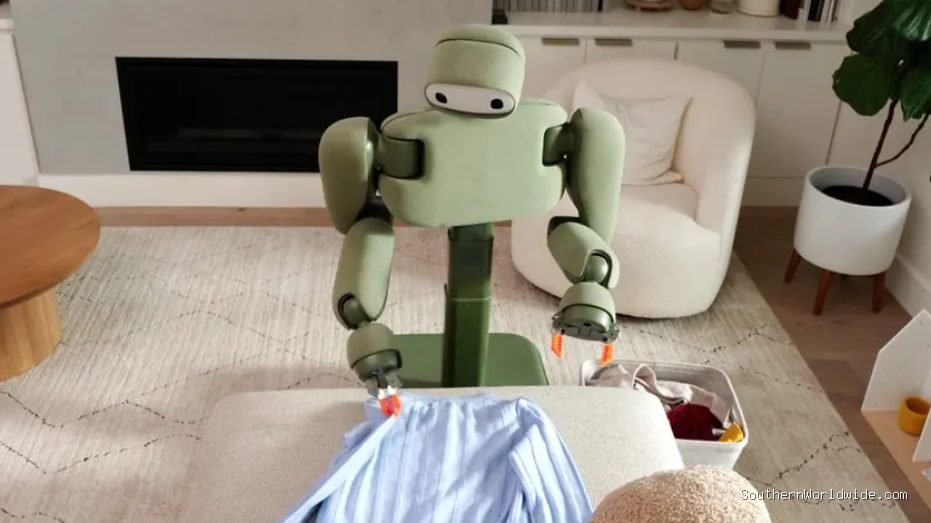
SouthernWorldwide.com – The prospect of a robot handling tedious household chores like folding laundry is appealing, especially for those with overflowing laundry baskets. Weave Robotics has introduced Isaac 1, a mobile home robot designed to tackle these often-delayed tasks.
This robot can manage dirty clothes, full hampers, fold garments, and put them away. It also assists with making beds, tidying pillows and blankets, and returning misplaced items to their designated spots.
The idea is particularly enticing for households with children, pets, or a seemingly endless cycle of laundry. However, Isaac 1 also prompts a significant personal consideration: how much access would you grant a robot in your home in exchange for fewer chores?
HUMANOID ROBOT CLEANS FIRST US APARTMENT
Isaac 1 is a wheeled mobile robot specifically engineered for domestic use. Weave Robotics states that the robot was designed and assembled in San Francisco. It features a flexible fabric exterior, a robust internal structure, and a collapsible torso.
The robot can reduce its size when not in use or extend to a human-like height when performing tasks. Unlike a robotic vacuum cleaner, Isaac 1 can reach for objects, move items, and interact with clutter within your home.
Control is managed through a smartphone companion app. This app allows users to request tasks on demand or schedule them for later, enabling Isaac 1 to operate while you are home or away.
Isaac 1’s primary functions are divided into two categories: Laundry Flow and Daily Reset. Laundry Flow encompasses finding dirty clothes, picking them up, handling loaded hampers, folding laundry, and putting items into storage.
Depending on your home’s setup, Isaac 1 may also assist with related tasks such as loading and unloading laundry from washing machines or dryers. The Daily Reset function focuses on tidying rooms to make them feel refreshed and ready for use.
This includes making beds, straightening pillows and blankets, and returning toys, shoes, and other clutter to their proper places. For many households, this capability could be a significant advantage, as laundry and daily tidying are time-consuming chores that rarely conclude.
Isaac 1 boasts an 8-hour battery life and requires approximately two hours for a full charge. It connects via Wi-Fi and has a base footprint of 20.5 inches by 22 inches. Its height is adjustable, ranging from 3 feet to 5 feet 9 inches, due to its collapsible and extendable torso.
Weave also specifies an 80-inch vertical reach and a 38-inch horizontal reach for Isaac 1. These specifications help illustrate how the robot can access beds, hampers, shelves, and other common household elements. Its wheeled base is designed for passive stability during task completion.
During the pre-order phase, customers can select a color preference from options including Sage, Gray, Slate Blue, Terracotta, or Vesper.
CHINA’S ROBOT-RUN HOTEL OPENS TO PUBLIC IN 2027
Weave states that Isaac 1 operates autonomously by default for its Laundry Flow and Daily Reset functions. However, the company also notes that teleoperation assistance may be employed when necessary to ensure task completion.
This detail is important as Isaac 1 operates within your home. Teleoperation means a human can remotely assist the robot if it encounters difficulties with an object, room layout, or task. In some instances, this could enhance the robot’s usefulness and prevent chores from being left unfinished.
Weave emphasizes that privacy is a fundamental aspect of Isaac 1’s design. The company also indicates that the robot has physical indicators to signal when it is operational.
However, Weave’s privacy policy reveals that its robots are equipped with video cameras and may record visual data of their surroundings. This can include the tasks being performed, objects within the robot’s field of view, and nearby individuals.
The policy further states that Weave’s personnel may remotely access this information in relation to the robot’s operation. While this does not necessitate immediate concern, it underscores the importance of reviewing the privacy policy before making a deposit.
While cameras may be necessary for Isaac 1 to fold clothes and navigate your home, your bedroom, laundry area, and living room are private spaces. Clear information is essential regarding what is recorded, who can access it, and for how long it is stored.
Before ordering, it is advisable to inquire about options for video deletion, the possibility of opting out of AI training usage, and methods to restrict the robot’s operating areas.
Weave offers two payment options for home customers. The first is an upfront payment of $7,999, with an optional $99-per-month premium membership. Alternatively, customers can opt for a subscription plan of $449 per month.
A fully refundable $250 deposit is also available for pre-ordering Isaac 1. This deposit secures your position in the order queue and remains refundable until the robot is shipped.
For some, the financial aspect may be weighed against the time saved. If Isaac 1 significantly reduces the burden of laundry and daily tidying, the cost might become more justifiable.
However, for others, a monthly payment of $449 might seem excessive for an early-stage home robot. Weave anticipates that initial shipments will commence in the fall of 2026, with deliveries starting in California and expanding to broader U.S. availability through 2027.
Following a pre-order, customers will receive a confirmation and thank-you email. As the delivery date approaches, the company plans to arrange a demonstration.
This demonstration can occur in person at a Weave facility or remotely via a video call. Weave also intends to use this time to understand your primary expectations for Isaac 1 within your home.
If Isaac 1 performs as advertised, it could liberate users from time-consuming chores that never seem to end. Laundry alone can consume several hours each week, particularly in busy households.
It could also be beneficial for individuals who find bending, lifting, or carrying heavy hampers challenging. For some homes, a robot that folds clothes and tidies rooms might offer more than just convenience.
However, Isaac 1 remains a connected device that navigates private spaces within your home. It utilizes cameras, connects to Wi-Fi, and may require remote assistance. Therefore, before placing a deposit, consider your home’s layout and where you would feel comfortable allowing it to operate.
GOOGLE TURNS OLD PHONES INTO CLOUD SERVERS
Your smartphone contains sensitive information such as emails, passwords, photos, banking applications, and personal data. In this replay of CyberGuy Live, Kurt the CyberGuy provides step-by-step guidance on simple phone security enhancements you can implement at your own pace.
You will learn how to improve your privacy settings, identify the latest phone scams, utilize trusted security tools, and receive a straightforward checklist for staying protected. You can watch the replay and access the checklist at CyberGuyLive.com.
Isaac 1 represents a significant advancement in home robotics, prompting a moment of reflection. The tasks of folding laundry, making beds, and repeatedly tidying clutter are universally unappealing and consume valuable time.
The primary challenge is the cost. At $7,999 upfront or $449 per month, Isaac 1 must offer substantial benefits beyond its demonstration capabilities. It needs to deliver genuine time savings, operate reliably, and integrate seamlessly into the home without introducing new complications.
Furthermore, privacy considerations are paramount. Isaac 1 employs cameras, connects to Wi-Fi, and may involve remote assistance. While these aspects may not be deal-breakers, obtaining very clear assurances would be essential before allowing it to operate in private areas like bedrooms or bathrooms.
The concept of a robot handling laundry is appealing, but the question remains whether most consumers are currently prepared to invest nearly $8,000 for this convenience.
Would you allow a robot access to your home if it meant you would never have to fold another load of laundry? Please share your thoughts by contacting us at CyberGuy.com.