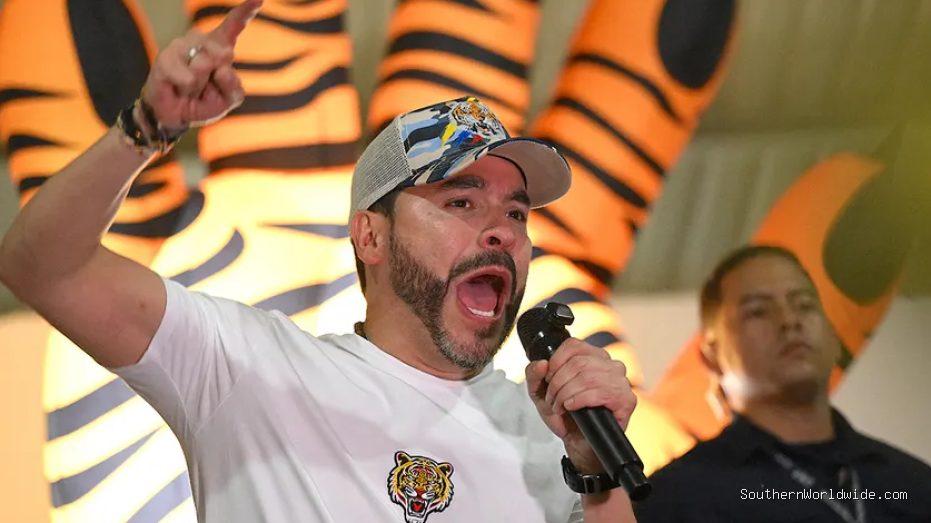
SouthernWorldwide.com – Former U.S. President Donald Trump has publicly endorsed Abelardo de la Espriella, a conservative attorney and businessman, for the presidency of Colombia, referring to him as “El Tigre.” Trump expressed his congratulations to de la Espriella during a White House event on Monday, stating that de la Espriella had won the election and would be a “great president.”
De la Espriella, known affectionately by his supporters as “El Tigre,” currently holds a narrow lead in the Colombian presidential race. With 99.9% of the votes tallied, he secured 49.7% of the vote, narrowly ahead of his socialist opponent, Senator Ivan Cepeda, who garnered 48.7%.
The preliminary results indicate that de la Espriella performed strongly in the country’s interior mountainous regions and the populous state of Antioquia. In contrast, Cepeda found support in the capital city of Bogotá and along the coastal areas, a pattern consistent with recent Colombian presidential elections.
However, the election outcome is not yet official. Senator Ivan Cepeda has formally challenged the results, citing alleged irregularities at numerous polling stations across the country. Despite these challenges, the prospect of overturning an election result of this magnitude would be an unprecedented event in Colombian political history.
If de la Espriella’s victory is confirmed, it would signify a broader trend of a rightward political shift across the South American continent. Similar electoral outcomes have been observed recently in countries such as Chile, Ecuador, Bolivia, and Peru, where conservative candidates have seen electoral success.
The election pitted two candidates representing starkly different ends of the Colombian political spectrum. Abelardo de la Espriella, with his “El Tigre” persona, has actively sought and received the endorsement of Donald Trump. His campaign platform emphasized a return to a strong law-and-order approach, reminiscent of former President Alvaro Uribe, and promised a robust military campaign against guerrilla factions and criminal organizations.
On the other side, Ivan Cepeda, a seasoned left-wing senator, vowed to continue the negotiation-focused strategy previously employed by Gustavo Petro, a political ally. Cepeda has a long history in Colombian politics, having served as a senator for 12 years and previously in the Chamber of Representatives. His political background is deeply rooted in the Colombian left, with his father, Manuel Cepeda, having been a prominent figure in the Colombian Communist Party before his assassination in 1994 during a period of intense internal conflict.
The first round of the election, held on May 31, saw de la Espriella leading with 43.7% of the vote, while Cepeda secured 40.9%. Senator Paloma Valencia, representing a right-wing faction, trailed distantly in third place with 6.9% of the vote.
Following the preliminary results of the second round, U.S. Secretary of State Marco Rubio extended congratulations to de la Espriella. Rubio expressed the Trump administration’s eagerness to collaborate with de la Espriella’s incoming government on advancing regional security cooperation and addressing illegal immigration to the United States.
De la Espriella’s campaign strategy bore significant resemblances to Donald Trump’s successful presidential bid in the United States. Both candidates positioned themselves as outsiders challenging the established political order. Notably, neither candidate had prior experience in elected or appointed government office before launching their presidential campaigns, largely operating outside traditional party structures.
A central issue that propelled de la Espriella’s campaign was security. He cultivated a strongman image to vehemently criticize the Petro administration’s policy of seeking peace through negotiations with armed groups. This approach was seen by many as too lenient.
Critics of Petro’s policy argue that its emphasis on negotiation and restraint in military action has inadvertently allowed groups like the ELN (National Liberation Army) and various FARC dissident factions to regroup. These groups have reportedly bolstered recruitment efforts and regained control over vital territories and drug trafficking routes.
In direct contrast, de la Espriella pledged to reintroduce an aggressive military strategy to combat terrorist groups and cartels. He also proposed the construction of “mega-prisons,” drawing inspiration from the crime eradication policies implemented by El Salvador’s President Nayib Bukele.
Furthermore, a de la Espriella presidency is anticipated to usher in a return to free-market economic principles. This would likely involve a reduction in government intervention in the economy and a renewed focus on lowering taxes.
The relationship between the United States and Colombia is also expected to strengthen significantly. This follows a period of considerable strain and tension between the Petro and Trump administrations, which was characterized by a series of public and often acrimonious exchanges on social media. Historically, Colombia has been a key ally for the U.S. in the region, but this alliance has seen a notable weakening under Petro’s tenure.
Political observers will also be closely monitoring the evolving dynamics between Colombia and Venezuela under a potential de la Espriella administration. It is expected that Bogotá, under de la Espriella, will align with the Trump administration’s stance on Venezuela. This would likely involve demanding a clear timeline for free and fair elections in Venezuela and urging the Venezuelan government to take decisive action against the ELN Marxist guerrilla group, which has reportedly found refuge in border regions and maintained close ties with former Venezuelan dictator Nicolás Maduro.