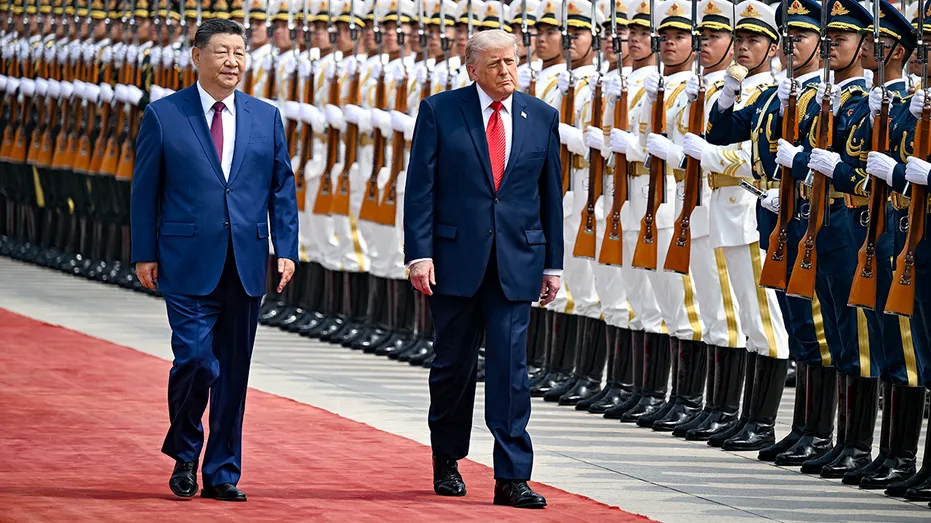
SouthernWorldwide.com – The recent summit between President Donald Trump and Chinese leader Xi Jinping in Beijing, while outwardly presenting a facade of diplomatic engagement, has served to underscore a deepening geopolitical reality: the emergence of a new Cold War between the United States and China.
Prior to Trump’s departure for China, concerns were raised that this meeting would transcend mere discussions on tariffs and trade. The assertion was that it would instead illuminate the fundamental shifts occurring on the global stage, characterized by a burgeoning rivalry driven by military might, economic influence, technological aspirations, and fundamentally divergent visions for global order.
The summit’s outcomes, in many ways, validated these concerns, perhaps even exceeding initial expectations.
While media coverage focused on symbolic gestures, trade talks, and elaborate ceremonies, three critical issues surfaced as paramount. Taiwan loomed large over the proceedings, China’s limited cooperation on Iran became evident, and Xi Jinping himself employed language rooted in ancient warfare to articulate the gravity of the rivalry.
The summit managed to de-escalate immediate tensions, but it did not resolve the underlying conflicts.
TRUMP-XI’S CHINA SUMMIT IS A DEFINING TEST FOR AMERICA IN THE NEW COLD WAR
A stark warning from Xi Jinping directly to President Trump regarding Taiwan underscored the significance of the issue. According to official Chinese foreign ministry statements, Xi emphasized that the “most important issue in China-U.S. relations” is Taiwan, and mishandling it could lead to “clashes and even conflicts” between the two nations, jeopardizing the entire bilateral relationship.
This pronouncement was both deliberate and extraordinary in its directness.
The strategic importance of Taiwan is often underestimated by the American public. Taiwan is a crucial component of the first island chain, a geographical barrier extending from Japan to the Philippines that constrains China’s naval projection capabilities into the Pacific. Furthermore, Taiwan is the world’s leading producer of advanced semiconductors, essential for everything from consumer electronics to sophisticated military systems. The United States, under the Taiwan Relations Act, is committed to supporting Taiwan’s defense capabilities. A Chinese takeover would severely damage American credibility among its allies in the region.
TAIWAN WATCHES TRUMP-XI MEETING FOR SIGNS CHINA WILL TEST US RESOLVE
Perhaps more revealing was Xi Jinping’s reference to the “Thucydides Trap,” a concept popularized by Harvard political scientist Graham Allison. This theory posits that war is often an inevitable outcome when a rising power challenges an established one. Xi questioned whether the United States and China could “overcome the Thucydides Trap and establish a new paradigm for relations between great powers.”
While President Trump highlighted themes of friendship, trade, and lucrative deals on his return journey, Xi framed the relationship through the lens of historical rivalry and potential conflict. This divergence in perspective is a key takeaway from the Beijing summit.
FIVE WAYS AMERICA CAN STOP A NEW COLD WAR WITH CHINA FROM TURNING HOT
This contrast offers significant insight into Beijing’s long-term strategic outlook.
The summit also highlighted persistent divisions between Washington and Beijing concerning Iran, despite public statements suggesting common ground. Both nations agreed on the importance of keeping the Strait of Hormuz open and preventing Iran from acquiring nuclear weapons. Reports indicated that China expressed interest in increasing its oil purchases from the United States, potentially reducing its reliance on the critical waterway.
However, the underlying substance of the discussions revealed a different narrative.
CHINA’S IRAN TIES COMPLICATE TRUMP-XI SUMMIT AS TENSIONS TEST US LEVERAGE
China’s substantial reliance on Gulf oil for its energy imports makes regional stability a genuine concern for Beijing. Despite this, intelligence reports have indicated that entities linked to China have supplied Iran with dual-use technologies, missile components, and sodium perchlorate—a crucial ingredient for solid rocket fuel—even as the United States voiced objections.
While Xi Jinping privately assured President Trump that China would not supply Iran with military equipment and desired the reopening of the strait, concrete plans or public commitments were notably absent. As noted by Foreign Policy, the summit yielded “few wins” concerning the Iran issue.
Beijing may offer selective cooperation when its interests align with those of the United States, particularly concerning energy flows and regional stability. However, Washington should avoid mistaking tactical alignment for strategic partnership. Iran continues to serve Beijing’s interests by diverting Washington’s attention, straining American military resources, and complicating the U.S. strategic posture in the Indo-Pacific.
AI ARMS RACE: US AND CHINA WEAPONIZE DRONES, CODE AND BIOTECH FOR THE NEXT GREAT WAR
To his credit, President Trump achieved one immediate objective: preventing the summit from devolving into overt hostility. His personal diplomacy succeeded in reducing immediate tensions and maintaining open lines of communication between nuclear-armed powers navigating concurrent crises in Iran, Taiwan, and the global economy. The current dynamic can be described as “managed rivalry,” where intense competition coexists with efforts to avoid direct conflict.
The core of this struggle extends far beyond trade, encompassing dominance in semiconductors, access to rare earth minerals, cyber warfare capabilities, and control over the computing infrastructure that will define future military power. This explains the last-minute inclusion of Nvidia CEO Jensen Huang in the U.S. delegation.
Huang’s presence was seen as symbolic of the contest for computing supremacy. Both governments recognize, as detailed in the book “The New AI Cold War,” that leadership in advanced machine learning systems and computing infrastructure will confer significant military and geopolitical advantages for decades to come.
Xi Jinping fully grasps this reality. China is actively integrating automated decision-making systems into its military command networks, predictive surveillance platforms, and cyber operations. This is not solely for economic competitiveness but for strategic dominance, aiming to render American power secondary even before any military engagement occurs.
Therefore, it is crucial for Americans to resist interpreting the summit’s cordial optics as a sign of waning rivalry. The state banquets, the tour of the Temple of Heaven, and President Trump’s invitation to Xi Jinping to visit the White House in September all contributed to an image of stability. However, the substance of Xi’s pronouncements points to a different conclusion.
Xi Jinping effectively conveyed to the United States that while cooperation is preferred, China will not yield on the issue of Taiwan. His choice of the Thucydides Trap to frame this message is significant, as this historical pattern has historically led to war in a substantial majority of cases. This was not an arbitrary choice.
This leaves Washington with a challenging but unavoidable strategy. The United States must bolster its deterrence capabilities in the Indo-Pacific, accelerate its efforts toward semiconductor independence, and maintain open communication channels with China. Deterrence is only effective if an adversary perceives that America possesses both the capability and the resolve to act.
As the proverb suggests, a wise person foresees danger and takes precautions, while the naive proceed and suffer the consequences. The Trump-Xi summit did not initiate the growing danger from Beijing; it merely illuminated a reality that serious analysts have recognized for years, and which those who prefer comfortable illusions continue to ignore.
Baca juga di sini: Mets Edge Out Yankees After Benge's Costly Mistake in Subway Series
The new Cold War is not a future possibility; it is an present reality. The summit served as definitive proof.