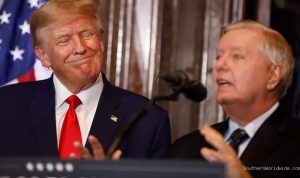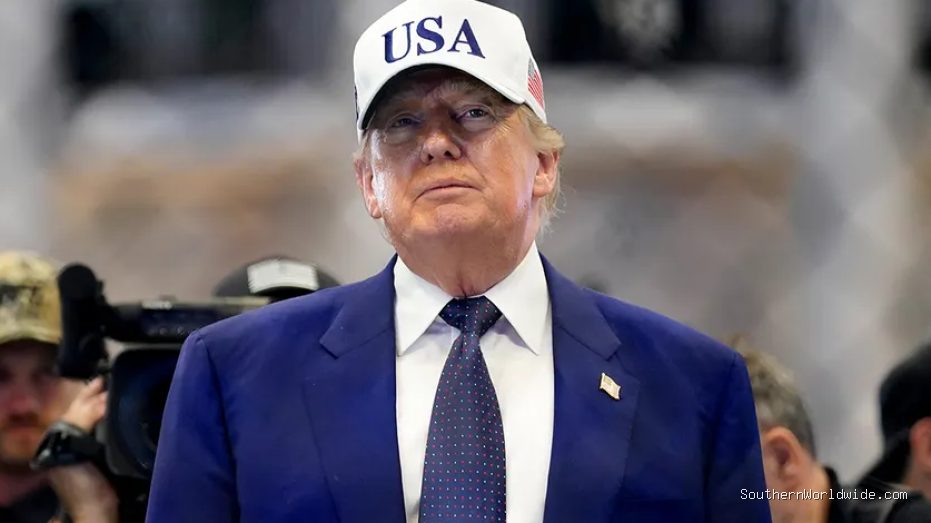
SouthernWorldwide.com – In a surprising move just days before a crucial Republican gubernatorial runoff in South Carolina, former President Donald Trump has issued a dual endorsement, backing both Attorney General Alan Wilson and Lieutenant Governor Pamela Evette.
This eleventh-hour decision comes as Trump navigates the complexities of the race to succeed term-limited Governor Henry McMaster in a state that reliably votes Republican.
Trump’s endorsement of both candidates, announced on his Truth Social platform, suggests a strategy to avoid alienating either faction within the party, acknowledging that endorsing only one could inadvertently harm the other.
The South Carolina runoff had been closely watched as a barometer of Trump’s influence over the Republican Party and the potency of his endorsements in primary contests.
This is not the first instance of Trump making multiple endorsements in a single Republican race. He has previously backed both Gina Swoboda and Jay Feely in the upcoming Republican primary for Arizona’s 1st Congressional District.
Perhaps the most memorable example was in 2022, when Trump endorsed “ERIC” in the Missouri GOP Senate primary. With two leading candidates named Eric—Schmitt and Greitens—both claimed the endorsement, though Schmitt ultimately secured the nomination.
In South Carolina, Trump had initially endorsed Evette late last month, approximately ten days before the gubernatorial primary election.
Evette emerged as the frontrunner in a crowded primary field, with Wilson securing the second position. Other notable candidates included Representatives Nancy Mace and Ralph Norman, as well as businessman Rom Reddy. As no candidate achieved a majority, the top two finishers, Evette and Wilson, advanced to the June 23 runoff.
Following their primary defeat, Mace and Norman subsequently endorsed Wilson. Additionally, Senator Ted Cruz, a prominent conservative from Texas, also threw his support behind Wilson a week prior.
The runoff contest between Evette and Wilson has intensified, marked by personal attacks and accusations of dishonesty during their final debate on Tuesday.
Wilson has sought to differentiate his extensive experience as the state’s Attorney General from what he characterizes as Evette’s more ceremonial role as Lieutenant Governor. He has emphasized his background as a combat veteran, prosecutor, and the state’s chief law enforcement officer.
Conversely, Evette has positioned herself as an outsider and a businesswoman with Trump’s backing, while portraying Wilson as a career politician.
South Carolina has not elected a Democratic governor in 28 years. The winner of this Republican runoff is widely expected to be the favorite in the general election against Democratic nominee Jermaine Johnson, a state representative.
The significant impact of presidential endorsements in GOP primaries has been evident in recent months. Trump’s favored candidates have successfully unseated incumbents he targeted in closely watched races across Indiana, Louisiana, Kentucky, and Texas.
However, Trump’s streak of statewide and congressional endorsements faced a setback three weeks ago. His last-minute endorsement of Representative Randy Feenstra in the race for Iowa’s governorship was insufficient to secure victory for the three-term congressman.
Feenstra was narrowly defeated by Zach Lahn, a businessman, farmer, and former political strategist. Lahn received support from political factions aligned with the Make America Healthy Again movement and Turning Point USA, a prominent conservative organization co-founded by the late Charlie Kirk.
Trump regained momentum a week later. Evette secured the top spot in the GOP gubernatorial primary, and long-time Trump ally Senator Lindsey Graham of South Carolina won his Republican Senate primary outright, avoiding a runoff.
Graham, who was endorsed by Trump, faced challenges from five other candidates. Among them was businessman Mark Lynch, who criticized Graham for his support of military action in Iran. Lynch had garnered backing from some MAGA leaders critical of Trump.
In recent days, Trump-backed candidates achieved victories in two of the three top races in Georgia and Alabama. The sole setback occurred against a billionaire businessman who invested over $100 million of his personal funds to bolster his campaign.
Representative Barry Moore, a member of the House Freedom Caucus and a staunch Trump supporter who received the president’s endorsement, comfortably defeated his rival Jared Hudson, a former Navy SEAL sniper backed by prominent conservative figures, in Alabama’s GOP Senate runoff.
In Georgia’s pivotal Republican Senate runoff, an eleventh-hour endorsement from Trump the previous weekend aided Representative Mike Collins, a vocal MAGA advocate, in his victory over former college football coach Derek Dooley, who was supported by popular conservative Governor Brian Kemp.
Collins is slated to face Democratic Senator Jon Ossoff in the general election. This race is among several that are anticipated to determine whether the GOP retains its narrow majority in the Senate following the midterms.
Jones consistently highlighted his endorsement from Trump. However, Jackson, who launched his campaign in February after Trump had already endorsed Jones, repeatedly stated that Trump had inspired his run.
In Georgia’s GOP gubernatorial runoff, however, the candidate Trump backed, Lieutenant Governor Burt Jones, who also received an endorsement from Kemp over the weekend, was defeated by Rick Jackson, who ran on an outsider platform.
A Trump political operative, commenting on the Tuesday loss of Trump-backed Jones, observed that “Rick Jackson set a record for spending in a statewide Republican primary. He spent Tom Steyer level money in a state a fraction of the size of California. That’s going to have an impact.”
The operative, who requested anonymity to speak freely, also emphasized that “Rick bearhugged Trump. All of his ads and material was about how he’s going to be Trump’s favorite governor. So the race was not really a referendum on Trump.”