SouthernWorldwide.com – A substantial funding request from the Pentagon, intended to cover some of the costs associated with the Iran war, is poised to face significant opposition from Senate Democrats. Furthermore, a critical element within this multi-billion dollar proposal could potentially create a divide among Republicans.
Congress received the nearly $88 billion package on Wednesday afternoon. This submission followed months of speculation regarding its eventual delivery and its precise cost. The current figure represents a considerable reduction from earlier projections, which had estimated the package could reach as high as $200 billion.
However, with approximately four months having passed and a tentative peace agreement now in place, Democrats appear disinclined to approve funding for munitions replenishment, despite concessions seemingly designed to garner their support.
CLOSED-DOOR OUTBURST TURNS INTO VICTORY FOR TRUMP’S IRAN NEGOTIATIONS
“It appears to be crafted to alienate Democratic votes,” stated Senator Chris Murphy, D-Conn. “They are clearly not aiming for this to pass.”
These concessions, which include $11 billion in aid for farmers and $1.4 billion to combat the Ebola outbreak in Africa, failed to sway Murphy. He asserted that the farm assistance, in particular, constituted a “war cost.”
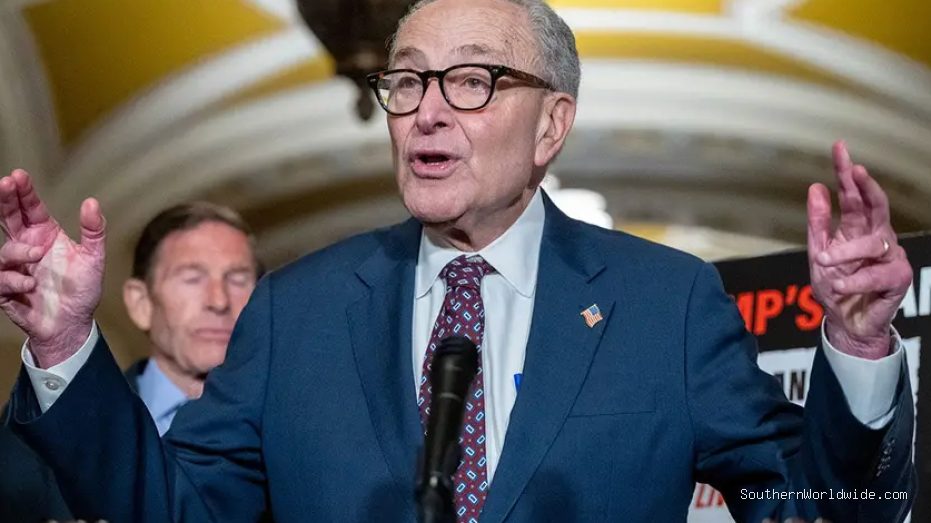
Senate Minority Leader Chuck Schumer, D-N.Y., also expressed his disapproval, accusing President Donald Trump of “asking taxpayers to clean up his messes.”
“After leading America into a reckless war, he now expects Congress to provide him with tens of billions more to cover up the damage — while families continue to face higher prices,” Schumer posted on X. “We should be reducing costs for the American people, not writing another blank check for Trump.”
Senator Josh Hawley, R-Mo., was unsurprised by the apparent readiness of Senate Democrats to reject the package, which requires at least 60 votes to pass in the Senate. He argued that “they haven’t supported anything this year, or last year.”
IRAN WAR’S PRICE TAG HITS $80B — MORE THAN DOUBLE WHAT CONGRESS WAS TOLD
“That’s literally true. I mean, including things they negotiated,” Hawley commented. “FISA, they negotiated, which I didn’t agree with when they negotiated it, but still, you know, they negotiated and said, ‘No,’ they negotiated all the appropriations bills then said, ‘No.’ I mean, so, you know, I’d be shocked if they supported it.”
The majority of the request is allocated to the Pentagon, totaling $67 billion for the War Department. This includes $21 billion to restock missile supplies depleted during the Iran offensive, known as Operation Epic Fury, $17 billion for military operations, $2.4 billion for drones, and $5.1 billion for cybersecurity and autonomy initiatives.
An additional $12 billion of the War Department funding is designated for classified programs. The request also earmarks $2 billion for the Coast Guard and $800 million for the National Guard.
The administration is also requesting $672 million for the removal of Iranian nuclear materials, inspections, verification efforts, and other counterproliferation activities.
According to the proposal, the funding would support the removal of Iranian nuclear materials, such as uranium hexafluoride (UF6), various forms of uranium, and research reactor fuel, including highly enriched uranium.
The proposal would also finance potential U.S. verification activities within Iran, contingent on site access, support inspections by the International Atomic Energy Agency, enhance efforts to detect nuclear smuggling, and expand Nuclear Emergency Support Team operations across the Middle East.
This funding comes as U.S. and Iranian negotiators are working to transform the recent memorandum of understanding (MOU) into a more comprehensive agreement governing Iran’s nuclear program and its stockpile of enriched uranium.
While the memorandum established downblending as the minimum acceptable method for managing Iran’s enriched uranium, negotiators have not publicly disclosed whether the material will ultimately remain in Iran, be transferred to another nation, or be destroyed.
TRUMP SEEKS $672M TO STOP IRANIAN NUKES AS NEGOTIATORS WEIGH FATE OF URANIUM STOCKPILE
While Democrats are expressing strong opposition to the supplemental spending package, a particular provision within the legislation could also present challenges for Republicans.
Among the provisions for farm aid is a policy to permanently permit the sale of gasoline blended with ethanol, a liquid biofuel derived from corn, known as E15.
The E15 issue has exposed a rare divergence within Senate Republican leadership, a rift that extends through the Senate GOP based on regional economic differences rather than personal animosity.
“Promising a year-round E15 mandate is a check the president cannot cash,” a Republican source stated.
Senate Majority Leader John Thune, R-S.D., supports this provision, particularly for the potential benefits it could offer candidates running for election or re-election in states where corn cultivation is dominant.
However, his second-in-command, Senate Majority Whip John Barrasso, R-Wyo., opposed the House bill for a year-round E15 mandate when it passed last month. He has argued that allowing such a mandate on the fuel blend would adversely affect small refiners and undermine the progress made in energy production under Trump’s signature legislation, the “big, beautiful bill.”
“America’s small refiners are unsung heroes of affordable American energy. Washington D.C. often overlooks them. Working families depend on them,” Barrasso stated on the Senate floor earlier this week. “I represent several small refineries in Wyoming. These refineries employ thousands of people.”
“They make gasoline prices more affordable,” he continued. “They strengthen our nation’s energy security. Proposed new mandates on small refineries would harm them and the people who work for them.”
Since the House bill’s passage, Thune has indicated that he has been engaged in ongoing discussions to identify a “path forward” on the issue.
“We are collaborating with stakeholders and our members on both sides to determine if this is something we can implement and achieve,” Thune remarked.
Senator Mike Rounds, R-S.D., a proponent of the provision, viewed it as an “incentive.” However, he acknowledged the possibility of it being amended out of the broader supplemental package.
“I mean, it makes for a better deal, and I don’t understand why they would want to remove it,” Rounds said.