SouthernWorldwide.com – The Commission of Fine Arts has officially given its approval for President Trump’s ambitious plan to construct a Triumphal Arch on the outskirts of Washington D.C.
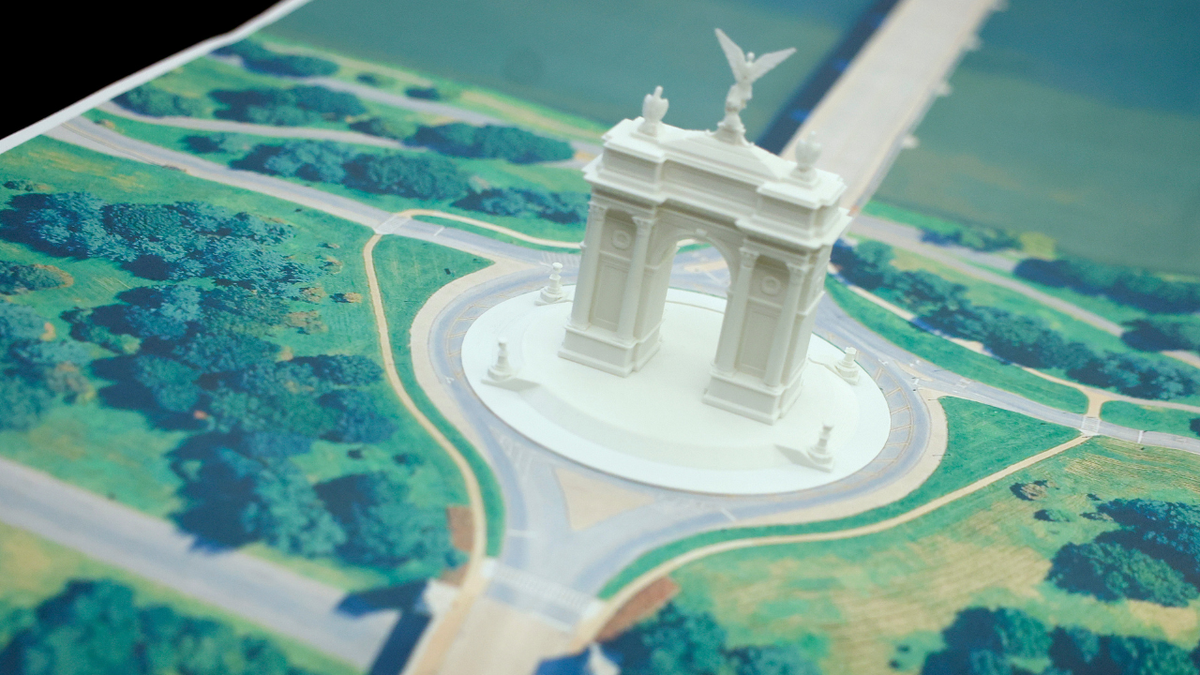
This landmark structure is slated to be positioned over the Memorial Bridge, directly opposite the Lincoln Memorial, marking a significant step toward its realization.
The architectural design, developed by the Department of the Interior, envisions a colossal arch standing 250 feet tall. It will be elaborately adorned with golden eagles and a statue of Lady Liberty crowning its apex.
This monument is intended to symbolize American exceptionalism and serve as a tribute to the nation’s 250th anniversary, which falls this July.
The Triumphal Arch embodies a core aspect of President Trump’s vision: a bold declaration that America is unashamed of its greatness and committed to constructing edifices befitting a powerful nation.
Furthermore, it signals the Trump administration’s ongoing dedication to revitalizing classical architectural styles in federal buildings.
Last summer, President Trump issued an executive order titled “Making Federal Architecture Beautiful Again.” This directive mandates the General Services Administration to ensure that new federal constructions enhance and beautify public spaces, thereby ennobling the United States.
The proposed arch represents a significant expression of this movement to re-establish beauty as a civic value, a principle the author proudly supports.
Baca juga di sini: As a Soldier's widow, I will always remember the kindness of everyday Americans.
Critics, particularly from elite circles, often dismiss such grand civic monuments as ostentatious or even fascistic, a notion the author finds difficult to accept.
The New Yorker, known for its sophisticated critique, has controversially labeled President Trump’s arch as part of an “Architecture of Autocracy.”
However, the author argues that the majority of Americans intuitively recognize that beauty in public spaces is not inherently authoritarian. Instead, public beauty is presented as a gift and a vital component of the nation’s republican heritage.
The design of the Triumphal Arch is seen as harmonizing with the classical and democratic architectural styles prevalent in structures like the Capitol Building, the Washington Monument, and the Jefferson Memorial.
In stark contrast, the author criticizes recent modernist architectural trends in Washington D.C., which the Trump administration aims to replace, describing them as ugly, authoritarian, and jarringly out of place.
Examples cited include the J. Edgar Hoover FBI Building, characterized as a “brutalist disaster,” and the Hubert Humphrey Building, likened to a “Soviet-era nightmare.”
The HUD building, famously described by Dr. Ben Carson as “ten floors of basement,” also falls under this critique.
These perceived “hideous buildings” in the nation’s capital are seen as diminishing expectations of government and making citizens feel insignificant.
The Triumphal Arch, conversely, is intended to convey a powerful message of American greatness and pride.
The author expresses anticipation for the construction of the Triumphal Arch in the coming months, viewing it as one of several projects aimed at restoring beauty to federal architecture, alongside initiatives like the East Wing Ballroom.
Earlier this year, the author introduced the Beautifying Federal Civic Architecture Act. This legislation seeks to codify into law the principles already established by President Trump’s executive order.
The proposed bill aims to ensure that classical buildings, exemplified by the Triumphal Arch, are constructed not only in Washington D.C. but also throughout the country for generations to come.
The author emphasizes that beautiful architecture should not be exclusive to Washington D.C. residents, recalling a personal connection to such structures.
Growing up in a trailer park in Columbia City, Indiana, the author found inspiration in the nearby Whitley County Courthouse, built in 1888.
The courthouse’s dome, rising above the town square, served as a symbol that the town, the law, and something grander than everyday life held significance.
The author urges Congress to enshrine these architectural principles into law, enabling more Americans to experience the inspiration derived from monuments like the Triumphal Arch and local courthouses.
These enduring and beautiful buildings are deemed worthwhile investments, reflecting the inherent value of the country itself.