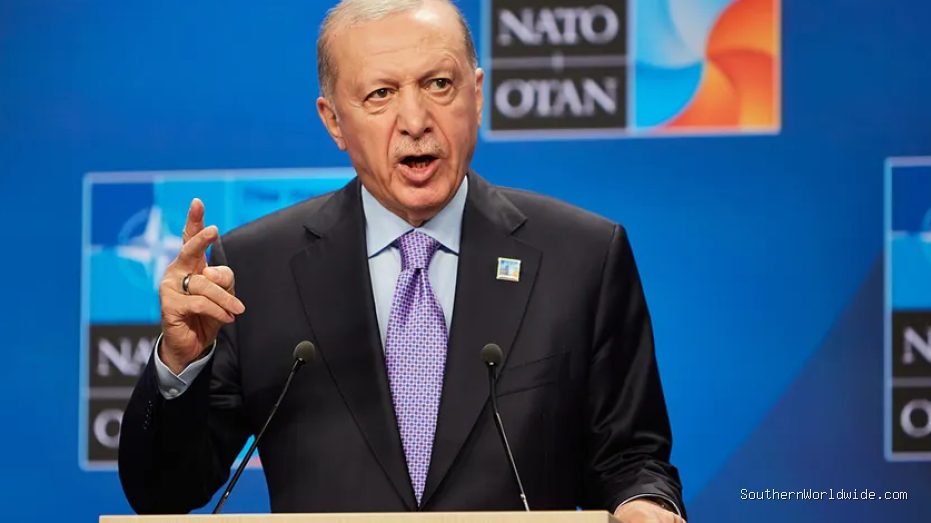
SouthernWorldwide.com – As U.S. President Donald Trump prepares to visit Ankara for the upcoming NATO summit, Turkish President Recep Tayyip Erdoğan is once again a central figure in alliance politics.
Trump has publicly praised Erdoğan, referring to him as a “friend” and a “respected leader.” This relationship could significantly influence defense discussions between Washington and Ankara, particularly concerning Turkey’s ongoing efforts to deepen military cooperation with the U.S.
This moment underscores Erdoğan’s unique position within NATO. After Turkey’s acquisition of the Russian S-400 missile defense system in 2019, which led to strained relations and concerns about its role as a troublesome ally, the country has become increasingly indispensable to the alliance. This is largely due to the protracted war in Ukraine, regional instability in the Middle East, and the growing strategic importance of the Black Sea.
However, for many observers, Erdoğan remains an enigmatic figure. Experts suggest that his political trajectory is not guided by a rigid ideology but rather by a consistent reinvention of himself to serve his primary goal: maintaining power.
The article highlights a recent report by Fox News detailing Turkey’s detention of over 200 suspects, including alleged ISIS militants, in a large-scale raid just before the NATO summit. This event points to the complex geopolitical landscape Turkey navigates.
Erdoğan has been at the helm of Turkey for over two decades, evolving from an Istanbul mayor with Islamist leanings to a pro-European reformer, then a nationalist strongman, and now a crucial player in NATO whose influence is recognized by leaders like Trump.
While his supporters view him as a leader who restored Turkey’s global standing, critics contend that he has eroded the country’s democracy, leading to the imprisonment of political rivals, journalists, and activists. However, many experts believe that Erdoğan’s most defining characteristic is not ideology but his drive for political survival.
Questions about whether he is an Islamist, a nationalist, a Western ally, a Russian partner, or an authoritarian are common. Gönül Tol, founding director of the Middle East Institute’s Turkey Program and author of “Erdoğan’s War: A Strongman’s Struggle at Home and in Syria,” explains that Erdoğan has embodied all these roles at different times.
The article also references a Fox News report on the strategic value of Turkey surging, with Trump betting on the former “troublemaker” of NATO. This suggests a pragmatic approach to foreign policy where strategic interests can outweigh past disputes.
Another related report from Fox News mentions six Kurdish fighters killed in an IRGC ambush, indicating ongoing regional conflicts that impact Turkey’s geopolitical position.
The Conservative Democrat
Erdoğan’s political journey began within Turkey’s Islamist movement. After attending an Imam Hatip religious school, he entered politics through National Outlook, an Islamist movement, and eventually served as the mayor of Istanbul.
Upon co-founding the Justice and Development Party (AKP) in 2001, Erdoğan distanced himself from the Islamist label. He presented himself as a “conservative democrat” advocating for economic reforms and closer ties with Europe. This strategic shift, according to experts, marked the first of his significant political reinventions.
When the AKP came to power in 2002, Turkey was actively pursuing EU membership, and the military’s influence in politics was diminishing. Erdoğan promised democratic reforms, economic modernization, and stronger Western alliances.
Initially, many liberals and centrists supported him. Tol notes that Erdoğan’s claim of no longer being an Islamist but a “conservative democrat” resonated well and served his political ambitions.
These early years of his leadership saw substantial transformations in Turkey’s economy and a significant boost in Erdoğan’s popularity.
Further context is provided by a Fox News article titled “Trump Bets on Former NATO Troublemaker as Turkey’s Strategic Value Surges,” highlighting the evolving dynamics between the U.S. and Turkey.
The Islamist
After solidifying his power, Erdoğan initiated another phase of political evolution.
Following the Arab Spring in 2011, he increasingly positioned himself as a proponent of political Islam. He supported Islamist movements across the Middle East while domestically championing himself as the protector of Turkey’s conservative religious majority.
“He aimed to integrate more Islamic principles into public life and education,” Tol explained. “He utilized this more Islamist narrative… with the ultimate goal of accumulating more power.”
This shift away from a pro-Western stance extended beyond rhetoric.
In 2016, Erdoğan accused the U.S.-led coalition of supporting terrorist organizations in Syria, including ISIS and Kurdish militias, which Turkey designates as terrorist groups. This claim was met with strong denials from the State Department, as reported by Reuters.
His vocal support for Hamas and strong criticism of Israel became defining aspects of his foreign policy.
In 2023, Erdoğan stated, “The perpetrators of the massacre and the destruction taking place in Gaza are those providing unlimited support for Israel,” characterizing Israel’s actions and their supporters as engaging in “murder and mental illness,” according to Reuters.
However, Tol advises against interpreting these stances solely as evidence of Erdoğan’s primary motivation being Islamism.
“Anti-Israel sentiment is prevalent across ideological lines in Turkey,” she commented, suggesting that Erdoğan’s foreign policy decisions are more often driven by political calculations than by religious doctrine.
A related Fox News article, “Trump’s Turkey Arms Sale Proposal Sparks Congressional Questions Before NATO Summit,” indicates ongoing debates surrounding U.S.-Turkey relations.
The Nationalist Strongman
As Turkey’s economic growth slowed and its regional ambitions faced setbacks, Erdoğan underwent another political pivot.
He embraced Turkish nationalism, forged alliances with hardline nationalist parties, and cultivated an image as an indispensable strongman capable of reasserting Turkey’s historical influence.
His supporters credit him with elevating Turkey to the status of a regional power.
“He does have genuine support,” Tol stated, estimating his support base at approximately 35%.
Some of his supporters rely on government aid and patronage networks established during his tenure. Others believe Erdoğan has restored a sense of dignity to conservative, religious Turks who historically felt marginalized by the country’s secular elite.
Furthermore, some view his increasingly assertive foreign policy as a sign that Turkey has regained its prominence on the global stage.
“They think, ‘We have become a world-class nation,'” Tol remarked. “‘Everyone is praising our president. Turkey is a big player.'”
While Erdoğan maintains a loyal political following, critics argue that this has come at the expense of Turkey’s democratic institutions.
Authorities have increasingly employed the judicial system and criminal investigations to suppress political opposition. This includes actions against Istanbul Mayor Ekrem İmamoğlu, whose arrest earlier in 2026 reportedly sparked nationwide protests, according to Human Rights Watch.
Human Rights Watch reports that the government has intensified efforts to undermine Turkey’s main opposition party, despite its strong performance in the 2024 municipal elections.
A related Fox News opinion piece, “Trump’s Personal Feuds With Allies From Italy to Israel Reveal How Personality Drives His Foreign Policy,” offers insights into how personal relationships can influence international affairs, potentially including those with Erdoğan.
The NATO Dealmaker
Currently, Erdoğan is navigating yet another political transformation.
After years of anti-Western rhetoric and friction with Washington, Turkey has been working to mend its relationship with the United States and Europe.
This anti-Western stance was once a cornerstone of Erdoğan’s political strategy.
He had accused the U.S.-led coalition in Syria of backing terrorist groups, condemned Washington’s sanctions following Turkey’s purchase of the Russian S-400 missile system, calling them a “hostile attack” on Turkey’s sovereignty and defense industry, and frequently criticized Western governments for their support of Israel’s actions in Gaza.
This shift in approach coincides with a significant increase in Turkey’s strategic importance.
The S-400 acquisition remains a major unresolved issue between Washington and Ankara. Following Turkey’s receipt of the Russian system in 2019, the U.S. removed Turkey from the F-35 fighter jet program and subsequently imposed sanctions on Turkey’s defense procurement agency.
“The F-35 is a different issue,” commented Jeffrey, suggesting the problem is technical rather than solely political.
Turkey’s strategic position, controlling the Bosporus and Dardanelles straits, possessing NATO’s second-largest military, and playing a crucial role in the Black Sea following Russia’s invasion of Ukraine, cannot be overlooked.
Jeffrey highlighted Turkey’s essential role in supporting Ukraine’s defense efforts. He pointed to Turkey’s implementation of the Montreux Convention, a 1936 treaty governing naval passage through the straits, its early provision of Bayraktar drones to Ukraine, and its mediation efforts between Kyiv and Moscow.
“You cannot contain Russia in the Black Sea without Turkey,” Jeffrey asserted.
For Tol, however, Erdoğan’s current engagement with NATO is simply another manifestation of his political adaptability.
“There was a period when he was strongly anti-Western, highly critical of NATO, and very critical of the United States,” she recalled.
“And now look at him.”
Growing Criticism
Human Rights Watch suggests that Erdoğan has leveraged Turkey’s increased importance to NATO as a shield while simultaneously intensifying pressure on journalists, activists, and opposition figures.
Freedom House reports that Erdoğan has become “increasingly authoritarian” over the last decade, consolidating power through constitutional amendments and the imprisonment of political opponents, independent journalists, and figures from civil society.
According to a June 2026 report citing Turkish Justice Ministry data, Turkey’s prisons held over 420,000 inmates, significantly exceeding their official capacity of approximately 304,000.
As Turkey’s strategic value has risen, NATO allies have become less vocal about its human rights record. Reuters noted this trend ahead of the summit, with former U.S. Ambassador David Satterfield emphasizing the continued importance for the West to publicly address the “degradation of democratic institutions in Turkey.”
Tol believes that Erdoğan’s domestic policies can be understood through a singular guiding principle.
“Everything is designed to keep him in power,” she stated. “Beyond that, I don’t see a unifying ideology that connects all his policies.”
As Trump heads to Turkey, this understanding of Erdoğan’s pragmatic approach to power may be key to comprehending one of NATO’s most influential and unpredictable leaders.