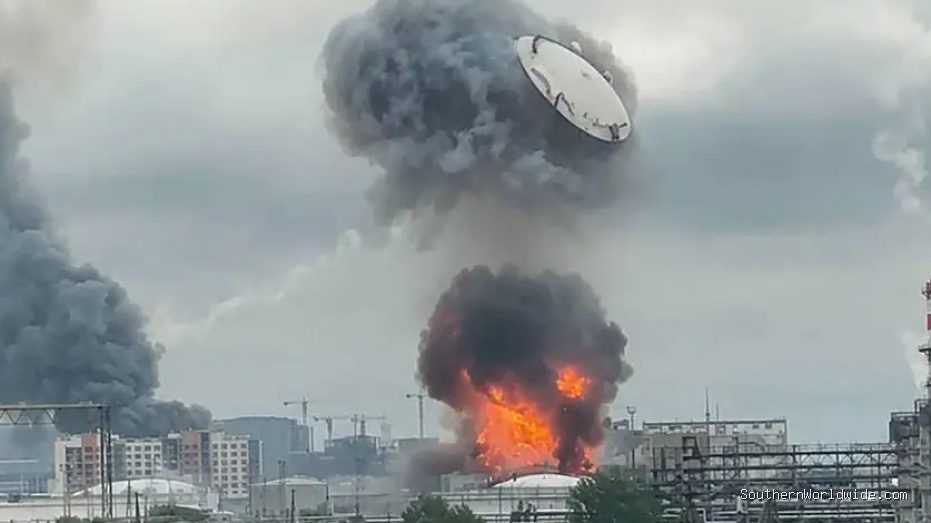
SouthernWorldwide.com – Ukraine’s escalating campaign targeting Russia’s oil industry is increasingly making its presence felt within Russia. This has compelled one of the world’s leading energy producers to curb diesel exports, seek fuel imports, and grapple with shortages that span from occupied Crimea to cities deep within its borders.
The repercussions are becoming more evident across Russia. Former Russian opposition politician and commentator Maxim Katz highlighted that these shortages represent one of the most direct ways many Russians have personally experienced the war’s consequences. This could prove particularly sensitive with State Duma elections slated for September.
Katz explained that while Russian elections are neither free nor competitive, they still serve a crucial purpose for Putin by projecting an image of public support to regional leaders, business figures, and other elites.
He elaborated, “If everybody sees in September that he has 20% support or 10% support, then questions begin about why he should appoint governors or control the system.” Katz added that this is a scenario Putin wishes to avoid.
The fuel crisis, according to Katz, directly challenges Putin’s strategy of presenting himself as being in complete control and of insulating ordinary Russians from the war’s costs.
“Putin tried to convince everybody that Moscow would continue to live its regular life and nobody would see the war,” Katz stated. “It was his war, not the war of ordinary Russians. But when the war comes home, this is a completely different story, and it changes the equation.”
Katz also pointed to the striking irony of Russia, historically a major exporter of oil and refined products, now seeking fuel supplies from other nations. Reuters reported that Moscow had approached Kazakhstan about importing approximately 50,000 metric tons of gasoline due to refinery outages that reduced Russian gasoline output by roughly 25% compared to the previous year.
The campaign reached a significant point this week with Ukrainian drones striking the Omsk refinery, Russia’s largest, located about 1,700 miles from Ukrainian-controlled territory. According to Reuters, the facility temporarily halted its processing operations following the attack. Days later, another strike forced Russia’s Saratov refinery to shut down for the third time this year.
This widening crisis prompts a fundamental question for Ukraine and its allies: can attacks on the infrastructure that fuels Russia’s military and economy influence President Vladimir Putin’s decision-making, or will the Kremlin continue to protect its war effort while shifting the burden onto its citizens?
“They have to buy fuel from Kazakhstan now,” Katz remarked. “Russia is one of the biggest exporters of oil and oil products and always has been. This is crazy.”
Despite this, Katz cautioned that the Kremlin would likely continue to prioritize military supplies even if civilian shortages intensify.
“He will find the fuel for the tanks. That is not the issue,” Katz asserted. “The issue is his grip on Russia.”
Retired U.S. Air Force Gen. Philip M. Breedlove, former commander of U.S. European Command and NATO Supreme Allied Commander Europe, stated that the impacts are already substantial.
“These strikes are beginning to seriously impact not just the economy but the Kremlin’s ability to sustain its war effort and military operations,” he added. “When Ukraine is able to hit large, high-value energy targets deep inside Russian territory, that changes the equation.”
“Russia cannot effectively defend every refinery and energy facility across their enormous territory, and that is the core problem for Moscow,” Breedlove observed. “Every asset they deploy to defend their infrastructure are assets not deployed to the frontlines.”
Moscow has already implemented emergency measures. Russia has banned diesel exports until the end of July as drone attacks have led to unplanned refinery shutdowns and reduced domestic supplies. According to Reuters, seaborne exports of diesel and gasoline decreased by 39% in June compared to May and were down 46% from the previous year.
Ukraine’s ambassador to Israel, Yevgen Korniychuk, indicated that American intelligence has played a vital role in assisting Kyiv in penetrating Russia’s extensive air defense network.
The Wall Street Journal, citing U.S. officials, reported in a 2025 article that “The U.S. will provide Ukraine with intelligence for long-range missile strikes on Russia’s energy infrastructure.” Reuters, referencing the Financial Times, also reported that “U.S. intelligence has helped Kyiv strike important Russian energy assets, including oil refineries, far beyond the front line, the newspaper said, citing unnamed Ukrainian and U.S. officials familiar with the campaign.”
Korniychuk stated that the strikes are creating significant pressure within the Russian system, even if they have not yet convinced Putin to alter his course.
“The majority of the Russian leadership understands that this is a crucial problem, but Putin personally does not,” he said. “The distance between him and the rest of the Russian leadership is growing tremendously. Even people he has trusted for many years understand that this is going nowhere, but that will not necessarily bring Putin to the same conclusion.”
Retired Lt. Gen. Richard Newton, former U.S. Air Force assistant vice chief of staff, argued that the broader strategic landscape is shifting in Ukraine’s favor.
“Throughout the conflict, the vast majority of the Russian homeland has been a sanctuary,” Newton remarked. “However, over the last several months, Ukrainian drone attacks have reached deep inside Russia — up to 1,500 miles recently.”
Newton noted that this pressure is mounting as Western support intensifies.
“That is a credit to President Zelenskyy, his military leadership and Ukraine’s defense industrial base,” he stated. “And it comes at the right time, with Europe now providing military capabilities and financial resources — and now, with renewed public support from President Trump.”
However, the strategy has its limitations. Russia continues to generate billions in energy revenue that remains beyond the reach of Ukrainian drones.
An analysis by Urgewald, a Germany-based nonprofit environmental and human-rights organization, using Kpler cargo data found that the European Union received 114 out of 118 cargoes shipped from Russia’s Yamal LNG project between January and May 2026, representing approximately 97% of the project’s exports. These shipments totaled 8.37 million metric tons and were valued at an estimated $5.7 billion.
These figures highlight the dual reality facing Kyiv: Ukraine can damage refineries, disrupt domestic fuel supplies, and force Moscow to reallocate resources, while Russia continues to earn substantial revenue from global energy markets.
Ambassador Korniychuk mentioned that President Zelenskyy has given the military 40 days to significantly alter the situation.
Katz cautioned that it is impossible to predict if Putin’s system is nearing collapse, but noted that authoritarian regimes can appear stable until they unravel with remarkable speed.
He drew a parallel to the final months of the Soviet Union.
“Nobody before the August Putsch could even think that in three months from now there would be no Soviet Union,” Katz recalled. “Systems like this — this is one of their common things — collapse quick.”
For the moment, Ukraine’s strikes have not halted Russian military operations or compelled Putin to negotiate. However, they have penetrated deep into Russia, strained its fuel system, and undermined the Kremlin’s efforts to keep the war from its population.
The question now posed by analysts is no longer whether Ukraine can impact Russia’s economic engine, but rather how much sustained pressure that engine, and Putin’s political system, can endure.