SouthernWorldwide.com – A United Nations official is once again facing scrutiny for sharing a social media post that contained claims made by an anti-Israel activist. The activist, Sarah Wilkinson, is currently facing charges related to inciting terrorism and expressing support for Hamas.
Vanessa Frazier, the UN Special Representative of the Secretary-General for Children and Armed Conflict, reposted an image on June 18. The image depicted three small objects that Wilkinson claimed were cluster munitions disguised as children’s toys, allegedly dropped by Israelis over Lebanon. Frazier added her own comment, stating, “If this is true it means that there is a deliberate, premeditated intent to kill children.”
A commentator, who is a former British army officer with expertise in Israeli Defense Forces (IDF) tactics, expressed that it was “deeply telling that a U.N. official should leap to share the ancient, antisemitic blood libel that Jews kill children.” This sentiment highlights concerns about the atmosphere created by what is described as “nearly three years of lies” surrounding Israel, where any allegation, regardless of its plausibility, is readily accepted.
The original poster of the cluster munitions accusation, Sarah Wilkinson, was reportedly arrested in the United Kingdom in 2024 on terror charges. Reports from the World Socialist Web Site and Al Mayadeen English, which is described as Hezbollah’s media arm, link Wilkinson to the social media profile on X that shared the post Frazier amplified.
The BBC reported last week that Wilkinson is scheduled to face trial in January. The charges include two counts of encouraging terrorism on social media, two counts of expressing support for a proscribed organization, specifically Hamas, and one count of failing to cooperate with a police investigation.
When questioned about her decision to remove the X post and the origin of its content, Frazier stated that she understood why her social media activities had raised questions. She confirmed that appropriate action was taken where concerns arose regarding her posts. Frazier emphasized that her intended message was to convey the Secretary-General’s alarm, as outlined in his Annual Report, regarding the use of explosive weapons in populated areas in Lebanon, a matter of serious humanitarian concern due to its long-term impact on civilians.
Frazier further clarified that her mandate is not executed through social media but through the UN’s established monitoring and verification processes, which she asserts apply the same standards to all parties involved in conflicts.
This incident is not the first time Frazier has faced criticism. In March, JNS reported that Frazier posted about being “deeply alarmed by reports of attacks on Iranian schools leaving a large number of casualties, mostly children.” The accompanying photograph showed numerous black body bags. However, it later became apparent that the photo actually depicted victims of the Iranian regime’s crackdown on protesters. Frazier subsequently removed the post and issued a new one with a similar sentiment but an updated image.
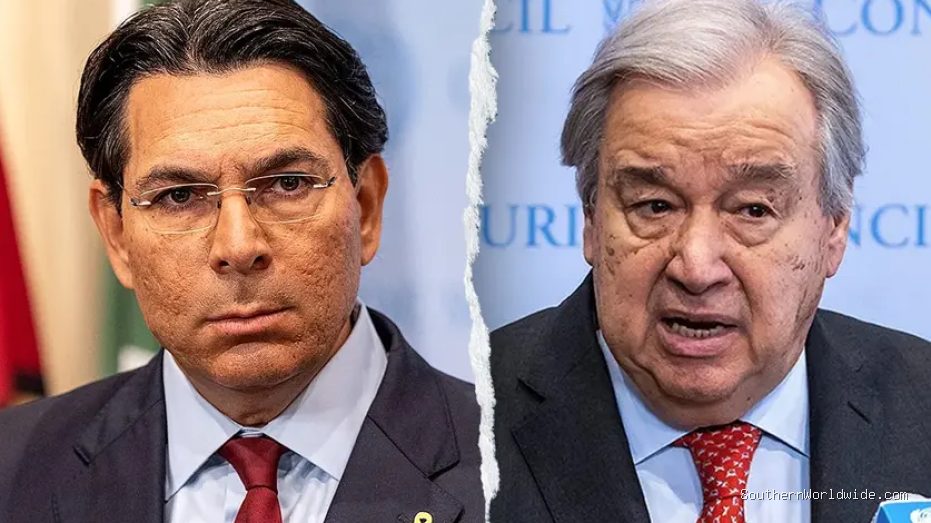
On June 24, Israel’s Ambassador to the UN, Danny Danon, sent a letter to the President of the UN Security Council. In the letter, Danon expressed Israel’s “grave concerns regarding conduct that appears inconsistent with the neutrality, professionalism, and impartiality expected of a senior United Nations official.”
Danon also raised concerns about Frazier’s “abrupt interruption of [his] remarks during a United Nations side event.” He described this interruption as being “in disregard of basic procedural norms and the respect owed to Member States.”
Reuters characterized the exchange between Danon and Frazier as “a furious shouting match.”
The release of the Secretary-General’s Annual Report on Children and Armed Conflict on June 17 has also been a source of concern.
An analyst, Bayefsky, criticized the UN’s use of the term “verified” when describing allegations. She pointed out the lack of detail regarding the methods and sources used for these supposed verifications.
Bayefsky drew a parallel between “ancient antisemitic blood libels accusing evil Jews of murdering non-Jewish children and the U.N. actors who repeat the same ugly falsehoods today.” She emphasized the historical danger of such “depraved lies” for Jewish communities worldwide.
Frazier defended the report, stating it was “the product of a rigorous United Nations (U.N.) monitoring and verification process and reflects information reviewed at multiple levels of the U.N. system.” She argued that suggesting the report is based on falsehoods would be a disservice to all child victims, including Israeli children whose suffering is also documented in the report.
Frazier also asserted that she holds “no bias against the State of Israel or against any Member States of the United Nations, and reject[s] the characterization.” She reiterated that as a UN official, “accuracy, impartiality, and credibility are fundamental to [her] work.”
A spokesperson defended Frazier, stating she has not and is not “vilifying” the State of Israel or any other country. The spokesperson highlighted that Frazier’s focus is on the protection of children globally, not on any single nation. According to the mandate from the Security Council, she does not “blacklist” Member States or other parties. The report’s purpose, the spokesperson explained, is to identify ways for listed parties to improve their behavior to ensure concrete protection for children, and Frazier has been effective in this regard.
Danon commented that it was “no surprise that Secretary-General Guterres expresses full confidence in Ms. Frazier.” He described Frazier’s report as a symptom of Guterres’ tenure, during which, he claimed, “the United Nations has repeatedly failed to uphold the standards of impartiality it claims to represent.”