SouthernWorldwide.com – The honor of playing for the U.S. men’s national team at the World Cup is significant, but few players have had the distinction of being named captain.
In the modern era, this role carries substantial responsibilities, including serving as the team’s on-field leader and maintaining composure among teammates during critical moments.
With the United States co-hosting the 2026 FIFA World Cup, it will mark the 12th time the U.S. has participated in the tournament. Historically, with the exception of the 1950 squad which utilized a three-player rotation for the captaincy and Claudio Reyna wearing the armband twice, a different player has held the captain’s honor for each U.S. appearance at soccer’s premier event.
Now, with defender Tim Ream designated as captain for this summer’s 26-man squad, we delve into the history of U.S. World Cup captains, tracing back to the inaugural tournament in 1930.
Born in 1897 to Italian immigrants in Harrison, New Jersey, Florie was a prominent American soccer player of the early era. He began his professional career after serving in the U.S. Navy during World War I. Within the American Soccer League, he excelled as a forward for Providence FC and the New Bedford Whalers. Although he was not selected for the 1928 Olympic team, he was appointed as the U.S. national team’s first World Cup captain for the 1930 tournament.
During the 1930 World Cup, Florie scored in a 3-0 victory against Belgium in the group stage, contributing to the team’s advancement to the semifinals, which remains their best finish in the tournament’s history. Florie’s final appearance for the U.S. team occurred in a 7-1 defeat against Italy at the 1934 World Cup.
Born in Liverpool in 1901, Moorhouse relocated to the United States after serving with Great Britain during World War I. Upon his arrival, he played for various clubs in the New York area. He initially served as the left back for the U.S. team at the 1930 World Cup. The U.S. team did not play any matches until the 1934 World Cup in Italy. For that tournament, Moorhouse was appointed captain.
The U.S. team employed a rotation of captains for its three games in the 1950 World Cup. Two of these captains, Harry Keough and Walter Bahr, went on to become well-regarded figures and ambassadors for the sport.
Keough captained the U.S. team’s opening 3-1 loss to Spain, a decision partly influenced by his ability to speak Spanish. He worked for the U.S. Postal Service during his playing career but later became an influential coach at St. Louis University, leading the team to five national championships.
Bahr captained the team’s 5-2 defeat against Chile in the final group stage match. He later coached Penn State’s soccer team from 1974 to 1988 and was recognized as the College Coach of the Year in 1979.
The middle group stage game, a historic 1-0 victory over England, is still regarded as one of the greatest upsets in World Cup history. The Scottish-born McIlvenny was given the honor of captaining the team that day due to his birth in Great Britain. His playing career commenced in England at lower-league levels, where he played for the now-famous Wrexham, before moving to the United States in 1949. The 1950 World Cup was his sole appearance for the United States.
Following the tournament, he returned to England to continue his career, initially with Manchester United, before retiring in 1958.
Born in Germany but raised in New York City, center-back Mike Windischmann played in youth leagues in the city before competing in college soccer for Adelphi University on Long Island. After graduating, Windischmann chose to play for the Brooklyn Italians, one of the most storied semi-professional clubs in American soccer history. His success with Brooklyn earned him a place on the 1988 Olympic team, where he scored in a 1-1 draw against Argentina.
Following the Olympics, Windischmann joined the MISL’s Los Angeles Lazers (an indoor club) and later the Albany Capitals of the outdoor American Soccer League. During his sole season with the Capitals, Windischmann was selected for the 1990 World Cup team, which was participating in the tournament for the first time in 40 years. He started all three games as the U.S. team exited without a point.
After the 1990 season, Windischmann retired from professional soccer, opting to play two more years with the U.S. national futsal team. He helped the team achieve a second-place finish at the 1992 FIFA Futsal World Championships.
Captaining the U.S. national team in 1994 was a significant undertaking, as it involved being the public face of a team hosting the tournament and marking the first time many Americans were watching the team, or even the sport. Meola handled the role exceptionally well, with the pony-tailed goalkeeper making crucial saves and displaying a charisma that endeared the team to many across the country. He even received a preseason invitation as a placekicker for the NFL’s New York Jets.
Meola began playing for the U.S. national team while still a student at the University of Virginia and secured the starting goalkeeper position for the 1990 World Cup. He played in the lower tiers of the domestic professional game, both outdoor and indoor, that existed at the time.
When Major League Soccer (MLS) commenced play in 1996, Meola became one of the league’s most pivotal players in its early seasons with the MetroStars and Kansas City Wizards. He was part of the 2002 World Cup team as a third-string backup and retired from playing in 2008.
The period leading up to the 1998 World Cup was tumultuous for the U.S. team. Head coach Steve Sampson dismissed captain John Harkes from the team due to “leadership issues.” It was later revealed that Sampson removed Harkes upon learning of an affair between Harkes and the wife of teammate Eric Wynalda. To help stabilize the team, Sampson turned to the 37-year-old veteran Thomas Dooley.
Read more : Myles Garrett's Path to Becoming the GOAT Pass-Rusher
The German-born Dooley began playing for the U.S. team in the years preceding the 1994 World Cup, as U.S. Soccer sought to assemble a more professional contingent of players. Dooley was found to have U.S. eligibility through his American father, who had served in Germany while in the Army. Despite being an outsider to the country, Dooley earned the team’s respect through his professionalism and dedication.
To this day, he remains the only American player to have won the German Bundesliga, achieving this feat in 1990/91 with Kaiserslautern. Unfortunately for Dooley, the 1998 World Cup proved to be a low point in the history of the U.S. national team, as the team lost all three group stage games, including a 2-1 defeat to Iran that resulted in their elimination from the knockout stages.
Dooley was granted a farewell match with the national team in 1999, concluding his international career with 81 appearances. Following his playing days, he transitioned into coaching, with most of his career spent in Asia. In April, he was appointed manager of the national team of Bangladesh.
As one of the most decorated American players of all time, Claudio Reyna holds the distinction of being the only player to captain the U.S. national team in two World Cups. Early in his career, he became the first American to captain a club in a top European league, playing for Wolfsburg in Germany’s Bundesliga. He achieved legendary status with the Scottish powerhouse Rangers, scoring the game-winning goal against Parma to secure qualification for the 1999–2000 Champions League.
Reyna’s contributions to the United States national team were groundbreaking. He was part of four World Cup squads, though an injury prevented him from playing in 1994. He helped the U.S. team reach the semifinals of the 1995 Copa América in Uruguay. He captained the 1996 Olympic team and scored against Argentina. In 2002, he captained the U.S. team to its best World Cup finish in the modern era, reaching the quarterfinals. That year, he became the first U.S. player named to the World Cup all-tournament team.
Injuries significantly impacted the final years of his career. A knee injury sustained in a 2-1 loss to Ghana at the 2006 World Cup marked his final appearance for the team. Following the U.S. loss, which led to their elimination after the group stages, he announced his international retirement.
The years following the disappointment of the 2006 World Cup proved to be successful. Upon being hired as coach in 2007, Bob Bradley immediately appointed Carlos Bocanegra as the team’s captain, and he led the team to several significant achievements.
In 2007, Bocanegra wore the armband during the team’s Gold Cup triumph. At the 2009 Confederations Cup, Bocanegra captained the team to victories over Egypt and the top-ranked Spain before falling to Brazil in the final. The following year, at the 2010 World Cup, the U.S. team won its group for the first time since 1930.
At the club level, Bocanegra’s extensive career was also marked by impressive leadership. He wore the armband for Fulham in the Premier League, Saint-Étienne in Ligue 1, Rangers in the Scottish Premiership, and concluded his career as captain for Chivas USA in its final MLS season before the club folded in 2014. A native of California, Bocanegra finished his international career with 110 caps.
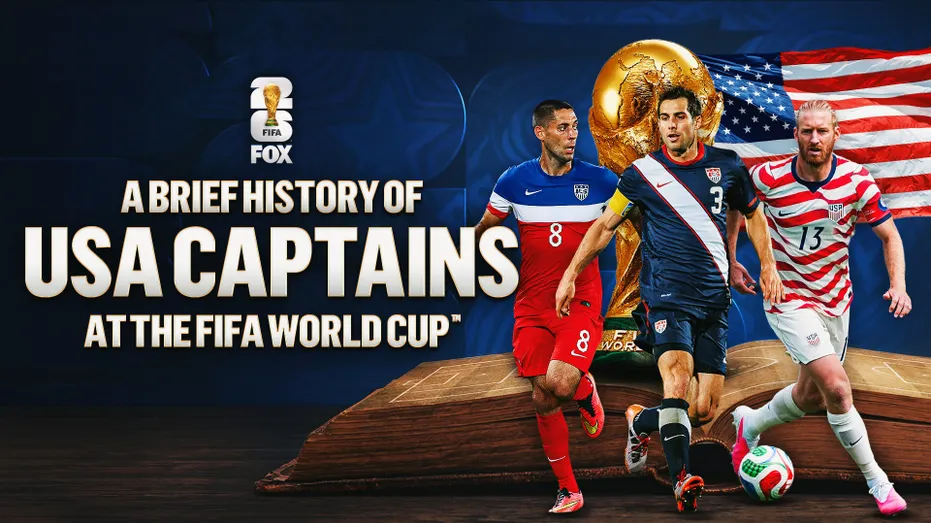
As one of the most popular and successful American players of all time, Clint Dempsey was Jurgen Klinsmann’s choice to captain the 2014 World Cup team in Brazil, having served in that role since 2013. The lead-up to that tournament was dominated by Klinsmann’s controversial decision to omit the team’s all-time leading scorer, Landon Donovan.
However, Dempsey immediately delivered a crucial goal just seconds into the first game, securing a vital 2-1 victory against long-time nemesis Ghana, who had eliminated the U.S. team in the two previous World Cups. Dempsey played in three World Cups, scoring in each tournament. He concluded his career tied with Donovan as the U.S. national team’s all-time leading scorer with 57 goals. He wore the armband a total of 20 times.
At the club level, Dempsey achieved considerable success with Fulham. His most outstanding season was in 2011-12, when he scored 23 goals for Fulham across all competitions, including 17 in the Premier League. In 2010, he scored a memorable goal against Juventus in a Europa League knockout victory, a goal often considered the most important in Fulham’s history.
Following the U.S. team’s failure to qualify for the 2018 World Cup, a youthful approach was adopted throughout the cycle leading up to the 2022 World Cup. Head coach Gregg Berhalter appointed Adams, then only 23 years old, as captain shortly before the tournament began.
After the Americans advanced to the Round of 16 before being eliminated by the Netherlands, Adams was named U.S. Soccer’s Male Player of the Year for 2022. In his club career, which saw him begin as a homegrown player for the New York Red Bulls and then move to Europe with RB Leipzig, Leeds United, and now AFC Bournemouth (whom he helped secure a sixth-place finish and a spot in the Europa League next year), Adams is part of the generation that revitalized the program after the embarrassing failure to qualify for the 2018 World Cup.
Adams remains a key player for the U.S. national team program under Mauricio Pochettino. However, he was not selected to captain the 2026 World Cup team, as the position was awarded to Tim Ream.
When Tim Ream made his United States national team debut in 2010, few could have predicted it would be the start of a remarkable international career spanning over 15 years. The center-back is now set to serve as the USA’s captain at the 2026 FIFA World Cup. At 38 years old, he will be the oldest player to ever captain the USA at a men’s World Cup.
Currently playing for MLS club Charlotte FC, the St. Louis native enjoyed a solid career in the English Premier League, most notably with Fulham. He joined an elite group of American players who have worn the armband in a Premier League match, a list that includes Brian McBride, Carlos Bocanegra, Claudio Reyna, Clint Dempsey, and Tim Howard.