SouthernWorldwide.com – A new poll has revealed a significant generational gap in how Americans perceive China as a threat, with younger adults showing considerably less concern compared to their older counterparts. This divergence represents one of the most pronounced generational divides concerning U.S. foreign policy.
The Ronald Reagan Institute Summer Survey indicates that a substantial 93% of Americans aged 65 and older expressed concern about China’s capacity to spy on the United States. In stark contrast, only 62% of those aged 18 to 29 shared this apprehension.
This disparity extends to other critical areas. Younger Americans were consistently less likely to voice worries about China’s potential use of force against Taiwan (56% compared to 86% among seniors), technology theft (61% versus 91%), the acquisition of U.S. land (68% versus 93%), and China’s role in the influx of fentanyl into the U.S. (68% versus 92%).
Despite this generational divide, national concern regarding China remains high across the board. Over 80% of all Americans expressed concern about China’s involvement in the fentanyl crisis, its espionage capabilities, and its land purchases within the United States. Furthermore, 66% of Americans believe that Taiwan’s security is important to the United States.
These findings emerge at a time when both Washington and Beijing are actively working to stabilize a relationship that is crucial on the global stage, following years of escalating economic and military tensions.
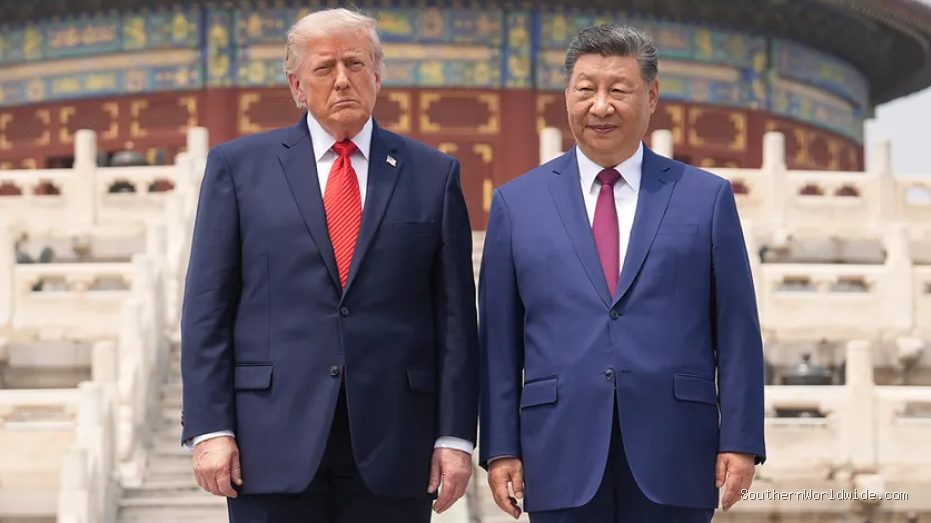
Following the imposition of significant tariffs on China early in his term, President Donald Trump engaged in discussions with Chinese President Xi Jinping in China in May. This meeting resulted in the announcement of several trade and investment agreements, alongside a commitment to maintain dialogue.
While concerns about China are prevalent throughout the nation, the survey suggests that younger Americans view the U.S.’s primary geopolitical rival through a distinctly different lens than older generations. This raises important questions about how public opinion might evolve as younger voters constitute a larger portion of the electorate.
The survey’s results are particularly noteworthy as they diverge from the prevailing sentiment among many national security experts. These experts continue to characterize China as America’s principal long-term competitor and adversary, even as diplomatic efforts aim to stabilize bilateral relations.
Secretary of War Pete Hegseth, speaking at the Shangri-La Dialogue in Singapore in May, acknowledged the legitimate concerns regarding China’s substantial military buildup and the expansion of its military activities both regionally and internationally.
However, he also noted that U.S.-China relations are currently in a better state than they have been in many years.
Following the summit between Trump and Xi in May, the then-U.S. president remarked to reporters that many complex problems, which others might have found insurmountable, had been resolved.
He also described President Xi as a “great leader” and China as a “great country.”
Other recent research also highlights broader differences in how Generation Z perceives U.S. foreign policy.
A 2025 survey conducted by the Carnegie Endowment found that younger Americans were less inclined than older generations to prioritize maintaining U.S. technological dominance over China. Generally, they favored a less expansive role for American leadership on the global stage.
The Reagan Institute Summer Survey is the organization’s annual assessment of public opinion on foreign policy and national security. It aims to gauge American perspectives on a range of issues, including global engagement, military strength, China, NATO, the Middle East, and democratic values.
The poll also identified significant partisan shifts regarding the U.S.’s role in the world. Republicans were more likely than Democrats to advocate for increased U.S. engagement and leadership in global affairs.
Specifically, 71% of Republicans believed the U.S. should take a leading role internationally, compared to 55% of Democrats. Overall, 61% of Americans favored greater U.S. engagement in global affairs, while 27% preferred a less involved approach.
These findings represent a notable departure from recent years.
Democratic support for greater U.S. engagement decreased from 65% to 55% over the past year, while Republican support saw a slight increase from 69% to 71%. This has widened the partisan gap from four percentage points to sixteen. The survey also revealed that 43% of Democrats now view U.S. involvement in the world as harmful, a significant increase from 22% a year ago.
The survey was conducted from May 26 to June 3 among 1,555 U.S. adults, with a margin of error of plus or minus 2.5 percentage points. Researchers employed a mixed-mode methodology, incorporating live telephone interviews, an online panel, and text-to-web responses.
To ensure the results accurately reflect the U.S. population, the data was weighted using demographic benchmarks from the U.S. Census Bureau’s 2023 American Community Survey, covering aspects such as age, gender, race, region, and education. The survey also included an oversample of 338 self-identified MAGA Republicans under the age of 30, which has a margin of error of plus or minus 5 percentage points.
These findings also come after a period in which the Trump administration adopted a more assertive foreign policy stance than some might have anticipated.
In addition to ordering strikes in Iran, the administration has expanded military operations targeting cartel-linked entities in the Western Hemisphere and intervened to apprehend former Venezuelan President Nicolas Maduro. These actions have brought questions surrounding American power and global leadership back to the forefront of public discourse.