
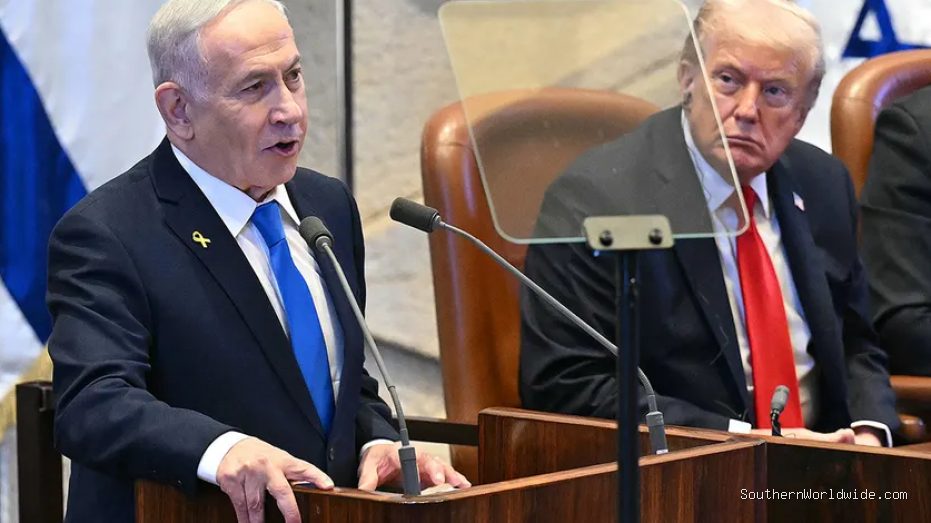
SouthernWorldwide.com – Israel is currently navigating a complex situation following the announcement of a Memorandum of Understanding (MOU) between U.S. President Donald Trump and Iran. The details of this agreement remain largely unclear, leading to a range of reactions within Israel, from cautious observation to outright criticism.
Iran’s Supreme National Security Council confirmed on Sunday that Tehran and Washington had finalized an MOU to end the ongoing conflict. This agreement reportedly stipulates an immediate and permanent cessation of all military operations across various fronts, including Lebanon.
Further negotiations for a comprehensive final agreement are expected to commence only after both parties have fulfilled their initial obligations. These discussions are anticipated to last for up to 60 days.
While Prime Minister Benjamin Netanyahu has yet to issue a direct statement, Israel’s Defense Minister Israel Katz offered a nuanced response on Monday. Katz refrained from direct criticism of the deal but emphasized that the Israel Defense Forces (IDF) would not withdraw from southern Lebanon.
Katz issued a stern warning, stating that if Iran retaliates against Israel due to the conflict with Hezbollah, “we will strike it with full force.” He asserted that the IDF would maintain its presence in the security zones in Lebanon, Syria, and Gaza indefinitely.
These security zones, according to Katz, have been among the IDF’s most significant achievements in the multi-front war that began with the Hamas-led attack on October 7, 2023. Consequently, Israel opposes any withdrawal from Lebanon, irrespective of external pressures.
Katz indicated that both he and Prime Minister Netanyahu had communicated these security positions to U.S. President Donald Trump and other senior American officials, including U.S. Secretary of War Pete Hegseth.
“We will not compromise on Israel’s security interests and the protection of our citizens,” Katz concluded, underscoring the nation’s unwavering commitment to its safety.
Concerns have been raised by some analysts regarding the potential implications of the deal. One perspective suggests that internal debate within Iran over accepting the agreement indicates potential flaws. If the current understanding of the deal is accurate, it is viewed as a “disaster” by some.
A “good deal,” as defined by one expert, would involve Iran completely relinquishing its nuclear program. This includes granting access to enriched uranium and establishing a robust monitoring system with unrestricted access, even to military facilities suspected of nuclear activities. Such an agreement should also prohibit the production of nuclear-capable missiles.
The status of Lebanon is considered a matter for discussion between Washington, Jerusalem, and Beirut. It is argued that Iran should not be a party to these discussions, especially if Lebanon is to be included in any deal with Iran, as this would grant Tehran a say in Lebanese affairs.
Israel has been living under the perceived threat of Iran’s nuclear program since 1998. Prime Minister Benjamin Netanyahu, with his extensive experience in this issue, is uniquely positioned to assess the situation. However, it remains uncertain whether he is satisfied with the current outcome or what his final assessment will be.
One critical viewpoint suggests that the emerging agreement fails to achieve Israel’s war objectives. This assessment posits that the Iranian regime will survive, its missile program will persist, and Iran will be able to rebuild its nuclear capabilities. This is seen as a failure for Netanyahu, potentially turning Israel into a “client state” dictated to on its national security.
In March, Prime Minister Netanyahu outlined three key objectives for the joint U.S.-Israel operation against Iran. These included removing the nuclear threat, eliminating the ballistic missile threat before they become too deeply buried to be attacked, and creating conditions for the Iranian people to achieve freedom and control their destiny.
There is a genuine concern that the MOU could “tie Israel’s hands.” An additional worry is that Hezbollah might exploit this situation to regroup and strengthen its forces along the border with Israel.
It is premature to determine if the deal will significantly strengthen Israel’s position compared to the 2015 Obama-era nuclear agreement. The fate of Iran’s stockpile of 60% enriched uranium and its nuclear infrastructure are key factors to consider.
Crucial questions remain unanswered regarding Iran’s uranium enrichment activities, including whether it will be permitted to continue enriching uranium on its soil, at what percentage, and how the international community will oversee its nuclear program through inspections.
Israel’s National Security Minister Itamar Ben-Gvir asserted on Monday that the MOU does not bind Israel, emphasizing the nation’s independence and sovereignty. He stated that Israel’s primary duty is to its citizens, soldiers, and the Jewish people.
Ben-Gvir declared his clear position: Israel is not a partner to an agreement that does not ensure its security and therefore does not bind it. While expressing appreciation for the United States and President Trump, he stressed that “the State of Israel is not a banana republic.”
On Friday, Netanyahu’s office released a statement acknowledging that while Israel is not a signatory to the MOU, the Prime Minister appreciates President Trump’s commitment to ensure the final agreement includes the removal of enriched material, dismantling of enrichment infrastructure, missile production limits, and the cessation of Iran’s support for regional proxies.
The statement quoted the Prime Minister as saying, “As long as I am the Prime Minister of Israel – Iran will not have nuclear weapons. President Trump and I are in full agreement on this issue.” Netanyahu reiterated his decades-long struggle against Iran’s nuclear program, asserting that without it, Iran would have long possessed atomic bombs to destroy Israel.


