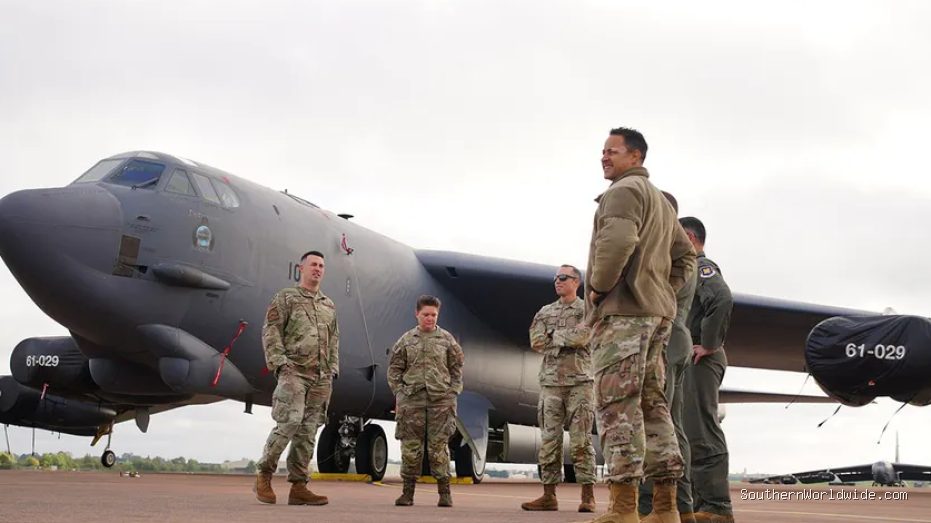
SouthernWorldwide.com – The B-52 bomber aircraft, a veteran of the skies, first entered service during the Eisenhower administration in the 1950s.
More than seven decades later, the Air Force is investing billions of dollars to modernize this Cold War-era bomber. The upgrades include new engines, enhanced avionics, and advanced radar systems, all designed to ensure its operational capability into the 2050s.
This extensive modernization effort was unexpectedly brought into sharp focus on Monday. A B-52 Stratofortress crashed shortly after takeoff from Edwards Air Force Base in California during a test mission, tragically resulting in the deaths of all eight individuals on board.
The crew comprised military personnel, government civilians, and contractors who were supporting the flight test mission. Boeing later confirmed that two of its employees were among the victims.
The crash signifies the loss of one of only 76 B-52s currently in the Air Force inventory. This nuclear-capable bomber remains a critical component of America’s strategic bomber force and is slated to serve alongside the Air Force’s next-generation B-21 Raider for decades to come.
As investigators commence their work to determine the cause of the incident, aviation attorney and veteran Marine helicopter pilot Justin Green noted that the aircraft’s demise moments after takeoff will likely heavily influence the initial stages of the investigation.
Green, who also co-chairs the plaintiffs’ executive committee in litigation related to the 2019 Boeing 737 MAX crash in Ethiopia and is involved in litigation concerning the midair collision over the Potomac River in January 2025, cautioned that the probe is still in its very early phases.
“The crucial aspect of any investigation is to avoid making assumptions,” Green stated. “In the initial days, it’s imperative to maintain an open mind and meticulously follow the facts wherever they lead.”
According to the Air Force, the aircraft was engaged in a local test sortie supporting the Air Force’s radar modernization program when it crashed. Edwards Air Force Base serves as the Air Force’s primary flight-test center, where aircraft are routinely utilized to evaluate new technologies and modifications before their broader deployment across the fleet.
The Air Force is currently undertaking one of the most ambitious modernization initiatives in the B-52’s long history.
The service plans to equip these bombers with new Rolls-Royce F130 engines, upgraded avionics, and a modern active electronically scanned array radar. These enhancements are intended to improve navigation, targeting, and situational awareness, thereby extending the aircraft’s operational lifespan well into the middle of this century.
The timing of this crash has naturally drawn attention to these ongoing upgrades. However, Green suggested that the radar system itself is not an immediate, obvious cause based on the limited information available.
“I believe it’s highly improbable,” Green responded when asked if the new radar system could have contributed to the crash. “A new radar system should not fundamentally impact an aircraft’s ability to take off safely.”
While investigators are expected to meticulously examine every facet of the aircraft and the mission, Green indicated that they will likely concentrate on factors that directly influence an aircraft’s capacity for a safe runway departure and subsequent climb after takeoff.
The age of the B-52 is also anticipated to be a subject of discussion. The bomber, which first entered service in the 1950s, remains one of the oldest aircraft within the U.S. military inventory. Nevertheless, Green posited that investigators might place more emphasis on maintenance records, recently installed components, and operational factors rather than the aircraft’s original design.
“This is a very old aircraft,” Green remarked. “A problem is unlikely to be a design flaw. It’s more probable to be a manufacturing issue if it involves a new part, a maintenance issue, or a piloting error.”
Investigators are expected to meticulously analyze physical evidence recovered from the crash site, alongside maintenance records and any available flight data. Green explained that the wreckage itself will “tell the story” and likely provide many of the answers the investigators are seeking.
He further added that flight data and cockpit recordings, if successfully recovered, could prove to be critically important in reconstructing the aircraft’s final moments.
The involvement of contractors and Boeing employees on the flight could also introduce unique legal considerations, depending on the ultimate findings of the investigators regarding the accident’s cause.
Generally, military personnel are precluded from suing the federal government for injuries or deaths sustained during military service due to the Feres doctrine, a long-standing legal precedent. Contractors are not subject to the same restriction; however, potential claims could still encounter significant legal obstacles depending on the crash’s circumstances and the involvement of any companies.
“Unless the manufacturer acted in a grossly negligent manner on its own, they may also have protection from any form of liability,” Green commented.
For the present, however, Green emphasized that determining responsibility remains a distant priority.
The Air Force has not publicly disclosed a cause for the crash. Investigators are expected to dedicate weeks, and potentially months, to examining evidence before arriving at any conclusions about what led to the downfall of one of the military’s most iconic aircraft.