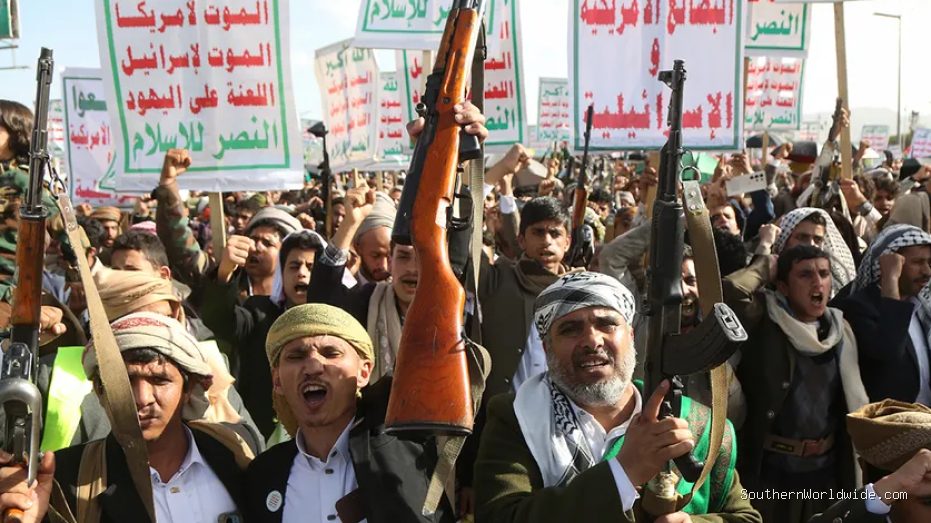
SouthernWorldwide.com – The United States has responded to threats of blocking another Middle Eastern waterway by Iranian proxy, the Houthis, who have declared Israeli-owned ships legitimate targets in the Red Sea.
The Red Sea, and particularly the Bab-el Mandeb Strait, has become a crucial shipping route for oil from the Middle East to Asia, especially since the Strait of Hormuz has seen reduced navigation.
Houthi spokesperson Yahya Saree announced a complete ban on Israeli maritime navigation in the Red Sea, stating that all enemy movements would be considered legitimate targets.
Fitton-Brown, a former UK ambassador to Yemen, commented that these tactics are unlikely to be significantly successful if allies maintain communication, Israel responds proportionally, and Iran refrains from provoking further conflict.
He expressed interest in observing if the Houthis would fully resume their campaign against Red Sea shipping. Such an escalation, he warned, would likely draw international condemnation and lead to strikes on Sana’a and Hodeida by Israel and the U.S.
This potential escalation, Fitton-Brown noted, could lead to a general increase in conflict, though he believes the allies would hold a clear military advantage.
These developments occur as reports indicate Ethiopia is strengthening its position as a key U.S. ally against Islamic terrorism in the Red Sea region.
Despite being landlocked, Ethiopia is the most populous country in the Horn of Africa with approximately 130 million people. Its proximity to the Red Sea corridor and its significant Christian population, around 60%, make it strategically important.
Diriba highlighted that Iran’s threat in the Bab el-Mandeb transforms the Horn of Africa into a militarized zone, placing Ethiopia at the center of a critical choke point crisis. Iranian influence, spreading through conflicts in Sudan, Eritrea, and Somalia, is creating a continuous arc of instability from the Arabian Peninsula into East Africa.
Ethiopia is situated within one of the world’s most volatile security corridors. Its strategic importance to the United States is amplified by this reality, as its stability directly impacts the expansion or containment of threats like Red Sea disruptions and the persistent al-Shabab insurgency in Somalia.
Despite its pro-U.S. stance, Ethiopia also maintains relations with Iran.
Fitton-Brown suggested that Ethiopia might be accused of playing both sides, as Iran has provided drone support and military aid to the Ethiopian government during the recent Tigray War.
He added that a new memorandum of understanding exists, through which Iran gains influence in Ethiopia while Ethiopia receives military, police, and intelligence support to combat its internal ethnic insurgencies.
However, Diriba clarified that Ethiopia’s engagement with Iran is not based on affinity or alignment but on strategic awareness. This involves keeping channels open for necessary engagement, selective cooperation, and managing relations with Iran strategically, while prioritizing its core partnerships, notably with the United States.
Ethiopia, according to Diriba, has adopted a flexible multi-alignment strategy. This prioritizes its strong security partnership with Washington while maintaining open communication with Tehran to preserve diplomatic flexibility in the increasingly fragmented Horn of Africa–Red Sea region.
Fitton-Brown stated that U.S.-Ethiopia relations are strong, particularly in counterterrorism efforts. He noted that both countries utilize Somaliland to their advantage without formally recognizing its independence.