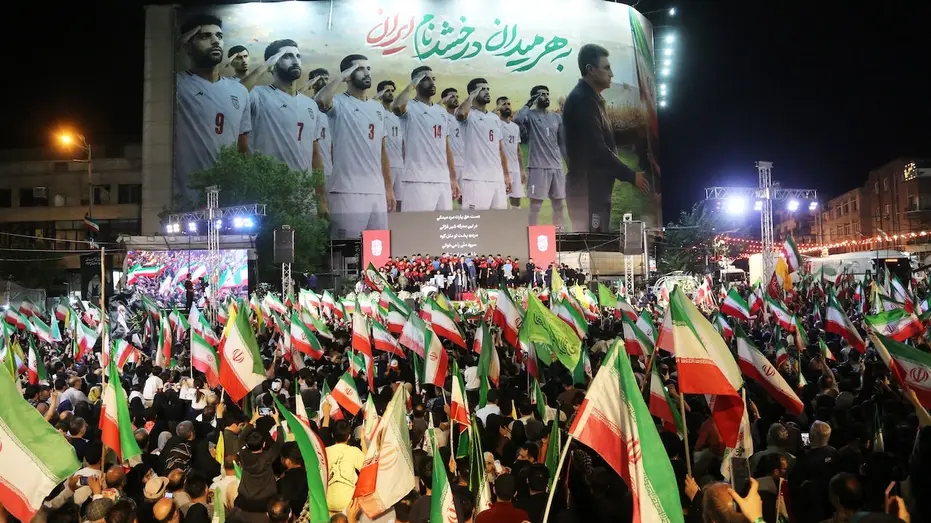
SouthernWorldwide.com – An opposition group in Iran has accused the country’s soccer clubs of being used as a tool for state surveillance, urging FIFA to ban the national team from the upcoming World Cup.
The National Council of Resistance of Iran (NCRI), citing alleged internal documents from the Islamic Revolutionary Guard Corps (IRGC), claims that the IRGC has infiltrated the Iranian soccer system.
These allegations suggest the use of stadium infrastructure, management positions linked to security, and advanced surveillance technologies to monitor fans and suppress dissent within the sporting community.
The NCRI’s report points to the potential violation of FIFA’s bylaws, which strictly prohibit political interference in the affairs of member associations.
The report details the alleged implementation of facial-recognition cameras within stadiums such as Azadi, Takhti, and Shahr-e Qods.
Furthermore, it claims that ticketing systems are linked to Iran’s national civil-registration database, enabling seat-by-seat mapping of spectators identified by their national ID numbers.
The NCRI also alleges that fan-club leaders are subject to monitoring and vetting processes.
According to translated documents, security officials discussed the necessity of utilizing surveillance cameras in stadiums to prevent “unpredictable security incidents” and potential “riots and civil unrest.”
These documents, reportedly from Iran’s Tehran Province Security Council in 2025 and the Sarallah Headquarters in 2024, highlight the regime’s focus on sports as a means of control.
Soccer is described as Iran’s most popular sport, with clubs like Persepolis and Esteghlal commanding massive fan bases.
This popularity makes stadiums a prime location for the regime to exert its influence and monitor gatherings of young people.
The NCRI-US, the Washington office of the opposition coalition, stated that their investigation into the regime’s surveillance tactics initially focused on protests but later revealed the extensive use of sports facilities for repression.
The group claims to have obtained internal Iranian security documents through the network of the People’s Mojahedin Organization of Iran (MEK).
The report indicates that minutes from a May 2025 Sports Commission meeting discussed equipping stadiums with facial-recognition cameras.
These minutes reportedly required strict cooperation from the Football Federation, the Football League Organization, Esteghlal, and Persepolis for the video surveillance project at Azadi Stadium.
The president of Iran’s soccer federation, Mehdi Taj, is named in the report as having been copied for the “executive implementation” of these surveillance measures.
Later sessions of the Tehran Province Security Council allegedly discussed smart ticketing connected to national registration, mandatory identity verification, and the use of “fan cards” for pre-vetted leaders.
The NCRI believes this data collection is intended to identify and subsequently arrest individuals who oppose the regime.
The report also accuses Iran’s soccer system of being infiltrated by IRGC and security-linked individuals for decades.
The NCRI names at least 15 individuals allegedly linked to the IRGC or security forces who have held high-ranking positions within clubs, federations, and sports organizations.
Mehdi Taj is identified as a former IRGC intelligence officer who currently leads the Iran Football Federation.
FIFA’s official bylaws mandate that member associations manage their affairs independently and remain neutral in political and religious matters, free from any form of political interference.
The NCRI is urging FIFA to expel Iran’s Football Federation, drawing a parallel to the international sports bans imposed on apartheid-era South Africa.
The group argues that sports facilities should not be dominated by military elements associated with the Iranian regime.
The NCRI asserts that sports federations must operate autonomously, independent of government control.
FIFA’s regulations state that violations of independence requirements can lead to sanctions, even if the association is not directly at fault for the outside influence.
The report also highlights allegations of systematic gender discrimination in Iranian sports, including restrictions on women attending stadiums and state control over female athletes’ attire.
While Human Rights Watch documented instances of women being denied entry to stadiums, FIFA has also acknowledged cases where women were permitted to attend Iranian matches.
However, rights groups maintain that Iranian women continue to face discriminatory barriers regarding stadium access.
The report also points to instances where Iranian athletes have faced repercussions for supporting or participating in anti-government protests.
The case of Habib Khabiri, a former captain of Iran’s national soccer team, is cited as an example of the regime’s repression of athletes.
Khabiri was reportedly executed in 1984 after alleged ties to the Mojahedin-e Khalq, following his arrest and torture in prison.
Khabiri’s refusal to renounce his political beliefs on television led to his execution, making him a symbol for athletes facing similar pressures.