SouthernWorldwide.com – The FIFA 2026 World Cup is heating up, and the energy surrounding the tournament is palpable, even in unexpected places like Dallas, Texas.
As the Japanese national team prepared for their match at “Jerry World,” officially known as Dallas Stadium, the atmosphere was already electric. The day before the game, a reporter found themselves immersed in the vibrant World Cup fever gripping the city.
After a hearty Tex-Mex lunch, a stroll through downtown Dallas revealed a city buzzing with excitement. The captivating sights of a city fully embracing the global soccer event were everywhere.
A chance discovery led the reporter to learn that Team Japan was staying at the W Hotel, just a few blocks away. Driven by curiosity and the desire to witness the team’s presence, they braved the sweltering 90-degree Texas heat to walk over.
The timing proved to be serendipitous. As they turned the corner onto Nowitzki Way and Houston Street, streets fittingly named after a basketball legend and a hero of the Texas Revolution, police had halted traffic.
Suddenly, a motorcycle cop’s flashing lights and blaring siren signaled something significant. Then, it appeared: a colossal bus, emblazoned in blue and featuring the iconic red disc of Japan, pulled into view.
The bus arrived at the W Hotel, and a small crowd, comprising about a dozen Japanese fans, gathered near the barrier. They waved enthusiastically, bouncing with the energy of a J-Pop concert, and shouted the names of the players as they disembarked.
The team was returning from their local training base at SMU, and the palpable energy suggested a spirited performance was on the horizon.
Social media has consistently highlighted Japan’s immense passion for soccer since the tournament’s commencement. This fervor was evident in a remarkable display.
The deafening chants that erupted long before kickoff were not for a game in progress, but for a live broadcast of the team simply disembarking from their bus at the stadium. They weren’t warming up or kicking a ball; they were just walking to the locker room.
It’s difficult not to find oneself rooting for Japan in the current global climate. As the country experiences a surge in international popularity driven by its rich tourism, cuisine, and pop culture, its soccer fandom has ascended to the world stage.
Japanese fans are known for their passion, exceptional friendliness, and legendary respectfulness. They readily embrace American culture while meticulously cleaning their stadium sections, regardless of the match’s outcome—win, lose, or draw.
Through family connections, the reporter found themselves at the heart of this unique experience. While acknowledging the Netherlands, the reporter declared their allegiance: unless the USA was playing, they were a “Lone Star Samurai Blue” fan.
The reporter’s brother-in-law and nephew had traveled all the way from Tokyo to their home state to watch the game with the reporter and their son. This marked their third World Cup attendance, but it was the reporter’s very first.
To provide a quintessential Texas experience for their Japanese relatives, they indulged in all the local favorites: homemade and restaurant barbecue, Tex-Mex cuisine, a visit to Buc-ee’s, and an outing to a gun range. Their relatives reportedly cherished every moment.
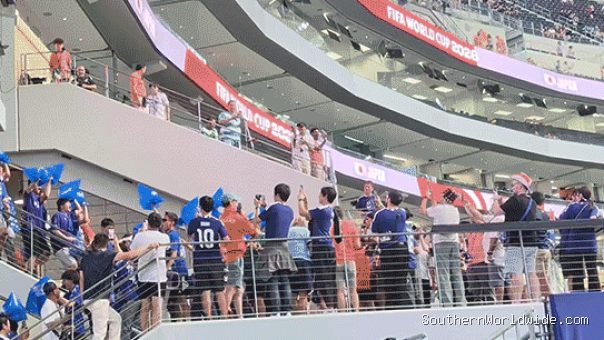
Tickets for the match were purchased the moment they went on sale, securing seats high up near the stadium roof. However, the view was exceptional from every vantage point; there wasn’t a bad seat in the entire venue.
They were surrounded by fellow fans, with the dedicated “ultras” positioned just to their left. Regardless of the action on the field, the continuous chant of “Nippon! Nippon!” filled the air.
The atmosphere was unlike any sporting event the reporter had ever attended in person, surpassing all previous experiences.
The vast majority of attendees were dressed in team colors. While the Dutch fans appeared largely stoic, the Japanese fans were vocal, animated, and actively kept the stadium alive with their energy.
The match commenced with a distinctly American-style countdown, reminiscent of a rocket launch.
However, the first half was notably subdued, lacking explosive action.
The Netherlands controlled possession for the majority of the first half, while Japan adopted a defensive stance. While some might describe it as “turgid,” terms like “cagey” and “strategic” offer a more favorable perspective. Both teams played according to their established patterns.
The second half presented a stark contrast, bursting with dynamic play from both sides of the pitch. The Netherlands took the lead when veteran defender Virgil van Dijk scored with one of his signature headers.
Instead of falling silent, the Japanese fans amplified their cheers and jumped with even greater intensity. The players visibly drew energy from this fervent support.
Just seven minutes later, Japan equalized through a goal scored by Keito Nakamura.
The equalizer ignited a thunderous roar from the crowd, echoing through the stadium.
In the midst of the jubilant chaos, the reporter exchanged high-fives with their family, the family seated in front of them, the Japanese family to their left, and, in a moment of accidental camaraderie, even a family behind them wearing Netherlands jerseys.
Fortunately, they seemed unfazed by the enthusiastic gesture.
The Netherlands regained the lead in the 64th minute, with Crysencio Summerville of West Ham finding the back of the net. Once again, the Japanese fans responded by intensifying their vocal support.
The players responded to the renewed energy by increasing their tempo and pushing higher and more aggressively up the field.
Their persistence paid off in the 89th minute. Japan earned a corner kick and expertly converted it into a brilliant goal, a header scored by the combined efforts of Koki Ogawa and Daichi Kamada.
The thrilling 2-2 draw was considered a highly respectable start to the tournament for the Japanese team.
While casual observers might not typically rank Japan among soccer’s elite, their performance is not surprising to those who have been closely following their progress.
Japan’s women’s team is already a dominant force globally, boasting a World Cup title. The men’s team has also achieved significant upsets in recent times, defeating powerhouses like Brazil and the top-five ranked England in the lead-up to 2026.
(It’s also worth noting their stunning victory over Spain in the 2022 World Cup, a result that led to the elimination of four-time champions Germany from the tournament.)
Furthermore, while the domestic J-League has been thriving for over 30 years, the national team has quietly established itself as a formidable presence in European club football.
The majority of the national team’s roster plays for top-tier European clubs. Defender Takehiro Tomiyasu was a fan favorite at English giants Arsenal before his move to Ajax; playmaker Takefusa Kubo plays for Real Sociedad; goalkeeper Zion Suzuki is with Parma; Hiroki Ito plays for Bayern Munich; and Kamada is at Crystal Palace.
This represents a substantial pool of elite European experience, and this list does not even encompass all of Japan’s national team talent.
Their skill level is exceptionally high. They play as a cohesive unit, demonstrating technical intelligence and a potent counter-attacking style that can quickly overwhelm the opposition’s defense.