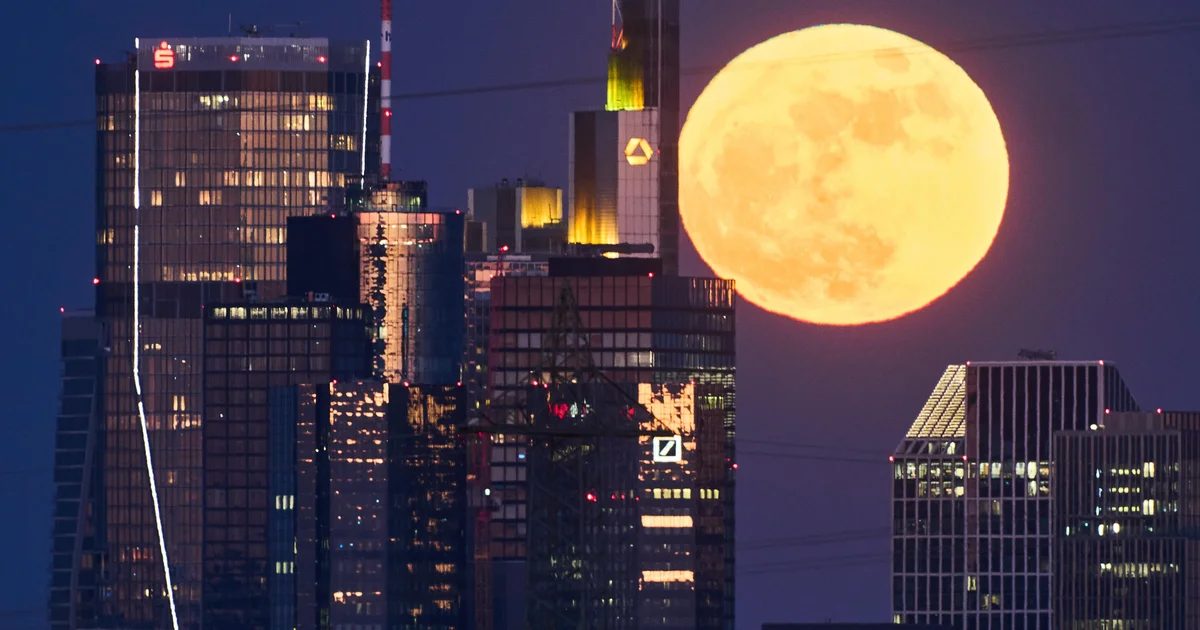
SouthernWorldwide.com – A rare celestial event, the blue micromoon, is set to grace the night sky this weekend, offering a spectacle that won’t be repeated until the end of 2028.
This particular full moon is characterized as a “blue micromoon” because it is both a blue moon and a micromoon. A blue moon, in astronomical terms, refers to the second full moon occurring within a single calendar month. This month, the first full moon took place on May 1.
A micromoon, on the other hand, is a full moon that happens when the Moon is at its farthest point from Earth in its elliptical orbit. This makes it appear slightly smaller and dimmer than an average full moon. The upcoming blue micromoon will be approximately 252,360 miles away from Earth.
For those in the Northern Hemisphere, the blue micromoon will be visible alongside Antares, a prominent star located in the constellation Scorpius. The visual display is expected to be particularly dramatic for observers south of the equator and across the Pacific Ocean.
In these regions, the moon will appear to pass directly in front of Antares, temporarily obscuring the star. This phenomenon is known as an occultation.
The term “blue moon” itself does not indicate any change in the moon’s color. Despite its name, the moon will not appear blue, turquoise, or any other unusual hue. The designation simply signifies the infrequent occurrence of two full moons within the same month.
Blue moons happen approximately once every two to three years. The last blue moon was observed in 2023, and the next one after this weekend’s event is not anticipated until December 31, 2028, according to astronomical sources.
The difference in apparent size and brightness between a micromoon and a typical full moon can be subtle. Astronomers estimate that the blue micromoon will appear about 6% smaller and 10% dimmer than an average full moon.
These subtle differences might go unnoticed by casual observers. However, for dedicated skywatchers, the event still presents a unique opportunity to observe a specific type of full moon.
Read more : The Left Continues to Invoke Jim Crow After Supreme Court Rejects Racial Gerrymandering
For those eager to witness the blue micromoon, intentional observation will be key. The Virtual Telescope Project has announced that it will be providing a live stream of the event, capturing images of the blue micromoon through its robotic telescopes.
This live stream will allow people worldwide to observe the celestial phenomenon, even if they cannot see it directly due to weather or light pollution.
The occultation of Antares by the blue micromoon will be a notable feature for observers in the Southern Hemisphere. Areas that will experience this include Argentina, Chile, New Zealand, eastern Australia, parts of Antarctica, and various islands.
Antares, often referred to as the “heart of the scorpion,” is a red supergiant star situated about 550 light-years away. A light-year is a vast distance, equivalent to nearly 6 trillion miles.
For observers outside the specific regions experiencing the occultation, Antares will remain visible alongside the full moon, creating a beautiful conjunction in the night sky.
The concept of a micromoon is the opposite of a supermoon, which occurs when the full moon is at its closest point to Earth, appearing larger and brighter. The most recent supermoon was observed at a distance of approximately 225,130 miles from Earth.
The upcoming blue micromoon, therefore, provides a contrast to the more dramatic appearance of a supermoon, highlighting the variations in the Moon’s apparent size throughout its orbit.
Understanding these orbital mechanics helps explain why some full moons appear more prominent than others. The blue micromoon is a reminder of the dynamic nature of our solar system and the predictable, yet often rare, celestial events it produces.
Skywatchers are advised to check local weather forecasts and find a location with minimal light pollution for the best viewing experience. While the differences may be subtle, the blue micromoon remains a significant astronomical event for enthusiasts and the public alike.