SouthernWorldwide.com – Robots have become exceptionally adept at rapid movements, repetitive actions, and tasks that would exhaust humans. However, when tasked with handling delicate, irregularly shaped, or slightly varied objects, robots often encounter significant challenges.
This is precisely where a new partnership between ABB Robotics and PSYONIC emerges. ABB Robotics is collaborating with PSYONIC, a California-based bionics company, to investigate the potential of leveraging real-world touch and motion data from human prosthetic users to train robotic arms.
In essence, the same advanced bionic hand that enables a person to securely grip a tool, delicately pick up a fragile item, or precisely adjust pressure in real-time could also be instrumental in teaching robots to perform these tasks with greater proficiency.
SOFT ROBOTIC ARMBAND GIVES PROSTHETIC HAND USERS NATURAL CONTROL
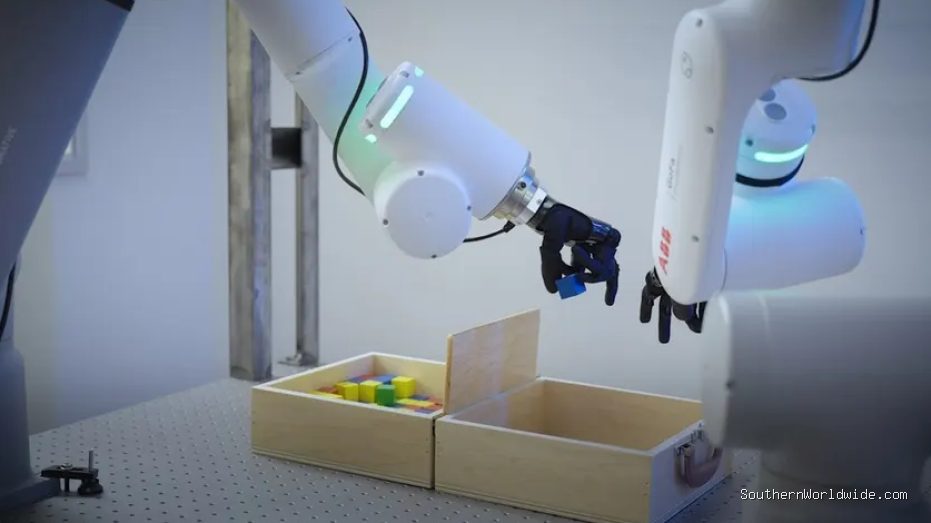
The core of this collaboration involves PSYONIC’s Ability Hand and ABB’s GoFa cobot. The Ability Hand was initially developed with prosthetic applications in mind. It features multi-articulating fingers, integrated pressure sensors, vibration feedback mechanisms, and flexible components designed to adapt to irregularly shaped objects. This combination is crucial because human grip is not a singular, fixed action. The way we hold a coffee cup differs from how we hold a screwdriver, and an egg requires a different touch than a mobile phone. Most individuals perform these adjustments instinctively.
For robots, replicating this intuitive adaptation is a complex endeavor. ABB and PSYONIC aim to explore how the movement, contact, and grip-force data generated by the Ability Hand can be utilized to train robots in handling objects that are fragile, uneven, or unpredictable. ABB’s GoFa cobot brings the industrial expertise to the partnership, providing the precision and repeatability necessary for controlled testing of these movements. The anticipated outcome is a robotic arm capable of learning from actual human handling data and subsequently applying this knowledge to tasks within factory and warehouse environments.
Industrial robots are already proficient in lifting, moving, welding, sorting, and assembling with remarkable speed. Nevertheless, many still falter when a task demands nuanced touch sensitivity. Consider a robot attempting to grasp a soft package, a delicate medical component, or a part that shifts subtly on a conveyor belt. Excessive force can damage the item, while insufficient grip can lead to it being dropped. Even a minor alteration in angle can disrupt the entire operation.
JOB-KILLING ROBOT LEARNS AT WORK, AND IT’S COMING TO THE FACTORY FLOOR
Consequently, gripping and dexterity remain significant hurdles in the field of automation. ABB identifies this as a pivotal aspect of its vision for Autonomous Versatile Robotics (AVR), which envisions robots capable of sensing, reasoning, moving, and handling objects with precision in dynamic environments.
Marc Segura, president of ABB Robotics, highlighted that human dexterity continues to be “one of the most difficult things to replicate in industrial-grade robotics.” He suggested that the collaboration with PSYONIC could be instrumental in “closing the long-standing gap” between human and robotic dexterity, a gap where this technology holds the potential to make a substantial impact.
The PSYONIC Ability Hand was engineered to assist individuals, incorporating myoelectric control, touch sensing, and compliant mechanics within a lightweight design. Its sensors are capable of detecting pressure during a grip, and vibration feedback can convey a sense of touch back to the user. This same sensing capability could prove highly valuable for robotic applications.
AI ENABLES PARALYZED MAN TO CONTROL ROBOTIC ARM WITH BRAIN SIGNALS
PSYONIC asserts that the Ability Hand can capture detailed information regarding movement, contact, and grip force. When this hand is utilized by individuals in real-world scenarios, it generates a more authentic dataset compared to demonstrations conducted solely in a laboratory setting.
Dr. Aadeel Akhtar, founder and CEO of PSYONIC, described dexterous manipulation as “a data challenge as much as a hardware challenge.” This statement encapsulates the essence of the matter. While improved robot hands are important, the training data that underpins their functionality may ultimately determine their utility in practical work environments.
ABB and PSYONIC anticipate that this research could have broad applications across industries such as automotive, aerospace, packaging, logistics, and life sciences. This is logical, as these sectors already extensively utilize robots, but delicate or variable handling tasks can still impede efficiency. A robot with enhanced grip adjustment capabilities could significantly improve the handling of fragile components, oddly shaped products, soft packaging, or repetitive tasks that pose ergonomic challenges.
HUMANOID ROBOTS HANDLE QUALITY CHECKS AND ASSEMBLY AT AUTO PLANT
The International Federation of Robotics has also noted that advanced gripping technologies and digital integration can lead to a reduction in engineering time by as much as 30%. This is a significant benefit for companies, as the implementation of automation is often protracted by setup, tuning, and custom engineering processes. If robotic hands equipped with touch sensitivity can streamline some of these tasks, companies may be able to deploy robots more rapidly and utilize them in more flexible ways.
There is a positive aspect to this development. Robots capable of performing repetitive or ergonomically challenging tasks could alleviate strain on human workers, potentially reducing the incidence of repetitive strain injuries caused by monotonous motions. However, this also raises broader questions about the future of labor. As robots become more capable, they may undertake tasks previously considered too variable for automation, which could influence hiring practices, training programs, and work assignments in the future.
The most beneficial application of this technology would be to augment human capabilities rather than simply replace them. For instance, robots could manage repetitive gripping tasks, allowing human workers to focus on oversight, quality control, machine setup, and more complex, higher-skilled duties.
Your phone contains your emails, passwords, photos, banking applications, and personal data. In this complimentary CyberGuy Live replay, Kurt the CyberGuy provides a step-by-step guide to simple phone security enhancements you can implement at your own pace. You will learn how to improve your privacy settings, identify the latest phone scams, utilize trusted security tools, and receive a straightforward checklist to maintain your protection. Watch the replay and access our checklist here: CyberGuyLive.com
ABB Robotics and PSYONIC are adopting a novel approach to one of robotics’ most persistent challenges: touch. Instead of relying solely on laboratory-based training, they intend to utilize real-world movement and grip data acquired from a bionic hand already in use by humans. This could equip robots with enhanced capabilities for delicate and variable tasks that have historically been difficult to automate. It could also propel industrial robots closer to safe and effective collaboration with humans in a wider range of settings. However, the human element should not be overlooked amidst this technological advancement. If robots are to learn from human touch, it is imperative for companies to establish clarity regarding data usage, workplace impact, and safety protocols.
Would you feel comfortable knowing that a robot in your workplace was trained using actual human touch data? Please share your thoughts by writing to us at CyberGuy.com.