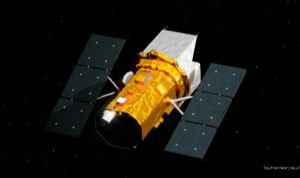
SouthernWorldwide.com – NASA is gearing up for a daring mission to rescue an aging telescope, the Swift Observatory, from an uncontrolled descent back to Earth.
This ambitious salvage operation, costing $30 million, is set to commence as early as this week with the launch of a specialized robotic spacecraft.
The space agency has contracted the startup Katalyst Space Technologies to elevate Swift to a higher orbit, enabling it to continue its crucial work of observing some of the universe’s most energetic cosmic events.
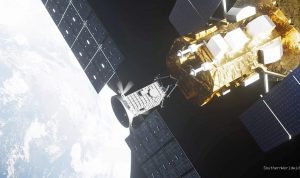
Katalyst’s three-armed robotic vehicle will pursue Swift after its launch from a Pacific atoll in the Marshall Islands, aboard a Pegasus rocket. The launch is tentatively scheduled for Tuesday.
Since its deployment in 2004, Swift has been experiencing a faster-than-usual orbital decay. This is attributed to recent intense solar activity, which has accelerated its descent.
To ensure its survival and continued operation, Swift must be moved to a higher, more stable orbit without delay.
The Hubble Space Telescope, another venerable NASA asset, is also facing a similar threat and could be a candidate for future rescue missions.
Like Swift, Hubble’s altitude is diminishing due to the Sun’s increased solar flare activity. Ghonhee Lee, CEO of Katalyst Space, indicated that his company’s next-generation robot, currently in development, could potentially assist Hubble within a few years.
Historically, only China has undertaken a comparable mission, successfully repositioning a satellite into a higher orbit four years ago.
“This marks the first American space robot designed for such a task,” Lee stated to The Associated Press. “NASA possesses numerous significant observatories, all of which could benefit from services like ours. This mission will demonstrate that this is a viable new strategy.”
Katalyst’s autonomous spacecraft, named Lift, is expected to take approximately one month to rendezvous with and capture Swift. Following the capture, it will take another couple of months to increase Swift’s orbit from its current 224 miles to the target of 373 miles.
The 1.6-ton gamma-ray observatory must maintain an altitude above 185 miles for the rescue to be successful. Current projections indicate that Swift will reach this critical threshold in October.
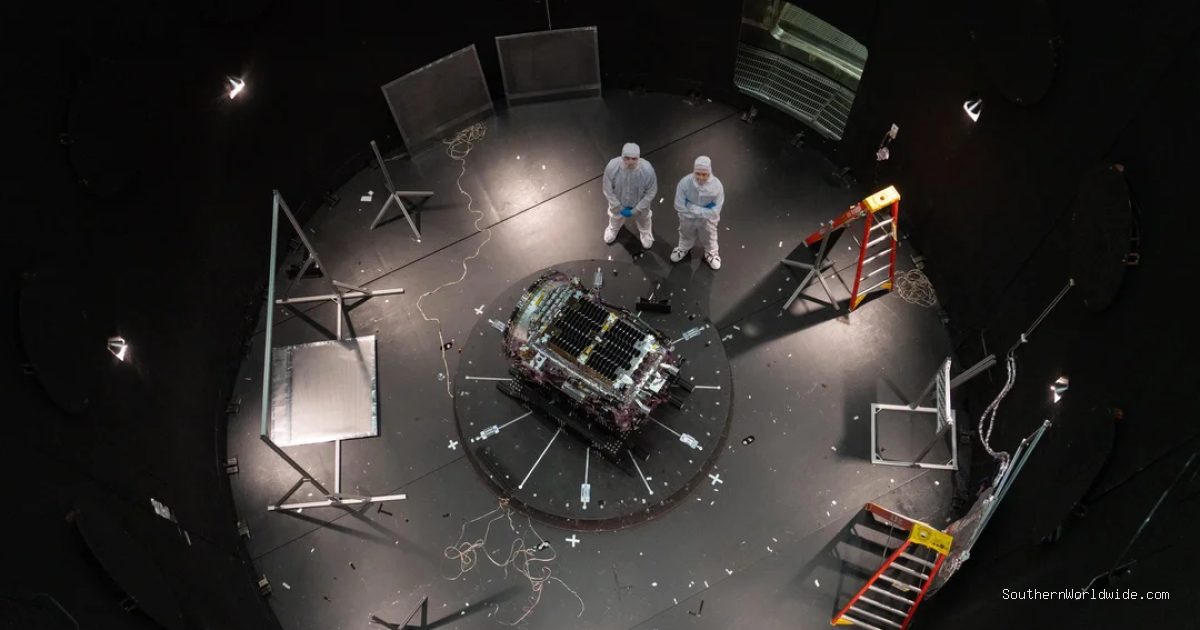
Lift, roughly the size of a small refrigerator and equipped with solar wings spanning 40 feet, features three arms, each extending just over three feet. These arms are fitted with grippers that resemble the hands of a Lego mini-figure.
If the operation proceeds as planned, Swift could resume its scientific observations by September, according to Lee.
Swift, valued at hundreds of millions of dollars, was not originally designed for repair or retrieval, making this mission particularly challenging. Company officials have cautioned that success is not guaranteed.
NASA entered into a contract with Katalyst last September, with two primary directives: the mission must be expedited, and it must not exacerbate the situation. Nine months later, Katalyst is prepared for the operation.
“To be candid, many doubted the feasibility of this mission. Few believed we would reach this stage,” commented Shawn Domagal-Goldman, NASA’s director of astrophysics.
NASA has managed to extend Swift’s operational life temporarily by deactivating all scientific instruments to slow its descent. Scientific observations were halted in February.
Nicky Fox, NASA’s chief of science mission, emphasized the importance of this endeavor. “If Swift reenters, we would lose that telescope and a significant portion of our observational capabilities,” she explained. “We currently lack the budget to build a replacement.”
While not every asset in space can be salvaged, Swift holds a special significance, according to Domagal-Goldman.
True to its name, Swift is engineered for rapid repositioning to capture transient astronomical phenomena, such as gamma-ray bursts and supernovae. With upcoming missions like the James Webb Space Telescope and the soon-to-launch Roman Space Telescope, a saved Swift would play a vital role as “NASA’s first responder.”
Katalyst views the Swift mission as a stepping stone for establishing a new in-space repair service. The company’s next-generation robotic rescuer, slated for launch next year, will be capable of servicing satellites at altitudes up to 22,300 miles.
Lee envisions a future with hundreds of orbital robots, not only performing repairs and repositioning satellites but also refueling them and constructing infrastructure such as solar farms and data centers.
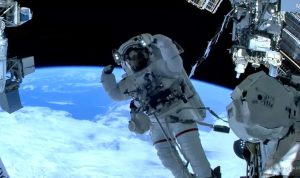
The Hubble Space Telescope, a 36-year-old instrument that benefited from astronaut servicing during the shuttle era, might receive a similar life-extension boost from Katalyst in 2028.
“It’s a national treasure,” Fox stated. “People are deeply fond of Hubble.”