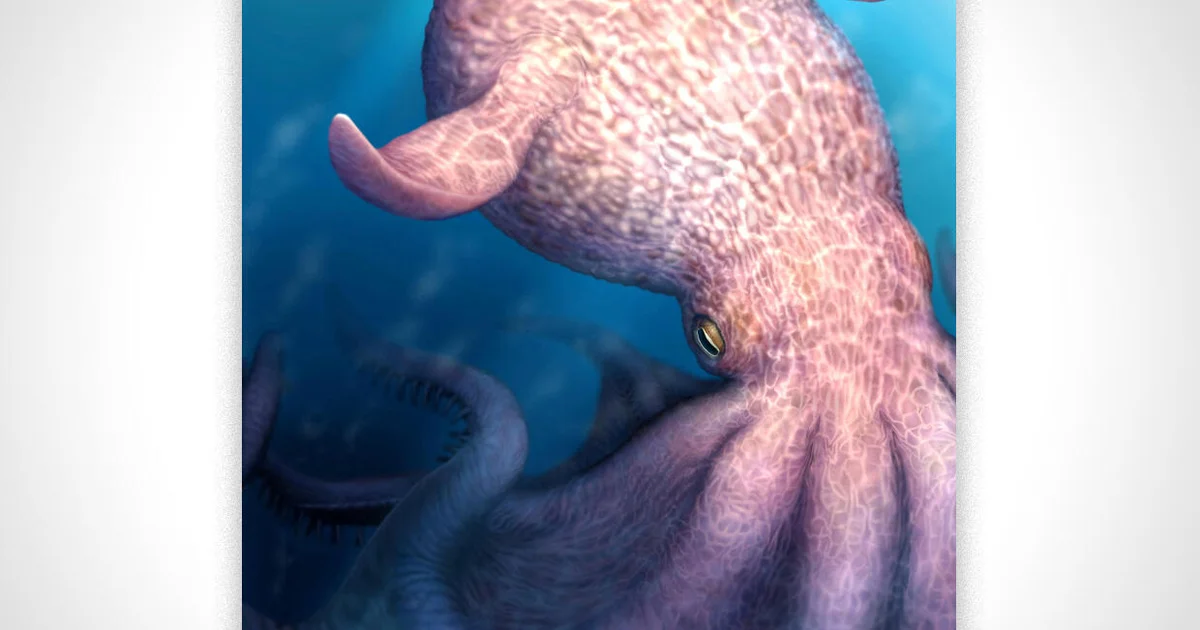
SouthernWorldwide.com – A recent study of fossilized jaws has revealed that colossal, kraken-like octopuses were once apex predators in the oceans during the age of dinosaurs, approximately 100 million years ago.
These ancient cephalopods possessed eight arms and elongated bodies that could stretch over 60 feet, making them formidable rivals to other marine carnivores of the time.
“These krakens must have been a fearsome sight to behold,” commented Adiel Klompmaker, a paleontologist at the University of Alabama, who was not involved in the new research.
While it’s well-known that the seas during the late Cretaceous period were dominated by sharks and marine reptiles like mosasaurs and plesiosaurs, the octopus has often been overlooked in discussions of top predators.
Scientists have previously studied large octopus relatives from the dinosaur era and smaller species that preyed on clams. However, the lack of well-preserved soft body fossils has made it difficult to determine their exact size.
Furthermore, there has been a prevailing perception that invertebrates, or creatures without backbones, were not substantial enough to be considered apex predators. Yet, the hardened chitinous beaks of octopuses are capable of crushing shelled and bony prey.
The new study, published in the journal Science, involved the analysis of 15 ancient octopus jaw fossils discovered in Japan and Canada’s Vancouver Island.
Researchers also identified an additional 12 jaws from Japan using a novel technique called digital fossil mining. This method involves closely scanning rock cross-sections to uncover hidden fossils.
By comparing these ancient jaws to those of modern octopuses, the scientists were able to estimate the size of these prehistoric creatures. The study concluded that the ancient octopuses ranged from 23 to 62 feet in length.
Yasuhiro Iba, a co-author of the study and paleontologist at Hokkaido University, stated that the largest jaw found was significantly larger than that of any modern octopus.
Iba informed Reuters that this newly identified predator ranks among the largest invertebrates ever recorded.
“Until now, the largest-known invertebrate has been the modern giant squid, which can reach about 12 meters (39 feet) in total length,” Iba explained.
The researchers also observed substantial wear and tear on the jaws of the largest specimens, including scratches, chips, and rounded edges.
These markings suggest that these ancient octopuses “repeatedly crushed hard prey such as shells and bones,” Iba noted.
Without direct evidence from the octopuses’ stomach contents, it remains challenging to definitively ascertain their diet or the extent to which they competed with other top predators for food.
It is possible they preyed on fish or snails, using their flexible arms to capture prey and their powerful beaks to break it apart.
“Our findings show that powerful jaws, and the loss of superficial skeletons, convergently transformed cephalopods and marine vertebrates into huge, intelligent predators,” the researchers concluded in their publication.
Neil Landman, a paleontologist at the American Museum of Natural History in New York, who was not involved in the study, suggested that searching for octopus fossils in other locations could provide a clearer understanding of their role in ancient food webs.
“It’s a big old planet,” Landman remarked. “So we have lots to look at to piece together the marine ecosystem through time.”
Read more : Spirit Airlines to Cease Operations Following Unsuccessful Government Bailout Talks
Earlier in April 2026, a prehistoric fossil previously believed to be the world’s oldest octopus was reclassified. Scientists determined that the remains actually belonged to a different type of marine creature, specifically a relative of the nautilus, a shelled cephalopod.