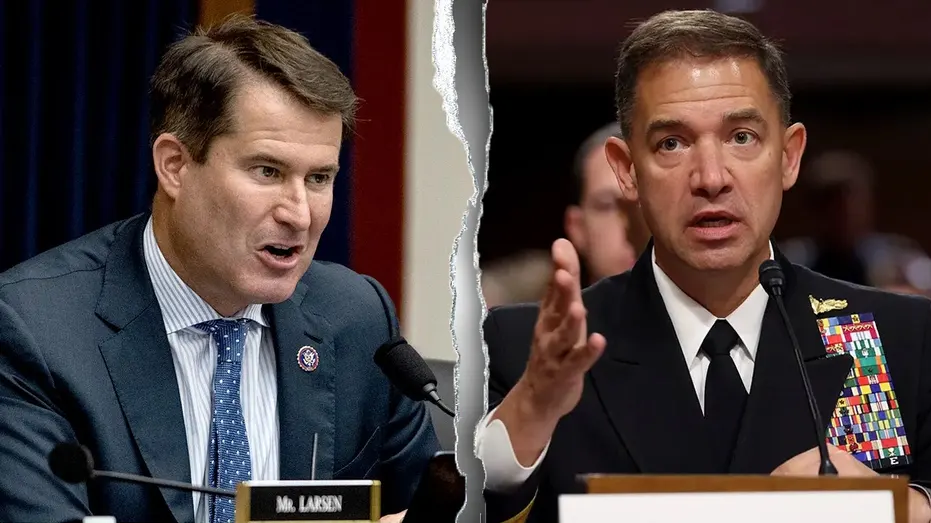
SouthernWorldwide.com – A heated exchange occurred during a House Armed Services Committee hearing on Tuesday, as Central Command Commander Admiral Brad Cooper strongly rebuked Democratic Representative Seth Moulton. The Massachusetts Democrat had questioned the cost in American lives of what he termed a failed strategy against Iran.
Moulton expressed his view that the situation in Iran was “not going well.” He then posed a direct question, asking, “how many more Americans we have to ask to die for this mistake.”
Admiral Cooper’s immediate response was sharp, stating, “I think it’s an entirely inappropriate statement from you, sir.”
Representative Moulton retorted, clarifying his intent, “It’s not a statement, it’s a question.”
The hearing took place in the context of Operation Epic Fury, which commenced on February 28. Fourteen U.S. service members have lost their lives in combat since the operation began.
Moulton, a Marine Corps veteran of the Iraq War and a consistent critic of the Trump administration’s Iran policy, repeatedly pressed Admiral Cooper. He highlighted what he described as the escalating repercussions of the conflict, including heightened instability in the Strait of Hormuz, a surge in oil prices, and intelligence suggesting Iran had begun rebuilding its missile infrastructure.
Admiral Cooper contested some of Moulton’s assertions. He labeled reports of Iran reconstituting key missile sites as “inaccurate.” Throughout his testimony, he consistently emphasized that U.S. forces had successfully achieved their designated military objectives.
This exchange followed an announcement by President Trump that he had instructed the military to halt planned operations against Iran for Tuesday. This pause was reportedly at the request of Gulf allies who were seeking to continue negotiations with Tehran. The U.S. has been observing a ceasefire since April 7.
According to a post by President Trump on Truth Social on Monday, Gulf leaders had requested the pause in strikes. They believed that “serious negotiations are now taking place, and that, in their opinion, as Great Leaders and Allies, a Deal will be made, which will be very acceptable to the United States of America, as well as all Countries in the Middle East, and beyond.”
Read more : Democrat Senator Reacts to Acting AG's 'Lying' Accusation
President Trump further stated that this potential deal would crucially include “NO NUCLEAR WEAPONS FOR IRAN!”
The contentious exchange marked the culmination of hours of critical discussions. During these discussions, Democratic members of the committee consistently questioned Admiral Cooper and other Pentagon officials. Their inquiries focused on whether the administration possessed a viable strategy beyond military actions, if the ongoing operations adhered to the War Powers Resolution, and whether the conflict was actually diminishing U.S. security despite significant battlefield successes against Iran.
Democrats also repeatedly challenged the administration regarding compliance with the War Powers Resolution. They argued that the continued blockade of Iranian ports and the military engagements in the Strait of Hormuz constituted active hostilities.
Representative John Garamendi of California pressed Admiral Cooper on the continued military operations in the region. He pointed out that U.S. forces had fired on Iranian tankers and engaged in exchanges with Iranian forces even after the administration had informed Congress that hostilities had ceased.
“The fact of the matter is that hostilities continue,” Representative Garamendi stated, accusing the administration of disregarding Congress and the Constitution.
Similarly, Representative Joe Courtney of Connecticut contended that the blockade itself was an “act of war.” Several Democrats also questioned the administration’s intentions regarding seeking congressional authorization for any future escalations.
On the other hand, Republican members of the panel defended the military campaign. They characterized it as a historic military achievement that had significantly weakened Iran’s capacity to threaten the United States and its allies.
Chairman Mike Rogers of Alabama asserted that U.S. operations had “rolled back 40 years of Iranian military investment.” He argued that the campaign had enhanced the safety of both the United States and its allies.
Admiral Cooper later testified that Iran was “significantly less capable” than it was prior to the strikes. He added that U.S. military actions had “derailed Iran’s strategy” across its nuclear, missile, and proxy networks.