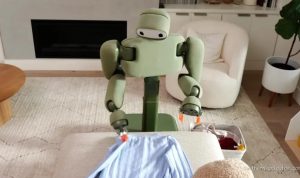
SouthernWorldwide.com – Figure AI, a prominent robotics startup based in California, has announced a significant achievement in autonomous operation with three of its humanoid robots completing over 24 hours of continuous work without human intervention.
The test, initially planned for eight hours, extended far beyond expectations, demonstrating the robots’ sustained performance. These AI-powered machines, running on Figure AI’s proprietary Helix-02 system, were tasked with sorting small packages around the clock. Their operation was broadcast via livestream, drawing considerable viewer attention.
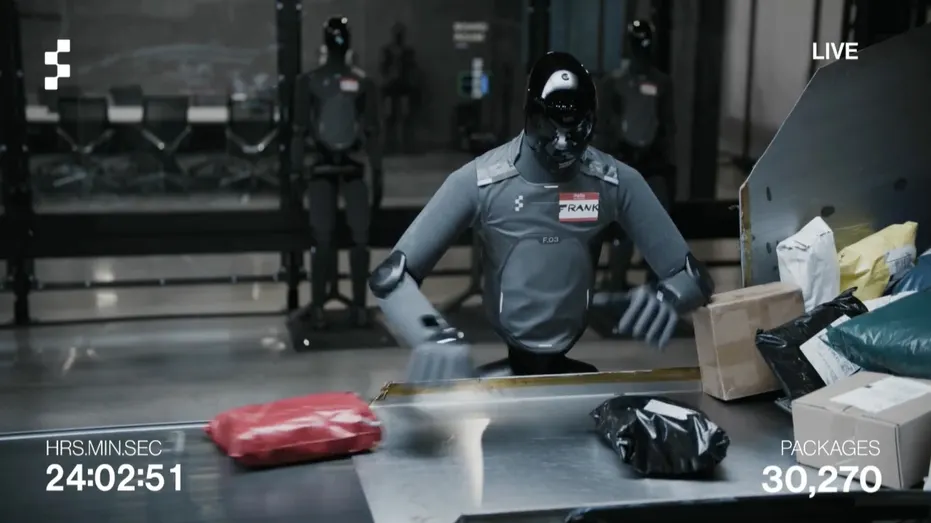
During the extended test, the robots were affectionately nicknamed Bob, Frank, and Gary by online viewers. Figure AI embraced this human element by subsequently adding visible name tags to the robots, making the demonstration more relatable.
The core task involved picking up small packages, identifying barcodes, and placing them onto a conveyor belt with the barcode facing downwards. This process was repeated continuously. Warehouse operations frequently rely on consistent movement, swift decision-making, and the ability to overcome minor obstacles, qualities that these robots demonstrated.
Figure AI reported that the robots successfully sorted over 28,000 packages during the operation. The company also stated that their operational speed was comparable to that of human workers. CEO Brett Adcock confirmed that the initial objective was an eight-hour run, but the test was prolonged after the robots performed flawlessly without any reported failures.
The robots utilized Helix-02, an in-house artificial intelligence system developed by Figure AI. This AI is described as a neural network that integrates visual perception, tactile sensing, proprioception (body awareness), and motor control. The demands on humanoid robots extend beyond simple arm movements; they require balance, precise gripping, postural adjustments, and the capacity to react to unexpected situations, such as an object landing in an awkward position.
Figure AI highlighted that the robots relied on onboard cameras and AI-driven reasoning for barcode detection and package sorting. Crucially, the company emphasized that no remote human control was involved; every action was a direct output of the Helix-02 system, as confirmed by Adcock.
The livestream provided the public with an unprecedented view of humanoid robots engaged in a real-time warehouse task. Viewers observed the robots continuing their sorting duties long after the initial eight-hour target was surpassed. The adoption of nicknames like Bob, Frank, and Gary transformed the perception of these machines, making them seem more like human colleagues on a late shift.
Figure AI’s decision to add name tags further humanized the demonstration, enhancing viewer engagement and making the technology more approachable. This seemingly small detail also amplified the broader implications of the technology: if robots can sustain long working hours, what will be the impact on human employment in these roles?
A key claim made by Figure AI concerns the robots’ recovery capabilities. The Helix-02 system is designed to initiate an automatic reset if a robot becomes immobilized or encounters a scenario outside its predefined operational parameters. This feature is particularly significant for practical workplace applications, as a robot requiring constant human assistance would be impractical.
A robot that can autonomously pause, reset, and resume its task offers substantial utility. Furthermore, Figure AI indicated that if a software or hardware issue arises, a robot can leave the operational floor for maintenance, with another robot seamlessly taking over to ensure continuous workflow.
The field of humanoid robotics is highly competitive, with companies like Tesla, Agility Robotics, and Apptronik also developing robots for similar applications in warehouses, factories, and logistics. Figure AI has already conducted trials of its robots at BMW manufacturing facilities in South Carolina, indicating a likely initial deployment in controlled industrial environments before any widespread adoption in domestic settings.
Read more : Tiger Woods reportedly returns to Switzerland to presumably resume rehab after quick trip back to Florida
The task of package sorting serves as a clear and understandable benchmark for this technology. If a robot can consistently perform a repetitive job for extended periods, it naturally leads to questions about its applicability in other areas.
The next critical step for Figure AI will be to demonstrate the reliability and effectiveness of its robots beyond a single, controlled livestreamed event. While the package-sorting run showcased endurance, businesses will require more comprehensive proof of performance.
This includes data on failure rates, maintenance requirements, and the robots’ ability to handle less predictable, “messier” conditions without disrupting the overall operation. Independent validation, beyond company claims, will be essential, especially given the variable nature of real-world warehouse environments.
Factors such as package diversity in shape and size, label placement variability, conveyor belt jams, and the presence of human personnel in the work area present challenges that a single demonstration may not fully address. A robot that excels in a controlled livestream must prove its mettle in the more chaotic reality of a working warehouse.
While the immediate impact of this technology may seem distant for many, its potential influence is considerable. Enhanced package handling could lead to quicker delivery times, and warehouses might reconfigure staffing for overnight shifts. Companies may also leverage robots to fill roles that are difficult to staff or physically demanding for humans.
Simultaneously, this development raises legitimate concerns about the future of employment. A robot capable of working tirelessly presents an impressive technological feat but can also be perceived as a sign of increasing automation encroaching on traditional labor sectors.
This does not necessarily imply the complete elimination of all warehouse jobs. Real-world work environments are complex, with varied package types, equipment malfunctions, and the need for human problem-solving skills that are not always apparent in demonstrations.
However, Figure AI’s test suggests a tangible progression of humanoid robots from short, attention-grabbing video clips to more extended, practical workplace trials.
Figure AI’s 24-hour package-sorting demonstration offers a glimpse into the future of warehouse automation. The robots still face the challenge of proving their capability in real-world conditions at a justifiable cost for businesses.
Nevertheless, the demonstration indicates that humanoid robots are moving beyond mere hype. The notable aspect of this event may be the apparent ordinariness of the task performed. These robots are not executing complex acrobatics or engaging in public displays; they are consistently performing the fundamental actions of picking up packages, reading barcodes, and placing items on conveyor belts.
This type of repetitive, seemingly mundane work is precisely where automation often finds its most impactful applications. If companies can ensure the reliability, safety, and affordability of these robots, the operational landscape of warehouses could undergo significant transformation in the coming years.