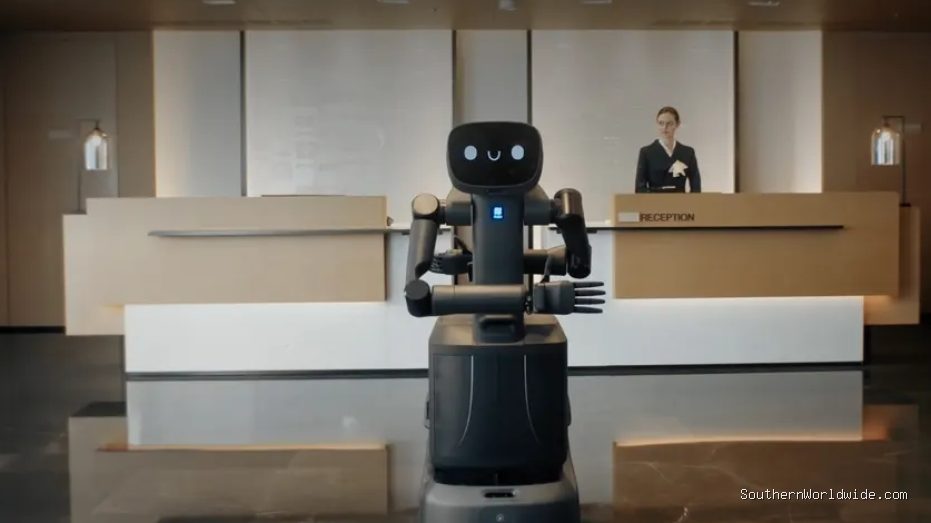
SouthernWorldwide.com – Pudu Robotics has unveiled plans for what it claims is the first “full-scenario robot-serviced hotel,” aiming to integrate robots into every facet of the guest experience. This ambitious project will deploy robots for services ranging from reception and room service to cleaning, food preparation, and overall guest support.
The hotel is slated to open its doors to the public in 2027. However, preliminary trials of its robot-powered services and select rooms are expected to commence in late 2026. Early visitors will have the opportunity to experience robot-assisted check-in and autonomous in-room deliveries before the comprehensive launch.
The hotel’s location is strategically chosen on West Artificial Island, a man-made island connected to the Shenzhen-Zhongshan Link in Guangdong Province. This cross-sea bridge and tunnel project is a significant undertaking within the Pearl River Delta’s transportation infrastructure development.
This choice of location is highly fitting, as Shenzhen is already recognized as a major technology hub in China. The presence of room-service delivery robots is already a common sight in hotels across many of China’s large cities, indicating a growing acceptance of robotic assistance in hospitality.
However, this new project ventures far beyond current applications. Pudu Robotics’ vision extends beyond simply supplementing human staff with a few robots. The company aims to establish a fully integrated robot service system capable of managing the entire guest journey.
The planned hotel is designed to feature 44 high-end rooms, a restaurant, a gymnasium, and various other guest amenities. Robots will be assigned diverse roles throughout the property, encompassing reception duties, room service delivery, cleaning operations, food preparation, and direct guest support.
This means guests could potentially check in with a robot, have their luggage delivered by automated means, and order refreshments directly from their smartphones without needing to contact the front desk. Furthermore, AI-powered cleaning robots will be responsible for waste detection and maintaining room cleanliness.
Pudu Robotics states that its robots will operate under a unified intelligence framework. This interconnected system ensures that different machines can perform their specialized tasks while remaining synchronized through a common software platform.
Specific robots will handle distinct functions. Pudu’s FlashBot will manage an intelligent vending system, enabling guests to request drink deliveries via their smartphones. The PUDU T300 is designated to transport luggage from the lobby to guest rooms.
Concurrently, the PUDU CC1 Pro and PUDU MT1 cleaning robots will undertake cleaning responsibilities, leveraging AI-driven waste-detection technology to optimize their operations.
During the Shenzhen launch event, the BellaBot Pro demonstrated its capability by serving coffee, while the KettyBot Pro was seen delivering refreshments and snacks. While such robotic service might still be novel for many travelers, it aligns with Shenzhen’s burgeoning tech culture, where robot baristas and drone food delivery are increasingly becoming a visible part of daily life.
The hotel’s operational backbone will be PuduFM 1.0, the company’s proprietary embodied intelligence foundation model. Additionally, PuduAgent will be utilized to oversee and manage the intelligent operations across the entire hotel ecosystem.
“This partnership signifies a crucial advancement in the large-scale implementation of embodied intelligence within premium hospitality settings,” stated Cong Guo, co-founder and CTO of Pudu Robotics.
Guo further elaborated that this project provides the company with a valuable opportunity to explore novel service models where artificial intelligence and robotics collaborate to deliver seamless and interconnected guest experiences.
While the ambition is considerable, the rollout is planned to be phased. The initial public trial is anticipated in late 2026, with the broader hotel opening scheduled for 2027.
China has already shown a strong inclination towards adopting service robots in various public sectors, including hotels, restaurants, airports, and other public spaces. This robot-run hotel represents an escalation of this trend into a more sophisticated phase.
Shenzhen Culture & Tourism Industry Development is collaborating with Pudu Robotics to transform West Artificial Island into a dedicated destination for robotics and technology. The hotel is conceived as just one component of this larger developmental initiative.
Over the next four years, the island is projected to incorporate additional robotic applications across the tourism and hospitality sectors. This development could establish the area as a testing ground for understanding traveler responses to an environment where robots manage almost every service touchpoint.
Should this hotel prove successful, it could fundamentally alter future travel expectations. The prospect of expedited check-ins, automated deliveries, and round-the-clock service might appeal strongly, particularly for guests arriving late or requiring immediate assistance.
However, this technological advancement also brings forth significant considerations. A hotel operated predominantly by robots raises pertinent questions regarding employment, data privacy, operational safety, and the fundamental nature of hospitality that guests truly desire.
While some travelers might appreciate the enhanced speed and efficiency, others may find themselves missing the warmth and intuitive understanding that a human staff member can offer. The ability to perceive the atmosphere, accommodate unusual requests, or provide assistance during unforeseen issues are aspects that robots may struggle to replicate.
This is precisely why this project holds considerable importance. It has the potential to gauge public readiness for hotels where artificial intelligence manages the entire guest experience, from arrival to departure.
China’s inaugural robot-run hotel appears poised to serve as a significant test case for the extent of automation achievable in the hospitality industry. While delivery robots have already become a familiar sight in hotel corridors, this project places robots at the core of the entire guest experience. The convenience offered could be remarkable, with the possibility of seamless check-ins, on-demand drink orders, automated luggage delivery, and immediate room support, all without the need to interact with a potentially busy front desk. For travelers prioritizing efficiency, this offers a distinct advantage. Nevertheless, the essence of hospitality has always transcended mere efficiency. Exceptional hotel stays are frequently defined by subtle human interactions—a welcoming smile, a thoughtful recommendation, or a swift resolution to a problem, all of which can significantly enhance a travel experience.
If a robot-run hotel can deliver a faster service, would you miss the human touch, or would you gladly bypass the front desk altogether? We invite you to share your thoughts by contacting us at CyberGuy.com.