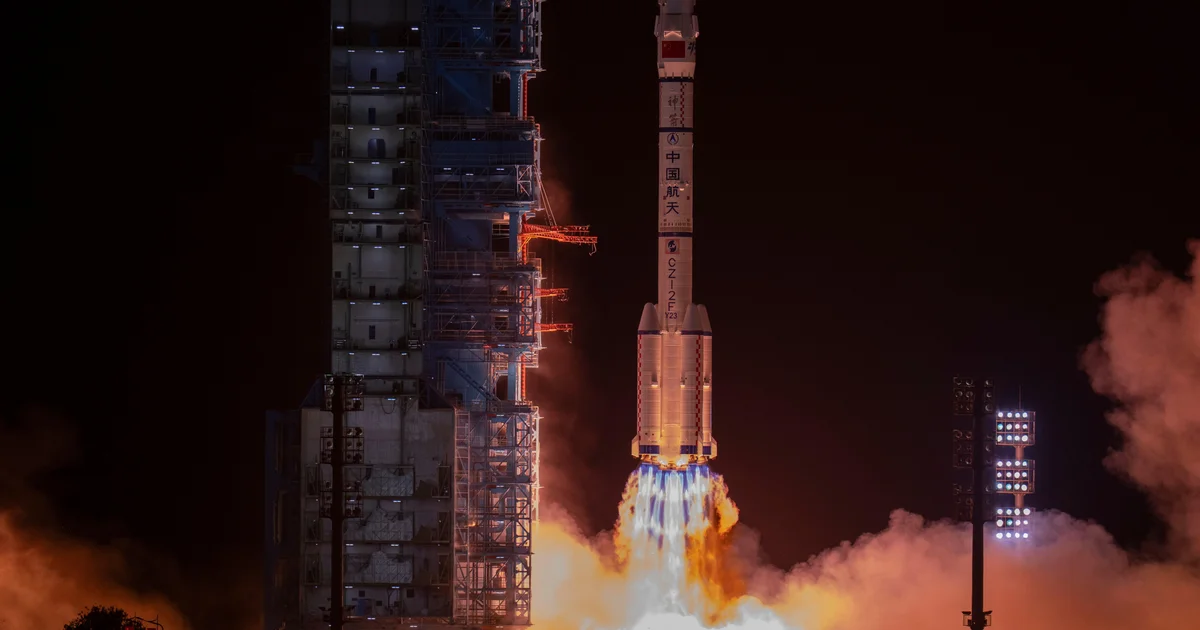
SouthernWorldwide.com – China has successfully launched the Shenzhou 23 spacecraft, carrying three astronauts to its space station. Notably, one of the astronauts is slated for an extended one-year stay in orbit, marking one of the longest individual missions in space history.
The launch took place at the Jiuquan Satellite Launch Center, located in the northwestern region of China. An official from the launch center, Li Benqi, confirmed the “complete success” of the mission in a statement released by Chinese state media.
This significant launch underscores China’s ambitious space agenda, which includes plans for its first crewed mission to the Moon by the year 2030.
The crew for the Shenzhou 23 mission comprises Commander Zhu Yangzhu, Zhang Zhiyuan, and Lai Ka-ying. Chinese authorities also identified Lai Ka-ying by her Mandarin transliteration, Li Jiaying.
Lai Ka-ying, who hails from Hong Kong and holds a doctoral degree in computer forensics, is making history as the first astronaut from the city to embark on a space mission. She is also recognized as China’s fourth female astronaut to venture into space, according to reports from Chinese state media.
The astronauts are scheduled to undertake numerous scientific and application-focused projects during their time in orbit. A key objective of the mission is to conduct an in-orbit handover with the crew of Shenzhou 21, who have already spent over 200 days aboard the Tiangong space station.
Read more : Blue Origin Rocket Mishap Fuels Space Race Worries
The Shenzhou 21 mission, which launched in late October, included China’s youngest taikonaut at the time. This mission also carried four mice, marking the first instance of live mammals being part of a Chinese space program mission.
One of the three astronauts on the Shenzhou 23 mission will remain at the Tiangong space station for a full year. The purpose of this extended mission is to study “human adaptability and performance limits” in the challenging environment of long-duration spaceflight, as stated by state media.
As China continues to advance its space capabilities, its astronauts have completed multiple missions to the Tiangong space station. The development of Tiangong was a strategic move, particularly after China faced exclusion from the International Space Station due to U.S. national security concerns.
The United States is widely considered China’s primary competitor in space exploration. NASA, the U.S. space agency, has set a target to land astronauts on the lunar surface by 2028.
China’s space station, named Tiangong, which translates to “Heavenly Palace,” welcomed its first crew in 2021. Last year, an emergency mission was conducted under the Shenzhou program, meaning “Divine Vessel,” to safely return a team of astronauts who were stranded on the space station due to a damaged spacecraft.
Prior to that incident, a group of Chinese astronauts experienced a nine-day delay in their return to Earth. This delay was caused by damage to the window of their spacecraft. They were eventually able to return on the Shenzhou 21 spacecraft after its crew arrived at the space station. Investigations by China’s space program concluded that the damaged spacecraft, Shenzhou 20, did not meet the required safety standards for carrying astronauts.