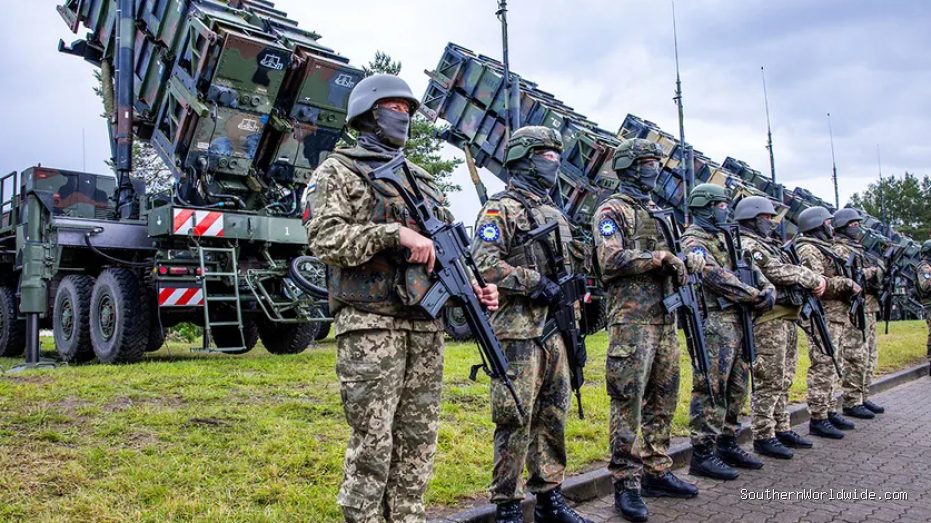
SouthernWorldwide.com – Germany is embarking on a significant military transformation, pledging to develop Europe’s most formidable conventional army. This ambitious goal is now underpinned by Berlin’s updated military strategy, a move that signals a historic shift for a nation long characterized by post-war military restraint.
The impetus for this change stems from the profound impact of Russia’s invasion of Ukraine. As stated by Hanefeld, Russia’s actions have disrupted established European certainties and challenged the international order. This has fundamentally altered the strategic landscape in which Germany operates.
Hanefeld further elaborated that Germany is currently Ukraine’s largest supporter. The decision to build the strongest conventional army in Europe, firmly integrated within the NATO alliance, represents an ongoing and significant commitment from Germany.
Historically, Germany’s post-World War II military identity was shaped by a policy of restraint. Following the war, West Germany was permitted to rearm only within the framework of a Western alliance. It joined NATO in 1955, and its armed forces, the Bundeswehr, were developed as a component of collective defense rather than as an independent power.
For many decades after reunification, Germany heavily relied on the security umbrella provided by the United States. This often resulted in Germany falling short of NATO’s defense spending targets, a recurring point of contention with the U.S., which felt that Europe’s largest economy was not contributing its fair share.
The full-scale invasion of Ukraine by Russia in 2022 compelled Berlin to re-evaluate its defense posture. Then-Chancellor Olaf Scholz famously termed this shift a “Zeitenwende,” or turning point. Current Chancellor Friedrich Merz is now aiming to translate this concept into a sustained military buildup.
Hanefeld acknowledged that while the changes in Germany are frequently referred to as a “Zeitenwende,” the historical context of the country makes this transformation a complex undertaking.
This military strengthening effort is occurring amidst public disagreements between U.S. President Donald Trump and Chancellor Merz. A U.S. defense expert has warned that these tensions could potentially complicate crucial decisions related to deterring Russia.
The friction intensified after Merz criticized the U.S. handling of negotiations with Iran, suggesting that Iran’s leadership was “humiliating” the United States. He also questioned the Trump administration’s exit strategy. President Trump responded by accusing Merz of being lenient on Iran’s nuclear program, despite Merz’s stated position that Iran must not acquire nuclear weapons.
These disagreements quickly extended into the realm of NATO politics. Trump subsequently raised the possibility of reducing U.S. troop presence in Germany and suggested that Merz should focus on resolving the war in Ukraine and “fixing his broken country” rather than commenting on Iran.
Merz then added another layer of complexity. Speaking to a young audience in Germany, he indicated that he would not advise his children to live, study, or work in the United States “today,” citing the evolving social climate in America. While he affirmed his admiration for America, he noted that this admiration was not currently growing.
Montgomery commented that criticizing the president in a meeting with schoolchildren in Germany was not indicative of professional diplomacy, particularly given President Trump’s known sensitivity. He emphasized that the United States is the larger nation in the relationship and that Merz, as a national leader, should have demonstrated greater discipline.
Montgomery further suggested that these tensions could have repercussions on critical security decisions, including Germany’s long-range strike capabilities.
He criticized recent U.S. actions to delay or potentially cancel the rotational deployment of long-range strike systems to Germany. These systems were expected to include Tomahawk, SM-6, or Precision Strike Missile capabilities. In May, Reuters reported that Germany’s defense ministry stated there had been no “definitive cancellation” of this deployment.
Montgomery described these as “bad decisions” made by the U.S. Department of Defense, highlighting the critical importance of these weapon systems for deterring Russia.
He clarified that the objective is not to engage Russia in conflict in Poland, the Baltics, or the Suwałki Gap, but rather to prevent Moscow from initiating an attack in the first place.
“And those long-range strike weapons are a big part of that. And I’m very disappointed in our Department of Defense,” Montgomery stated.
A source with knowledge of the situation indicated that despite briefings suggesting potential reductions in U.S. involvement, the defense relationship between the U.S. and Germany remains robust, and cooperation continues to be close.
Montgomery argued that Germany’s development of a substantial and impressive defense industrial base is beneficial for NATO, Western security, and even for major U.S. defense contractors. He posited that Germany, rather than Poland, France, or the United Kingdom, is most likely to become the central hub of Europe’s future defense industrial base.
Germany has historically been a key location for the U.S. military presence in Europe. Hanefeld pointed to Ramstein Air Base, Landstuhl Regional Medical Center, and the training area in Grafenwöhr as examples of Germany’s continued significance for American power projection and NATO deterrence.
“These facilities serve U.S. national security interests and U.S. military personnel and further NATO’s ability to deter and defend,” Hanefeld stated. He expressed confidence that NATO will maintain its transatlantic core while becoming more European in the coming decade.
At the 2025 NATO summit in The Hague, allies committed to investing 5% of their GDP annually in defense and defense-related spending by 2035. This includes core military expenditures and broader security investments. According to the German government, Merz stated at the time that this decision was intended to safeguard “freedom, security and prosperity.”
Hanefeld indicated that Germany is already on track to meet this target, announcing that Berlin will increase defense spending to 5% of GDP “well before” 2035 and recruit nearly 100,000 new active-duty soldiers into the Bundeswehr.
He also addressed U.S. critics who contend that Germany and other European allies are still not shouldering their fair share of the defense burden. Hanefeld highlighted that Germany has signed over 380 contracts, valued at more than $33 billion, with U.S. defense companies for the procurement and manufacturing of fighter jets, transport helicopters, air defense systems, and ammunition.
“It’s a down payment on the transatlantic future and on our political commitment to shift the burden for deterrence and defense to Europe,” Hanefeld remarked.
One of Germany’s most tangible commitments is its permanent brigade stationed in Lithuania, which is expected to comprise approximately 5,000 German military and civilian personnel. The Bundeswehr states that this force is intended to be fully operational for the defense of NATO’s eastern flank in the Baltic region within three years.
Hanefeld described the brigade as one of Germany’s “signature efforts” to assure Baltic allies that NATO “will defend every inch of allied territory.”
For Germany, this transformation transcends financial considerations; it represents a political and cultural departure from decades of cautious military engagement. For the United States, it serves as a test of whether an ally, long criticized for underspending, can now become the European backbone that Washington has advocated for.
Hanefeld affirmed that this is precisely the direction Berlin intends to pursue.
“NATO will remain transatlantic at its core,” he stated, “but will become more European over the next decade.”