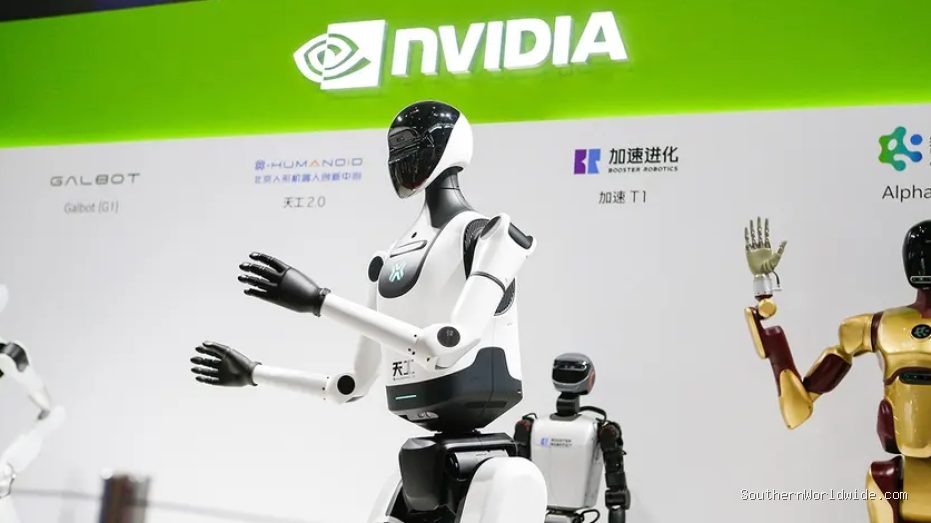
SouthernWorldwide.com – NVIDIA, a prominent technology company renowned for its advancements in AI computing and robotics systems, has unveiled NVIDIA Halos for Robotics. This groundbreaking system is being hailed as the industry’s first comprehensive, full-stack safety solution specifically designed for robotics and physical AI.
Physical AI refers to intelligent machines capable of perceiving, making decisions, and acting within the real world. NVIDIA states that Halos integrates AI compute, essential safety software, sensor data, various safety applications, and inspection protocols. The overarching objective is to equip robots with a standardized safety architecture before they begin operating in close proximity to humans.
HUMANOID ROBOTS ARE GETTING SMALLER, SAFER AND CLOSER
NVIDIA Halos for Robotics serves as a critical safety system for both robots and physical AI. According to NVIDIA, it effectively connects the pivotal layers necessary for the development, validation, and deployment of robotic systems.
This integration encompasses AI compute power, system software, the processing of sensor data, dedicated safety applications, and rigorous inspection processes. Essentially, NVIDIA aims to embed safety into the core of robot design from the outset. This proactive approach is becoming increasingly vital as robots are slated to operate in environments already populated by human workers.
NVIDIA highlights that the system benefits from over 18,600 engineering years dedicated to the development of autonomous vehicle safety. This extensive background is particularly relevant because robots and autonomous vehicles share a common challenge: the need to accurately sense their surroundings, make rapid decisions, and operate with enhanced safety around people.
The forthcoming generation of autonomous robots is expected to navigate dynamic and unpredictable environments. This could include busy warehouse floors with human workers, shared spaces traversed by moving equipment, and other robots performing their individual tasks. Such complexity presents a significant safety hurdle.
For a robot to function safely, it requires sensors to understand its immediate environment. Subsequently, it needs robust AI compute capabilities to process this incoming information efficiently. Finally, sophisticated safety software is essential to guide its behavior in real-time, ensuring safe interactions.
NVIDIA asserts that Halos provides robotics companies with a standardized safety architecture. This architecture connects the primary safety layers, preventing them from operating in isolation and fostering a more cohesive safety framework.
“Physical AI is transforming how factories, warehouses and logistics operations work, and robotics teams need a unified safety architecture to scale autonomous systems into these environments,” stated Deepu Talla, vice president of robotics and edge AI at NVIDIA. “With NVIDIA Halos for Robotics, developers and system builders can harness NVIDIA’s proven autonomous vehicle safety foundation to develop safer robots faster and bring them into industrial operations alongside workers with greater confidence.”
NVIDIA Halos for Robotics addresses multiple layers of robot safety. The NVIDIA IGX Thor and NVIDIA Holoscan Sensor Bridge offer industrial-grade AI compute, integrated safety features, and sensor connectivity crucial for real-time robotics and safety-critical workloads.
The NVIDIA Halos OS provides the foundational software stack for robotics safety. This includes Halos Core, which manages safety-related operating functions. The system also incorporates safety applications developed using the NVIDIA Halos Outside-In Safety Blueprint. This blueprint leverages external cameras and AI agents to enable robots to adapt their behavior in industrial settings.
Furthermore, NVIDIA has established the NVIDIA Halos AI Systems Inspection Lab. NVIDIA describes this facility as the world’s first program accredited by the ANSI National Accreditation Board for physical AI functional and AI safety. The lab assists partners in preparing their Halos integrations for third-party certification by esteemed organizations such as TÜV Rheinland, UL Solutions, TÜV SÜD, exida, SGS, and CertX.
Agility is recognized as the inaugural company to adopt NVIDIA Halos for Robotics. Their humanoid robot, Digit, is specifically engineered for industrial applications in logistics, manufacturing, and warehouse environments. Notable customers include Amazon, GXO, Schaeffler, and Toyota Motor Manufacturing Canada. Agility is collaborating with NVIDIA to integrate NVIDIA IGX Thor and Halos Core into Digit’s proprietary safe human detection system. NVIDIA IGX Thor delivers industrial-grade AI compute with built-in safety functionalities, while Halos Core supports essential safety-related operating functions.
The robotics company will also participate in the NVIDIA Halos AI Systems Inspection Lab. Through this collaboration, Agility and NVIDIA aim to utilize the lab to ensure Digit’s safety software, AI components, and cybersecurity protections meet stringent standards like IEC 61508, ISO 13849, and ISO/IEC TR 5469 prior to final third-party certification.
“Safety has to be built into the robot and validated across the entire system,” commented Peggy Johnson, CEO of Agility. “Partnering with NVIDIA to implement and optimize the Halos for Robotics system extends our leadership in responsible automation, which is a non-negotiable requirement for bringing humanoids safely into industrial workflows.”
HUMANOID ROBOT SWAPS ITS OWN BATTERY TO WORK 24/7
NVIDIA indicates that the Halos for Robotics ecosystem comprises a diverse range of partners, including those in software, embedded systems, sensors, silicon, industrial applications, and certification bodies. Software partners such as Acontis, Amazon FreeRTOS, and QNX provide support for real-time operating environments, safety communications, and embedded software essential for functional safety development.
Embedded systems partners like Advantech and NexCobot are delivering safety-designed IGX-based systems tailored for robotic deployments. Sensor and silicon partners include prominent names such as Infineon, NXP, SICK, STMicroelectronics, and Texas Instruments. Industrial application partners, including FORT Robotics, Inventec, KION Group, and Neurealm, are actively developing functional safety agents utilizing the NVIDIA Halos Outside-In Safety Blueprint.
Certification bodies also play a crucial role in this ecosystem. TÜV Rheinland is currently inspecting NVIDIA IGX Thor, Halos OS, and Holoscan Sensor Bridge for their readiness in functional safety certification. This initiative builds upon TÜV SÜD’s prior inspection of the Thor SoC and its certification of Halos Core for ISO 26262 compliance. The NVIDIA Halos AI Systems Inspection Lab involves over 40 companies, encompassing manufacturers, certification bodies, and safety vendors.
NVIDIA Halos Core for NVIDIA IGX is currently available in early access for registered developers. It offers support for both Linux and Linux with QNX configurations.
The open-source NVIDIA Halos Outside-In Safety Blueprint is also accessible in early access via GitHub. This blueprint forms an integral part of the Halos Applications layer within the Halos OS.
Based on NVIDIA’s announcement, this comprehensive system is designed for developers, robotics companies, and industrial operations that are aiming to integrate physical AI into practical, real-world workplaces.
If humanoid robots are to coexist and collaborate with humans, safety must transcend mere promises made in polished demonstrations. NVIDIA’s initiative aims to standardize robot safety more effectively before these humanoids become commonplace in industrial settings. This could potentially accelerate adoption for companies. However, it also brings to the forefront a critical question: who ultimately determines when a robot is deemed sufficiently safe to operate alongside humans?
The certification aspect is particularly noteworthy. NVIDIA is emphasizing the importance of safety software, AI components, and cybersecurity protections being addressed and prepared *before* final third-party certification. This level of detail is precisely what individuals should be inquiring about now, rather than after robots have already become a fixture on the factory floor.
However, let’s be candid. A humanoid robot that appears impressive on a stage presents a vastly different operational profile once it enters a real workplace. Employees will rightfully want to understand how it perceives them, how it responds to sudden movements, and what protocols are in place when unexpected situations arise.
ROBOT SOCCER PLAYER DENTS WALL WITH TERRIFYING KICKS
NVIDIA’s strategic move with Halos for Robotics is commendable. For humanoid robots to function safely alongside people, safety must be intrinsically integrated into the entire system from its inception. Agility’s adoption of Halos for Robotics clearly illustrates the direction this technology is heading. What stands out most is the emphasis on certification readiness. NVIDIA is discussing the rigorous preparation of software, AI components, and cybersecurity protections prior to final third-party certification. This is the caliber of detailed information that should be sought before any company declares a robot ready for human collaboration.
Would you feel comfortable working alongside a humanoid robot if a company stated that its safety system had undergone inspection and was prepared for certification? Please share your thoughts by contacting us at Cyberguy.com.