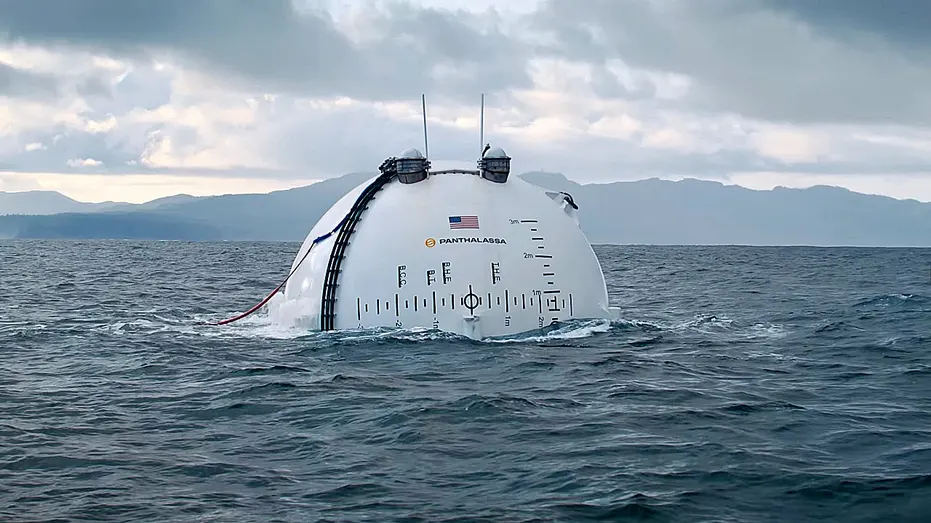
SouthernWorldwide.com – Artificial intelligence (AI) is already integrated into our daily digital lives, powering our phones, search engines, and various applications. Now, a novel concept is emerging from Silicon Valley investors: the possibility of operating the AI infrastructure at sea.
A company named Panthalassa has successfully secured $140 million in a Series B funding round. This substantial investment signals a strong belief in their ambitious plan to develop and deploy autonomous, floating AI computing nodes powered by ocean waves. With this latest funding, Panthalassa’s total investment reaches $210 million. The funding round was spearheaded by Peter Thiel, co-founder of Palantir, and the company intends to utilize these funds to establish a pilot manufacturing facility near Portland, Oregon. Furthermore, Panthalassa plans to launch its Ocean-3 pilot node series in the northern Pacific Ocean by late 2026.
Rather than constructing more land-based AI data centers, Panthalassa envisions placing computing power directly on the ocean’s surface. The system is designed to harness the energy from ocean waves to generate electricity, while seawater will be utilized for cooling the onboard systems. These computing units will then process AI requests and transmit the results back to land via low-Earth-orbit satellites.
LOWERING YOUR ELECTRIC BILL COULD BE FLOATING IN THE OCEAN
META BUILDS WORLD’S LARGEST AI SUPERCLUSTERS FOR THE FUTURE
Panthalassa’s innovative floating nodes are engineered to convert the motion of ocean waves into usable electricity. The company reports that it has dedicated a decade to refining the technology behind its power generation, onboard computing, and autonomous marine operations. Previous prototypes, including Ocean-1, Ocean-2, and Wavehopper, underwent testing in 2021 and 2024. Each node can be conceptualized as a self-contained, floating power station equipped with AI hardware. The natural movement of waves powers a generator, which in turn supplies electricity to the onboard AI chips.
WHY AI IS CAUSING SUMMER ELECTRICITY BILLS TO SOAR
The primary application for these onboard chips will be AI inference. This is the crucial stage where an AI model generates a response to a user’s prompt after it has been trained. In simpler terms, it’s the process that allows a chatbot to answer your questions. This specific function makes the ocean-based approach more feasible. While training massive AI models requires extensive data transfer and precise coordination, AI inference, which involves responding to prompts, may be more manageable for a floating node, especially in certain scenarios.
The immense power demands and spatial requirements of AI data centers, coupled with the need for cooling systems and potential community resistance to large facilities, have prompted a search for unconventional solutions. Ocean-based computing represents one such innovative direction.
Panthalassa’s strategy involves positioning its nodes in wave-rich offshore locations. The objective is to directly utilize wave energy onboard, eliminating the need to transmit power back to land. “We’ve built a technology platform that operates in the planet’s most energy-dense wave regions, far from shore, and turns that resource into reliable clean power,” stated Garth Sheldon-Coulson, Panthalassa’s co-founder and CEO.
A SUPERCOMPUTER CHIP GOING TO SPACE COULD CHANGE LIFE ON EARTH
The surrounding cold seawater also presents a natural cooling solution for the onboard chips, addressing a significant challenge in data center operations where heat generation is substantial. Unlike traditional land-based data centers that draw heavily from existing power grids, Panthalassa’s floating nodes are designed to generate their own electricity from wave energy.
A SUPERCOMPUTER CHIP GOING TO SPACE COULD CHANGE LIFE ON EARTH
While the ocean offers advantages in power generation and cooling, it introduces a critical challenge: connectivity. Traditional data centers rely on high-capacity fiber-optic cables for rapid data transfer. A floating node situated far offshore would likely depend on low-Earth-orbit satellite links. While this can support some AI responses, it may result in slower speeds and more limited capabilities compared to fiber optics.
Read more : Trump Targets Blue-State Medicaid Fraud to Save Money
SOLAR DEVICE TRANSFORMS USED TIRES TO HELP PURIFY WATER SO THAT IT’S DRINKABLE
The complexity increases when multiple nodes need to collaborate. AI systems often depend on seamless and rapid communication between chips, servers, and storage units. When these components are located on floating nodes in the ocean and communicating via satellite, maintaining synchronized operations becomes significantly more challenging. Consequently, AI data centers at sea might not be a viable replacement for land-based facilities in the immediate future. They may be better suited for specific AI tasks where the model can operate independently onboard, and the responses do not necessitate constant inter-machine communication.
Another practical consideration arises when equipment malfunctions. A land-based data center can dispatch technicians for repairs. However, a floating AI node operating in rough seas might require a dedicated vessel, specialized equipment, and favorable weather conditions, adding considerable cost and time delays.
Panthalassa claims to be developing autonomous systems specifically designed to withstand harsh marine environments. Their press release indicates that the Ocean-3 testing phase aims to demonstrate AI inference capabilities and refine manufacturing processes before commercial deployment in 2027. Nevertheless, the ocean environment is inherently unforgiving. Saltwater can corrode equipment, storms can transform routine maintenance into complex operations, and constant motion puts immense stress on hardware. For Panthalassa’s vision to succeed, the company must prove that its nodes can operate reliably for extended periods in challenging oceanic conditions with minimal human intervention.
WHY AI IS CAUSING SUMMER ELECTRICITY BILLS TO SOAR
The concept of ocean-based data centers is not entirely new. Microsoft previously explored underwater data centers through its Project Natick, with tests conducted in 2015 and 2018. These trials demonstrated that sealed underwater servers could function reliably, utilizing seawater for cooling and reportedly exhibiting a lower failure rate than comparable land-based systems. Microsoft eventually concluded the project.
Chinese companies have also reportedly been advancing underwater data center projects near Hainan and Shanghai. In Singapore, Keppel has explored floating data center designs, a concept particularly appealing due to land scarcity. Panthalassa’s approach, however, distinguishes itself by integrating wave power with onboard AI chips and satellite-based data transmission. A key reliance on floating nodes that must operate independently, far from the support typically afforded to conventional data centers, makes this endeavor noteworthy and also a subject of fair skepticism.
At present, this initiative will not directly alter the functionality of your phone or computer. You are unlikely to see an “ocean wave powered” label on your favorite AI application anytime soon. However, the broader implications are significant for everyone. AI’s voracious appetite for electricity means that as more companies integrate AI into their products, the demand for computing infrastructure will continue to grow. This escalating demand can impact energy grids, water resources, local disputes over new data center developments, and ultimately, consumer utility bills over time.
Panthalassa posits that its innovative approach could alleviate the necessity for new land-based data centers and power plants, thereby easing pressure on local communities and the power grid. However, the company must first demonstrate the system’s reliability at sea. If ocean-based AI transcends its testing phase, it could also bring forth new considerations regarding marine maintenance, environmental oversight, and the governance of computing infrastructure in international waters.
Take my quiz: How safe is your online security?
Think your devices and data are truly protected? Take this quick quiz to see where your digital habits stand. From passwords to Wi-Fi settings, you’ll get a personalized breakdown of what you’re doing right and what needs improvement. Take my Quiz here: Cyberguy.com
The widespread adoption of AI on smartphones and computers means that the substantial computational work is often performed in large data centers behind the scenes. This context highlights why Panthalassa’s ocean-based proposal is garnering attention. The company aims to leverage wave energy for power and seawater for cooling. The primary hurdle lies in proving that these floating AI nodes can withstand harsh marine conditions, function effectively with limited satellite connectivity, and be maintained efficiently. If Panthalassa succeeds, AI powered by the ocean could become a tangible part of our technological landscape. Conversely, failure could underscore the immense challenges in meeting AI’s escalating energy demands.
Should this wave-powered AI technology become widespread, would you have concerns about the potential impact of these floating nodes on our oceans? Please share your thoughts by writing to us at Cyberguy.com