SouthernWorldwide.com – NASA has successfully launched the Artemis II mission, sending a crew of four astronauts on a historic nine-day journey around the moon and back. The mission, which experienced several delays, finally lifted off on Wednesday at 6:35 p.m. EDT.
Commander Reid Wiseman, pilot Victor Glover, astronaut Christina Koch, and Canadian astronaut Jeremy Hansen are on board. Wiseman expressed the excitement of the crew and the public for this return to lunar exploration, stating, “I think the nation and the world has been waiting a long time to do this again.”
The mission was initially slated for an early February launch but was postponed due to issues with hydrogen fuel leaks and the upper stage propellant pressurization system. NASA has confirmed these problems have been resolved, paving the way for the launch.
A Landmark Test Mission
The Artemis II mission is significant as it marks the first crewed flight using NASA’s Space Launch System (SLS) rocket, currently the world’s most powerful operational booster. It is also the inaugural piloted flight of the Orion deep space crew capsule.
A primary objective of this mission is to rigorously test the Orion capsule, named Integrity. Wiseman emphasized its role as a test flight, noting that the crew is prepared for various scenarios, including a potential early return to Earth or a lunar flyby.
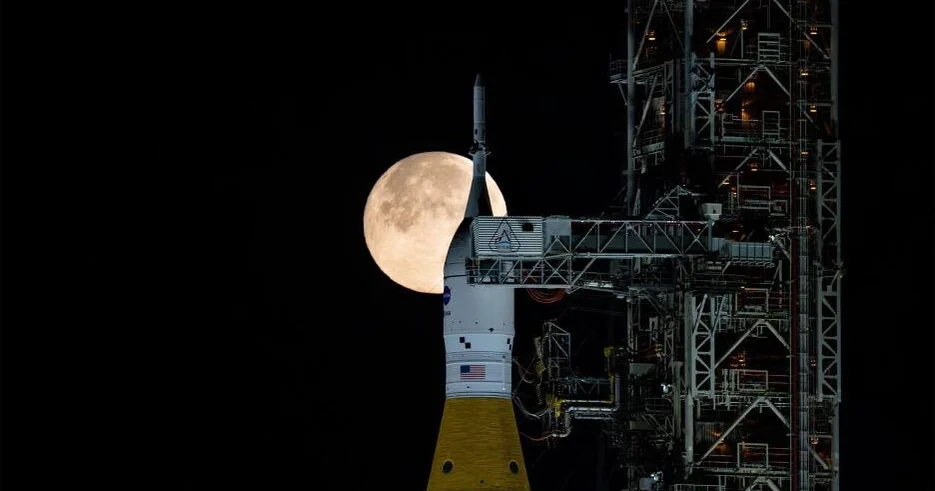
A full moon rises behind the Space Launch System rocket, a reminder of what the rocket was built to do. – NASA
Wiseman, Glover, and Koch are experienced NASA astronauts. Hansen, on his first spaceflight, will achieve the distinction of being the first Canadian to venture beyond Earth’s orbit.
This mission signifies the first time humans have traveled towards the moon since the Apollo 17 mission over five decades ago.
Paving the Way for Future Lunar Landings
Artemis II is a crucial step in NASA’s renewed space ambitions, particularly in light of China’s plans to land astronauts on the moon by 2030. NASA aims to achieve its own lunar landing missions by 2028.
However, before lunar landings, the agency intends to thoroughly evaluate the Orion crew capsule’s performance during the Artemis II voyage.
The Artemis II astronauts, left to right: commander Reid Wiseman, pilot Victor Glover, astronaut Christina Koch and Canadian astronaut Jeremy Hansen. – NASA
In the following year, NASA plans to conduct rendezvous and docking tests in low-Earth orbit with lunar landers being developed by SpaceX and Blue Origin. These tests will verify critical systems and operational procedures. Following these preparations, NASA astronauts are scheduled to land near the lunar south pole within two years.
Meanwhile, NASA is focusing on increasing its flight cadence and developing plans for a lunar base where astronauts can conduct research and technological development for extended periods.
NASA Administrator Bill Nelson highlighted this “step-by-step approach” as essential for achieving ambitious goals, drawing parallels to the success of the Apollo program. He emphasized that the current objective is not just exploration but establishing a sustained human presence on the moon, stating, “America will never again give up the moon.”
An Intense First Day in Space
The Artemis II astronauts began their journey atop the SLS rocket, propelled by nearly 9 million pounds of thrust. The 5.7 million-pound rocket accelerated the Orion crew ship into space, reaching speeds of nearly 5 miles per second.
NASA’s Space Launch System, the most powerful rocket in use, will launch the Artemis II flight to circle the moon. – Graphic by AFP via Getty Images
Two crucial rocket firings shortly after liftoff placed the spacecraft on an elliptical orbit with a high point of 43,760 miles, marking the farthest humans have traveled from Earth since the final Apollo mission in 1972. The Orion capsule separated from its propulsion stage approximately three hours and 23 minutes after launch.
These maneuvers are designed to establish a 24-hour orbit, providing ample time to verify the functionality of Orion’s communication, navigation, propulsion, and life support systems before proceeding to the moon. These tests include evaluating the capsule’s toilet system.
Glover, with assistance from Wiseman, also practiced maneuvering the Orion spacecraft around the spent SLS upper stage, simulating the procedures required for future docking with lunar landers or the Gateway space station.
“It is a crazy first day,” Wiseman told CBS News. “We come off the pad here at the Kennedy Space Center, and we have about 90 minutes (for) one trip around the Earth at low Earth orbit … making sure everything looks really good at a basic level. And then we head out to (44,000) miles from Earth for a 24-hour orbit.
“That one 24-hour orbit gives us time to check out all of (Orion’s) environmental control, life support systems,” Wiseman said. “Can it scrub our carbon dioxide? Can it keep us alive? Can we drink water? Can we go to the bathroom? All those basic human functions. … We’ve got to go get those things tested before we press out to the moon.”
Following a planned nap, the crew will execute another critical engine firing to place the spacecraft into an orbit measuring 44,555 miles by 115 miles. Flight controllers will then assess Orion’s performance before making a final decision on whether to proceed to the moon.
This mission is particularly important as the Orion spacecraft is equipped with a full suite of life support systems for the first time. The previous unpiloted Artemis I test flight in 2022, while successful in its overall flight, revealed unexpected damage to Orion’s heat shield during reentry. The Artemis II mission utilizes the same type of heat shield, but NASA has implemented a modified reentry trajectory to mitigate the risk of similar damage.
Four Days to the Moon
Assuming Orion’s systems perform as expected, the crew will initiate the “trans-lunar injection” burn approximately 25 hours after launch. This six-minute engine firing will increase the spacecraft’s velocity by about 900 mph, propelling it out of Earth’s orbit and towards the moon, a journey expected to take four days.
Read more : Oil Prices Reach Wartime Highs, Brent Crude Surpasses $126 Per Barrel
While confident in the mission’s success, the astronauts and their families acknowledge the inherent risks. Hansen stated, “It’s a test flight, and we have to be willing to take that risk. … And the most important thing we do next is we stack the next rocket, and we’d let the next four volunteers get on top of it and go.”
Circling the Moon After Half a Century
Unlike the Apollo 8 mission, which orbited the moon, the Artemis II crew will not land or orbit the moon. Instead, they will follow a “free return” trajectory, utilizing lunar gravity to guide them back to Earth.
NASA’s Artemis II mission plans to take a crew of four in the Orion spacecraft around the moon and back to Earth. – Graphic by Jonathan WALTER and Paz PIZARRO / AFP via Getty Images
This trajectory ensures that if any major issues arise with Orion’s navigation or propulsion systems, the capsule will still return to Earth without requiring manual thruster adjustments. The free return path will bring the crew within approximately 4,100 miles of the moon’s surface at its closest point.
The Far Side of the Moon and a New Distance Record
The Artemis II crew will be the first humans to witness large portions of the moon’s far side. Unlike previous Apollo missions, which primarily focused on the near side facing Earth, this mission’s trajectory will allow for daylight observation of areas on the far side never before seen by human eyes.
“Four people, two windows pointing right at the lunar surface, and a highly choreographed dance, really, of who has the cameras, who has the other voice recording devices, and how we are supporting the people actually taking the data and making the observations,” Koch explained.
Glover added, “Twenty-four men have seen the moon, and we’re going to send the first set of woman’s eyes. And there’s actually some differences, they think that she can potentially see colors that, you know, we (men) may not see.”
If the mission proceeds as planned, the Artemis II crew is expected to surpass the record for the greatest distance from Earth ever traveled by humans, set by the Apollo 13 crew at 248,655 miles. The Artemis II mission is projected to reach a distance of approximately 252,000 miles.
A High-Speed Return to Earth
The mission is scheduled to conclude with reentry and splashdown on April 10. The Orion capsule will reach speeds of approximately 25,000 mph as it enters Earth’s atmosphere, about 75 miles above the Pacific Ocean.
During reentry, the capsule will be enveloped in a plasma fireball as its heat shield withstands temperatures up to 5,000 degrees Fahrenheit. This will cause a temporary radio blackout for about five minutes.
Lessons Learned from Artemis I Heat Shield Damage
The Artemis II Orion capsule is equipped with the same heat shield used during the unpiloted Artemis I flight in 2022. While the capsule performed well, analysis revealed that the heat shield sustained unexpected damage during reentry, with portions of its outer layer detaching.
The heat shield protecting the Orion capsule during an unpiloted test flight in 2022 was seriously damaged during reentry. – NASA
Engineers determined that the heat shield’s outer char layer became permeable due to high entry temperatures, allowing gases generated in lower layers to escape. During the Artemis I’s “skip” reentry trajectory, the reduced heating allowed these gases to build pressure, causing portions of the shield to break off.
To address this, NASA has adopted a modified reentry trajectory for Artemis II, which involves an initial dip into the upper atmosphere followed by a shorter climb out. This approach is expected to allow the heat shield to erode more evenly, preventing the buildup of damaging pressure.
“And so that’s the plan,” stated Amit Kshatriya, NASA’s associate administrator, regarding the decision to proceed with the existing heat shield and the modified reentry profile.
Splashdown and Recovery
The reentry and splashdown sequence is expected to take approximately 13 minutes. Nine minutes into reentry, the Artemis II crew will begin monitoring the deployment of 11 parachutes designed to slow the capsule to a splashdown velocity of around 15 mph.
This complex parachute system includes drogue chutes to stabilize the capsule, followed by three main parachutes to bring the spacecraft to a safe landing speed. The system is designed with redundancy, allowing for safe return even if one parachute fails to deploy.
In the event of a normal descent, the Orion capsule will impact the water at 15 to 17 mph. Airbags will be deployed to ensure the capsule remains upright.
Upon landing, the astronauts will be recovered by helicopter and transported to a Navy amphibious transport dock. After initial medical checks and communication with their families, they will return to the Johnson Space Center. The Orion capsule will be recovered and transported back to shore for further analysis by NASA engineers.
Miles Doran contributed to this report.