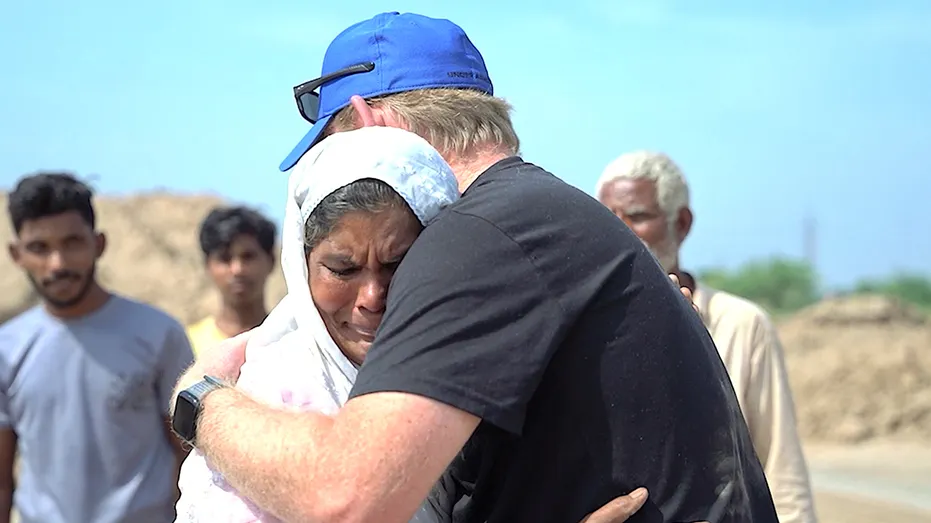
SouthernWorldwide.com – Americans are traveling to Pakistan to rescue Christians ensnared in what is described as modern-day slavery, with many attributing their efforts to divine intervention.
Within hours of arriving, one American, Hutchings, managed to pay off the debts of two enslaved Christian families, thereby securing their freedom and breaking what he described as a “curse that they’ve had for hundreds of years.”
The practice of debt bondage, known as “peshgri” in Pakistan, drives families into desperate situations. They accept advance loans for essential needs, which then trap them in cycles of debt that are exceedingly difficult to escape due to the repayment structures.
Emmanuel Hernandez expressed his shock upon learning that Christians in Pakistan were living in debt-based enslavement within the nation’s brick-making industry. His firsthand experience came when he traveled to Pakistan to meet his future wife and witnessed bonded laborers at a brick factory.
In January 2025, Hernandez established the nonprofit organization Project Jubilee. He credits divine grace for the sufficient donations received, which have enabled them to free 300 Pakistanis from slavery.
While Project Jubilee is committed to freeing any bonded slave, regardless of their background or faith, Hernandez noted that “98% of the people we rescue are Christians.” He attributes this to their status as “second-class citizens” in Pakistan.
The average cost to assist one family is approximately $8,500. This figure reflects Project Jubilee’s understanding that escaping bonded labor requires more than just debt relief.
“Our goal is for them to succeed in life and make sure that they never go back,” Hernandez stated. To achieve this, his team handles all necessary legal paperwork, provides families with two months of rent and food, connects them with local ministers, sponsors children’s education, and equips each family with a tuk-tuk for income generation.
Hernandez mentioned that while factory owners generally accept the release of slaves once their debts are settled, some have imposed restrictions on the number of families that can be freed monthly or have forbidden future visits from his organization.
Hutchings discovered Hernandez’s online profile in late 2025 and reached out to join the cause. A retired IT professional, Hutchings described himself as “just a normal guy who wanted to do something…to help people.”
Following a brief phone conversation, Hernandez invited Hutchings to accompany him on a trip to Pakistan in January. Hutchings accepted, and during this visit, he freed two families. He admitted to being “hooked” by the experience and described the process as deeply emotional, emphasizing that it “changes an entire family’s future for generations.”
Hutchings found witnessing the transformation in children particularly impactful. He shared how they can now ask children, “what do you want to be when you grow up?” a question they likely never considered when their future seemed predetermined as brick workers, like their parents.
Hutchings subsequently founded his own nonprofit, Intentional Faith Foundation, to channel donations from individuals eager to help free more enslaved individuals.
Just months after his initial trip, Hutchings returned to Pakistan in May to free an additional ten families. Following the viral spread of a video documenting his visit, his nonprofit received enough funding to rescue another family from enslavement.
The practice of bonded slavery was formally outlawed in Pakistan in 1992, according to Hall, but “enforcement remains weak.” Discrimination against religious minorities, including Christians, persists beyond bonded labor. The U.S. Commission on International Religious Freedom noted in 2025 “recent and escalating attacks against religious minorities” in Pakistan.
During his recent visit, Hutchings encountered difficulties in securing housing for the families, as many landlords were reluctant to rent to Christians. However, a Pakistani Christian group was instrumental in finding housing and employment for the parents, and a teacher for the children, many of whom were illiterate.
A 2023 report from Pakistan’s National Commission for Human Rights outlined recommendations to alleviate the suffering caused by bonded labor for approximately three million Pakistanis. The report’s chairperson expressed dismay that “in the 21st century, slavery persists in the form of bonded labor.”
Among the recommendations are prohibiting child labor in brick kilns, facilitating access to justice for laborers, and establishing unions for collective representation. The report also suggests registering all brick kilns, increasing the use of automated machinery, and encouraging brick purchasers to source from kilns that offer “a safe and decent working environment.”
For Hutchings, this work has been profoundly meaningful. He stated, “Looking back, it is hard to see any of it as random. I believe God’s hand was in it from the beginning, and even though we were doing all of this to show Jesus’ love towards these people, we ended up receiving more than we gave.”