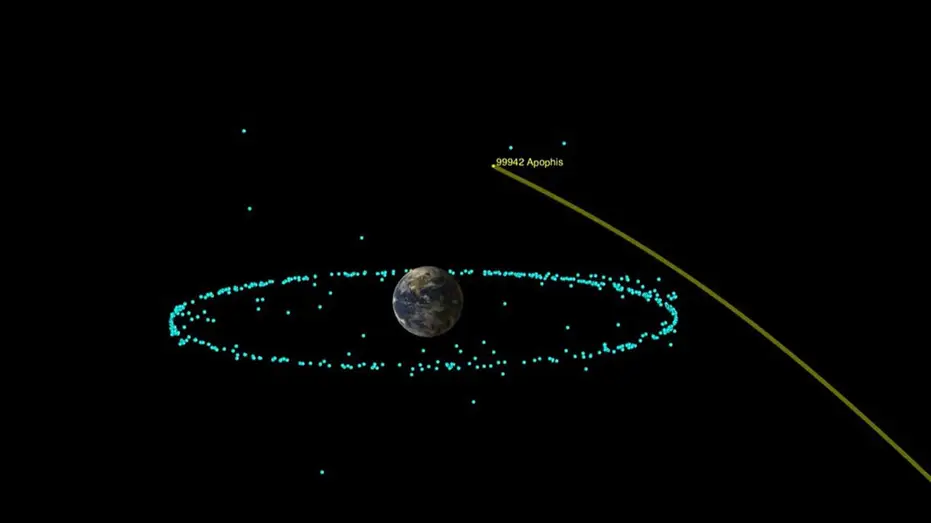
SouthernWorldwide.com – A colossal asteroid, comparable in size to the Eiffel Tower, is slated for an exceptionally close flyby of Earth in 2029. However, scientists have reassured the public that there is no threat of impact.
The celestial body, identified as Apophis, is projected to pass approximately 20,000 miles from our planet’s surface on April 13, 2029. This trajectory will bring it closer to Earth than many of the satellites currently orbiting our planet, according to NASA. Apophis is categorized as “potentially hazardous” and is composed of primordial material, remnants from the early solar system that never coalesced into a planet or moon.
When Apophis was first discovered in 2004, there was a possibility of it impacting Earth in the years 2029, 2036, or 2068. However, astronomers have since meticulously tracked the asteroid using both optical telescopes and ground-based radar. This continuous observation has significantly improved our understanding of its orbital path.
Based on the accumulated data, NASA has expressed high confidence that Apophis poses no impact risk to Earth for at least the next century. This advanced understanding alleviates previous concerns about potential collisions.
The discovery of Apophis occurred on June 19, 2004. The initial observation was made by astronomers Roy Tucker, David Tholen, and Fabrizio Bernardi at the Kitt Peak National Observatory, located near Tucson, Arizona.
Unfortunately, due to a combination of technical issues and adverse weather conditions, the asteroid could only be observed for a brief two-day period. Later, in December of the same year, another team of astronomers in Australia managed to re-establish contact and observe the asteroid, according to NASA’s records.
In anticipation of Apophis’s historic close approach, observatories across the globe and in space are preparing to study it. The primary goal is to gain a deeper understanding of its physical characteristics. In a proactive move, NASA has redirected one of its spacecraft to rendezvous with Apophis shortly after its 2029 flyby.
This spacecraft, previously tasked with gathering a sample from asteroid Bennu and successfully returning it to Earth in September 2023, has now been assigned a new mission. It was originally part of the OSIRIS-REx mission and has been repurposed to study Apophis.
The spacecraft has since been renamed OSIRIS-APophis EXplorer, or OSIRIS-APEX, and is currently en route to meet its new celestial target. The European Space Agency (ESA) is also participating in this scientific endeavor, dispatching its own spacecraft to conduct further studies of the asteroid.
Apophis is expected to be visible to observers in the Eastern Hemisphere, provided the weather conditions are favorable. Remarkably, it will be observable to the naked eye, without the need for telescopes or binoculars.
NASA has highlighted a particularly significant aspect of this close encounter. The gravitational forces exerted by Earth as Apophis passes by will cause it to be “pulled, twisted, stretched, and squeezed.” This phenomenon is unique to very close encounters with planetary bodies.
Read more : Swiss Man Contracts Hantavirus After Cruise Amid Deadly Outbreak
The overall gravitational pull from Earth is anticipated to alter Apophis’s orbit around the Sun. This alteration will result in a slightly larger orbit and, consequently, a longer orbital period for the asteroid.