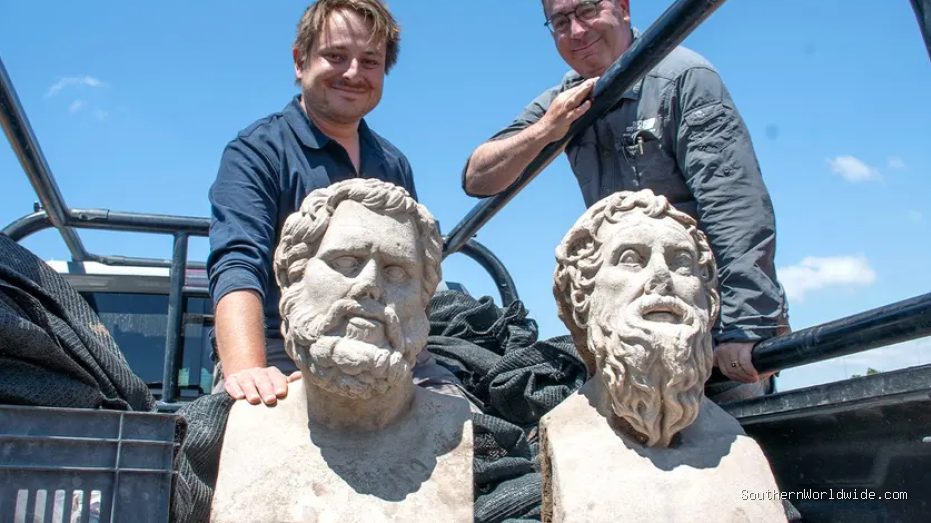
SouthernWorldwide.com – Two remarkably preserved Roman-era marble statues, dating back approximately 1,700 years, have been unearthed by archaeologists in Israel near the town of Binyamina.
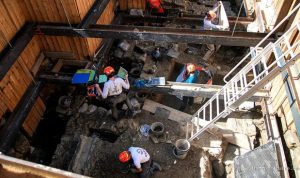
The discovery was made during an archaeological excavation conducted ahead of the construction of a new coastal high-speed railway line. The statues were found buried face down within a wine collection pit associated with a Roman-Byzantine winepress.
The Israel Antiquities Authority (IAA) announced the find in a press release on June 15, describing the statues as depicting two unknown figures from the ancient Greco-Roman world.
One of the statues bears a Greek inscription that officials believe identifies it as “Lycurgus.” This inscription has sparked considerable interest among researchers, who are now considering whether it refers to the ancient Spartan king or the Athenian statesman of the same name.
Michael Sorotskin, an IAA archaeologist involved in the excavation, expressed his astonishment at the discovery. He recounted how workers alerted him when something unusual protruded from the ground while they were digging the winepress.
Sorotskin described a sense of anticipation, feeling that they were on the verge of uncovering something extraordinary. The initial discovery was not typical pottery, but the smooth, cool feel of marble.
He elaborated on the slow, careful process of revealing the two statues, admitting he is still searching for the precise words to convey the magnitude of the find.
The excavation directors, Eliran Oren and Avishag Reiss, confirmed that the statues were found deliberately placed, lying face down. This suggests they were intentionally hidden or buried when the winepress was no longer in use.
The exact reasons for their burial remain unknown, though the possibility of them being hidden for preservation purposes is being considered. Oren and Reiss characterized the discovery as a “once-in-a-lifetime” event.
They also noted the common, almost serendipitous nature of significant archaeological finds often occurring on the final day of an excavation, adding to the mystique of this particular discovery.
Peter Gendelman, an expert on the Caesarea region from the IAA, highlighted the rarity of such a find, stating it is the first of its kind in approximately three decades.
Regarding the “Lycurgus” statue, Gendelman suggested that further research is needed to determine if it indeed represents either Lycurgus of Sparta or Lycurgus of Athens. This line of inquiry is just beginning.
During the Roman period, such statues were typically displayed in public buildings or in the residences of affluent individuals. They served as a means for people to connect with the broader cultural and spiritual landscape of antiquity.
Gendelman pointed out that the remains of a bathhouse were previously discovered not far from the current excavation site. He speculated that the statues might have once adorned a luxurious villa belonging to a wealthy resident of Caesarea.
Currently, the statues are undergoing a meticulous cleaning and conservation process. Following this, researchers will conduct further analyses to ascertain the precise identity of the figures they depict.
This discovery is the latest in a series of significant archaeological announcements from Israeli researchers this year. In May, the IAA reported that a fragment of a 1,700-year-old Roman-era statuette was identified thanks to the chance discovery by a child in the Negev Desert.
Around the same period, archaeologists also unearthed a “mysterious and impressive” ancient tunnel near Jerusalem. This tunnel is located in proximity to sites associated with the biblical Kingdom of Judah.