SouthernWorldwide.com – Archaeologists undertaking an excavation beneath Paris’s Notre Dame Cathedral have unearthed a trove of historical artifacts, shedding light on centuries of buried history. Among the significant discoveries are a 1,700-year-old Roman coin and enigmatic markings on pottery fragments that continue to baffle experts.
This extensive excavation, a project in the making for several years, commenced as part of the cathedral’s reconstruction efforts following the devastating fire in 2019. Recent findings from this meticulous dig were detailed earlier in June by The Associated Press.
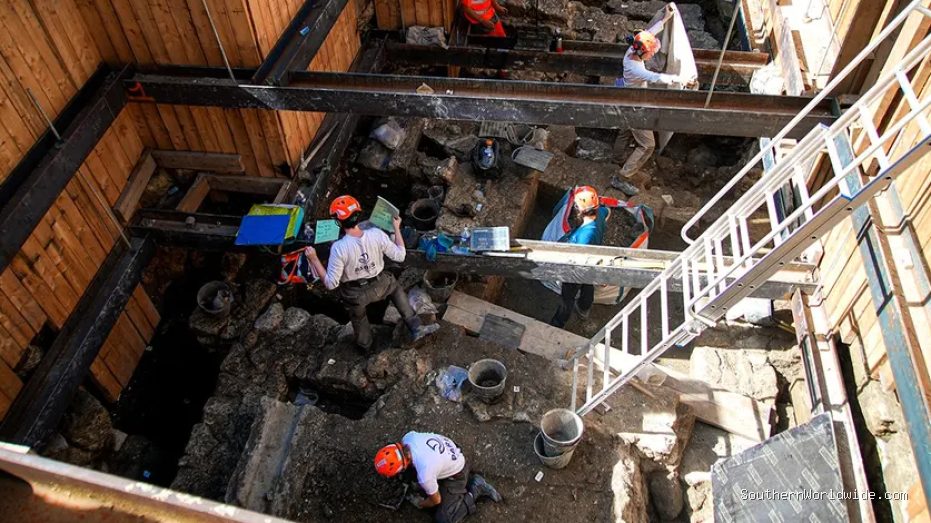
The archaeological team has been diligently excavating the cathedral’s forecourt, delving approximately 13 feet below the current ground level in their search for remnants of the city’s ancient past.
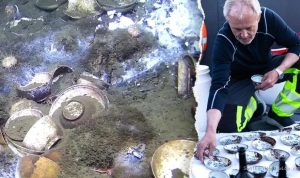
One of the notable finds is a coin dating back to the 4th century, bearing the likeness of Emperor Constantine. Alongside this, numerous medieval pottery fragments have been recovered, many of which feature markings that archaeologists have yet to decipher.
Archaeologist Valentine Breloux highlighted the rarity of finding complete ceramic pieces during such excavations. However, she pointed out that the most intriguing discoveries were the mysterious reddish markings found painted inside several pottery fragments, the meaning of which remains an unsolved puzzle.
The excavation, which has been hailed by French media as the “dig of the century,” has yielded a wealth of other objects. These include intact jugs and cups that were found discarded in what was once a latrine, serving as a refuse pit.
This ancient garbage pit also contained evidence of daily life, such as broken plates and animal bones. Further layers of history were revealed with the uncovering of medieval grain pits, structures used for storing harvested grain, dating from the 6th to the 10th centuries.
A Roman-era doorstep was also discovered at the site. Archaeologists noted that this stone had been removed from a larger structure, inverted, and repurposed as paving material for a pathway.
Lucie Altenburg, a conservator with the Paris archaeology unit, described the excavation as a “rare opportunity” for researchers.
She expressed the hope that the project would allow them to “go back in time even further than we’ve ever been before,” offering unprecedented insights into the past.
Altenburg further elaborated that this project provides archaeologists with a unique chance to “work on something that’s tangibly going to make a difference to the history of Paris.”
While Roman artifacts are highly valued by archaeologists, according to the AP, the team also harbors hopes of uncovering evidence related to the Gauls, the indigenous people who inhabited the region before the arrival of the Romans.
Archaeology student Yasmine Benali observed the visible stratification of history at the site, remarking, “Here you can see the layers — medieval Paris, Roman Paris, maybe even before that.”
Benali added that such discoveries contribute to a deeper understanding of the city, making it “feel less like a postcard and more like something still being discovered.”
The current excavation is part of a larger renovation project for the Notre Dame square. This broader initiative is anticipated to introduce more trees and other features designed to enhance the visitor experience, with completion expected by 2028, according to Altenburg.
Emily Carter, a tourist from Manchester, shared her perspective on the excavation, stating that it “makes Notre Dame feel alive again.”
She reflected on the profound realization that “You come to see the cathedral, then realize there’s another city under your feet.”
Carter concluded that this hidden layer of history is “almost more moving” than the visible monument itself.