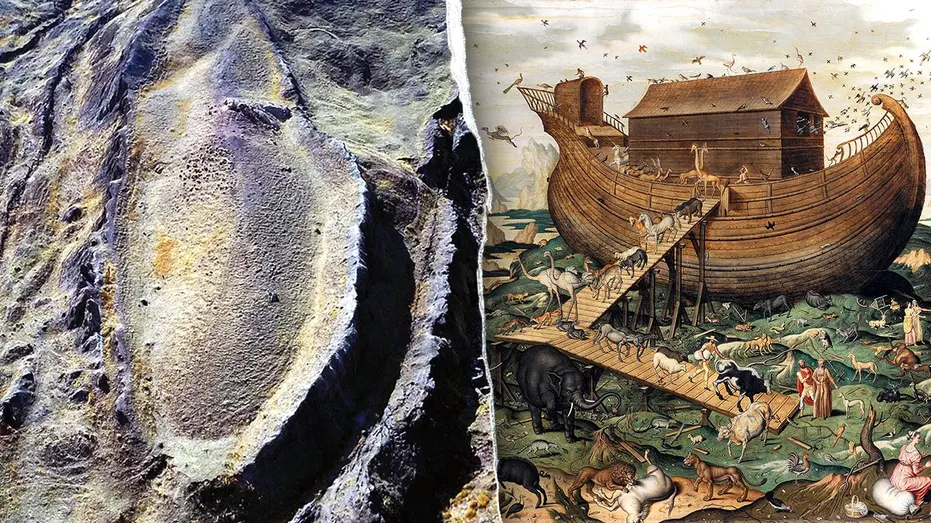
SouthernWorldwide.com – New findings involving soil analysis from a site in eastern Turkey are reigniting the age-old debate about whether the remains of Noah’s Ark could be buried there.
Andrew Jones, a researcher associated with Noah’s Ark Scans, stated that his team believes the Durupinar site holds the buried remnants of the biblical vessel.
This formation, located in eastern Turkey, has been a subject of discussion since its discovery in the 1950s. The debate centers on whether it is a natural geological formation or the actual Ark.
While some geologists maintain that the “ark” is a naturally occurring structure, other researchers suggest that recent discoveries offer fresh support for the theory of the biblical vessel’s existence at the site.
A significant point of contention was a 1996 paper published in the Journal of Geoscience Education. This paper argued that the formation was a natural geological structure, not the remains of Noah’s Ark.
However, the latest findings are based on a recently completed soil analysis. Researchers involved claim that this analysis indicates chemical differences beneath the surface that are consistent with decayed organic material.
The soil samples were gathered in 2024 and have undergone analysis in the intervening months. Jones highlighted significant differences between samples taken from inside the boat-shaped formation and those from just outside it.
“The differences between the ‘inside’ and ‘outside’ samples are statistically staggering,” Jones reported. He noted that organic matter was found to be three times more prevalent inside the boat shape compared to the soil immediately outside.
According to Jones, this disparity in organic matter suggests the presence of a “massive concentration of decayed carbon-based material,” which could include wood, resin, or animal matter.
The 1996 paper’s authors, Lorence Gene Collins and David Franklin Fasold, had previously dismissed claims about Noah’s Ark at the site as “bogus,” asserting it was a natural rock structure.
The recent soil analysis revealed that the formation contained 38% more potassium, a substance often associated with wood ash. Furthermore, there was an eight-fold difference in the pH level between the inside and outside samples.
Jones explained that such a radical shift in pH indicates that the internal environment possesses a different chemical history compared to the surrounding mountainside soil. He described it as suggesting a “closed system” where biological materials decayed over time.
This decay process, he posited, would have leached minerals into the surrounding earth, permanently altering its chemistry. These new findings are expected to intensify the ongoing debate surrounding the Durupinar formation.
Jones expressed that the new data “suggests an internal complexity that is difficult to attribute to natural geological processes.”
He further stated that the team is requesting Turkish scientists to conduct additional testing. This includes core drilling and advanced 3-D mapping of the site.
Jones posed a compelling question: “We’ve moved from asking ‘Does it look like a boat?’ to ‘Why is there a three-layered, right-angled inside structure, carbon-rich boat formation the exact length of Noah’s ark given in the Bible buried in the middle of a mountainside in the mountains of Ararat?'”
This perspective shifts the focus from mere visual resemblance to the underlying evidence of structure and composition.
The research also builds upon previous 3-D ground penetrating radar scans conducted in 2019. These earlier scans had identified subsurface features and anomalies within the formation.
Jones elaborated on the scan data, noting the presence of subsurface features within the formation. He specifically mentioned tunnels approximately four meters down and two meters high.
These tunnels, he reported, appear to run down the center of the boat shape and along the inside edge of the hull formation. This structural detail, he believes, is significant.
“We really believe that this layout … would suggest that it’s a man-made object and not just a natural formation,” Jones concluded, emphasizing the potential implications of these findings.