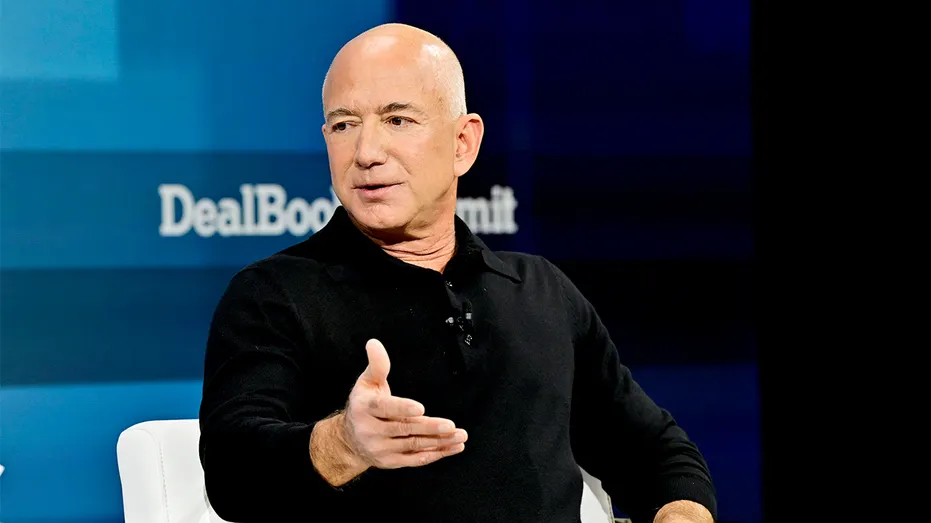
SouthernWorldwide.com – Billionaire Jeff Bezos has ignited a firestorm in America’s ongoing tax debate with a provocative suggestion: the bottom half of American earners should pay zero federal income tax.
This isn’t about lower taxes or temporary relief; Bezos is proposing a complete elimination of federal income tax for a significant portion of the population.
Regardless of one’s stance on billionaires, Bezos’ proposal resonates with a deeply felt sentiment among many Americans.
A substantial number of citizens, upon hearing this idea, likely found themselves questioning their own tax obligations.
This sentiment stems from a feeling of financial exhaustion experienced by the middle class.
Many Americans feel perpetually strained, as if they are constantly being pushed to work harder by Washington.
Bezos highlighted that the bottom 50% of earners contribute a minuscule fraction of the total federal income tax revenue, especially when compared to top earners.
It has been noted that this lower-earning group already effectively pays little to no federal income tax due to deductions and credits.
Therefore, Bezos’ proposal could be viewed not merely as a tax cut, but as a significant psychological shift for the nation.
His suggestion implies a scenario where “what if work actually paid again?”
This idea carries immense political weight.
Consider the impact on a nurse earning $75,000 annually, suddenly having several thousand extra dollars each year.
This could provide much-needed financial breathing room, potentially offering an alternative to concepts like universal basic income.
In the wealthiest nation globally, it raises a pertinent question: is it fair to continue pressuring those who are just managing to get by?
However, this is where the discussion becomes complex, and a significant concern arises for those who already feel they are paying more than their fair share.
The fundamental reality is that someone must ultimately fund the government’s operations.
Washington’s spending habits have been likened to teenagers using their parents’ credit cards.
If half the country ceases to pay federal income taxes, one of three outcomes is inevitable.
Either the wealthy will pay substantially more, government spending will be drastically cut, or America will resort to further borrowing and money printing.
The saying “two out of three ain’t bad” might not apply here, as the consequences could be dire.
The political landscape reveals a reluctance among politicians to cut spending, as such expenditures are often tied to securing votes.
Historically, Washington has leaned towards increasing the national debt.
America is already grappling with a national debt exceeding $39 trillion, projected to surpass $40 trillion by year-end, with interest payments alone constituting the third-largest budget item.
This financial trajectory is unsustainable, resembling a temporary fix that masks a worsening underlying problem.
Both major political parties are being disingenuous with the American public on this matter.
The left suggests that billionaires alone can indefinitely support the modern welfare state, which is an untenable proposition.
Conversely, the right often implies that tax cuts are self-funding, which is rarely the case.
The reality is more complex and less palatable: America suffers from a spending addiction and navigates a convoluted tax code.
This is precisely why Bezos’ remarks have struck such a chord with the public.
Deep down, many Americans feel the current system no longer adequately rewards productive behavior.
At this juncture in its history, the nation must consider whether it wishes to continue fostering hard work, productivity, and capitalism.
Individuals are generally willing to pay taxes when they perceive the system as equitable.
However, they become emotionally resistant when they feel the rules are unfairly stacked against them, which is the current sentiment.
This discourse also sheds light on a potential fundamental shift in America’s tax structure, moving from an income-tax-based system towards a consumption-tax society.
This implies taxing spending more heavily while reducing the tax burden on work.
Ideas such as a flat tax and a value-added tax (VAT) are being considered.
The increasing influence of AI, automation, and globalization on the job market may make taxing labor progressively more challenging from a political standpoint.
Before embracing the idea of “zero taxes,” Americans should consider a crucial question.
Do they desire Scandinavian-style benefits accompanied by Scandinavian-style taxation, or American-style freedom with American-style taxes?
Ultimately, the laws of economics are inescapable.
For those who identify as capitalists, relinquishing this economic system is not a desirable prospect.
While Jeff Bezos may have initiated the conversation, the core conflict is not merely about billionaires versus workers.
Baca juga di sini: Stranded Travelers Face Delays Due to Airport Technical Glitch
It is about whether America still possesses the understanding and will to fund the nation it aspires to be in the coming centuries.